Endless austerity, state and local edition

Brian Nichols of the essential Employ America has a useful, if depressing, roundup of the coming wave of state-local austerity. Some highlights: Ohio, Nevada and Pennsylvania have already announced hiring freezes; Ohio is also looking at a 20 percent across the board cut in state spending, while Virginia has canceled planned raises for teachers. Many cities, including New York, St. Paul and New Orleans, are laying off public employees. And as I noted in my last post, New York  State is planning to slash $400 million from the hospitals at the front line of the crisis.

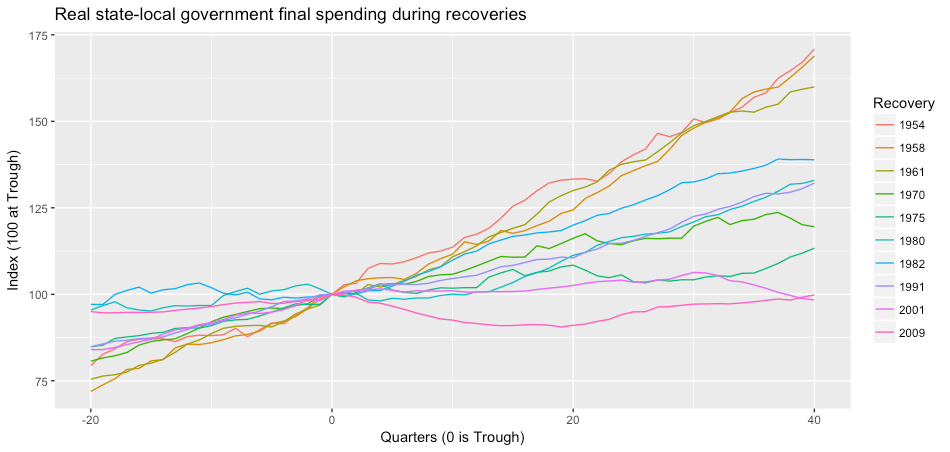
This isn’t new. One of the many drawbacks of American federalism is that state and local government spending — which includes the great majority of public sevices that people use on a day to day basis — is distinctly procyclical. Following the 2007-008 crisis, austerity at the state and local level more than offset stimulus at the federal level. And it lasted much longer than the recession itself.

In fact, as my colleague Amanda Page-Hoongrajok points out, inflation-adjusted state and local final expenditure did not return to its 2009 level until 2019.1 On a per-capita basis, real state and local final expenditure is 5 percent lower today than it was at the bottom of the last recession.

Source

As we face the rising wave of public-service cutbacks, we need to be fighting on all levels. We need to demand a massive package of aid to state and local govrnments as part of Stimulus IV. We need to be pushing the Fed to do more to support municipal finances. We need to keep the pressure up on mayors and governors not to throw their hands up and wait for the feds, but to be creative in working around their fiscal constraints.2 And also, we need to keep in mind: As far as state and local spending is concerned, the Great Recession never ended.

Daily News Op-Ed: Why Is Governor Cuomo Still Trying to Cut Medicaid?

(My Roosevelt colleague Naomi Zewde and I have an op-ed in the March 26 Daily News, criticizing Governor Cuomo’s plans to push ahead with cuts to state Medicaid spending despite the epidemic.)

Last week, as the coronavirus shut down much of New York, the state announced a bold plan to drastically cut funding for the state’s hard-pressed health care providers.

That’s right: As the coronavirus crisis escalates across New York State, Gov. Cuomo is proposing to slash funding for those at the frontlines.

Specifically, the cuts come via the Medicaid Redesign Team, appointed last month by the governor with the charge of cutting $2.5 billion from the state’s annual health spending. These cuts will not only mean an even more overstretched health care system; they will mean lost jobs.

For example, $200 million is slated to be cut from Consumer Directed Personal Assistance (CDPA), which allows elderly or disabled New Yorkers to hire their own home care assistants. As a Daily News editorial recently noted, CDPA was responsible for 36,000 new private-sector jobs in New York City in 2019, a lion’s share of all such jobs.

The biggest savings come from across-the-board cuts to health care providers, including $400 million from the state’s hospitals.

Cutting health spending in an epidemic seems like obvious lunacy. But it’s even worse than it seems.

Since the start of this epidemic, nearly one in five American households have had their hours cut or been laid off due to the virus. In New York, Cuomo said that the state has “never seen such volume” of unemployment claims.

As the economy slides over a cliff, we desperately need to keep people employed so that they can pay their bills and keep local businesses running. The proposed cuts will not only kneecap our health care system, but they will also deepen the coming recession.

But don’t we have to do something about out-of-control Medicaid spending? No, we do not. Medicaid spending is already under control.

Over the past five years, Medicaid spending in New York has risen by a steady 4% a year — exactly the same growth rate the state’s economy has had as a whole. And thanks to the Affordable Care Act, the share of total Medicaid costs paid by the state has gone down.

The apparent Medicaid crisis is entirely of the governor’s own making. When an arbitrary “global cap” on Medicaid spending turned out to be unachievable, instead of accepting reality, the state shifted a portion of the bill from fiscal year 2019-2020 to 2020-2021. This created the illusion of a big rise in this year’s costs.

Not only are there no runaway costs to rein in, but health spending is also an important economic stimulus. About 13% of New Yorkers work in health care — more than in manufacturing and finance combined. New York’s hospitals are stable sources of employment in many communities where good jobs are scarce. While many of the state’s traditional industries are in decline, health care promises to be a growth industry in the 21st century — if its growth isn’t cut off by shortsighted cutbacks.

Cutting state Medicaid spending today would be especially perverse, as the federal government appears poised to pick up a larger share of the program’s spending, just as it did in the last recession.

When private sector spending falls in a recession, the role of government is to lean against the wind, and boost public spending to fill the gap. Fiscal stimulus is primarily the responsibility of the federal government, but a state as large and rich as New York should also do its part — especially if leadership in Washington is lacking.

In normal times, trying to balance the budget through Medicaid cuts would be a mistake. Today, it is economic malpractice.

Talk on the Economic Mobilization of World War II

Two weeks ago – it feels much longer now – I was up at UMass-Amherst to give a talk on the economic mobilizaiton of World War II and its lessons for the Green New Deal.

Here is an audio recording of the talk. Including Q&A, it’s about an hour and a half. Here are the slides that I used.


The big three lessons I draw are:

1. The more rapid the economic transformation that’s required, the bigger the role the public sector needs to take, in investment especially, and more broadly in bearing risk.

2. Output can be very elastic in response to stronger demand, much more so than is usually believed. There’s a real danger that over-conservative estimates of potential output will lead us to set our sights too low.

3. Demand conditions have major effects on income distribution. Full employment is an extremely powerful tool to shift income toward the lower-paid and to less-privelged groups, even in absence of direct redistribution.

EDIT: The underlying paper is being revised to update the lessons for the present in light of the fact that “the present” is now an acute public health crisis rather than an ongoing climate crisis. The first part of the new version is here. The rest will be forthcoming in the next couple weeks.

You can also listen to an interview with me on Doug Henwood’s Behind the News here.

Tracking COVID-19

FIGURES UPDATED 3-15-20

You’ve probably seen various graphs online showing the increase in coronavirus cases in various countries.

I don’t know that I am adding any value here, but I decided to reproduce those graphs using the convenient data from Johns Hopkins Coronavirus Research Center. (I can’t vouch for  the reliability of the Johns Hopkins data, but it seems to be what most news organizations are relying on.) Here’s one showing cases for all countries other than China that have reported at least 100 cases. The x axis is days after the 100-case mark was reached.


What we see here is that most countries show a consistent 35-45 percent daily growth in reported cases. Only Japan, at 20 percent, and Singapore and more recently Korea, at around 10 percent, depart significantly from this. It’s also interesting how stable the growth of cases in Japan has been over the past three weeks.

Now here is the same figure, but for US counties that have reported at least 10 cases. The x axis here is days since the first day with a least 10 cases. [UPDATE: I have stopped updating this graph since the Johns Hopkins site now reports cases only for US states.]

What surprises me here is that we basically see the same ~40 percent daily growth rate in cases. I would have thought that given all the insitutional differences and issues around testing, the US picture would have looked somehow different. But it seems like we might reasonably extrapolate from the international experience, that New York or Seattle could reach 10,000 cases in the next two weeks.

I have no expertise whatsoever on infectious diseases, so I am not going to say anything else about this.

Anyway, here is the R code if you want to produce figures like these from the most current data on the Johns Hopkins site. They also give latitude and longitude for every place included, so it wouldn’t be much more work to make an interactive map. Could be an interesting excercise for anyone teaching a statistics or data science course.

UPDATE: I had to change the code because Johns Hopkins is no longer reporting data for US places other than states. Here is the equivalent state-level figure. As you can see, the states with significant numbers of cases all show the same 40 percent daily growth rate.


#install.packages('reshape2')
#install.packages('ggplot2')
library(reshape2)
library(ggplot2)

corona <- read.csv('https://raw.githubusercontent.com/CSSEGISandData/COVID-19/master/csse_covid_19_data/csse_covid_19_time_series/time_series_19-covid-Confirmed.csv',
                   stringsAsFactors = F)
state.abbrevs <- read.csv('https://raw.githubusercontent.com/jasonong/List-of-US-States/master/states.csv', stringsAsFactors = F)
corona[,-1:-4] <- apply(corona[,-1:-4], 1:2, FUN=as.numeric)
US <- corona[corona$Country.Region=='US', ]
USplaces <-  US[grep(',',US[,1]),][,-2:-4]
USstates <- US[grep(',',US[,1], invert=T),][,-2:-4]
USstates <- USstates[grep('Princess',USstates[,1], invert=T),]
states.temp <- USstates
for (i in 1:nrow(USstates)){
  abbrev <- state.abbrevs[state.abbrevs[,1]==USstates[i,1],2]
  rows <- grep(abbrev, USplaces[,1])
  states.temp[i, -1] <- colSums(USplaces[rows, -1])
}
states.temp<- states.temp[!is.na(states.temp[,1]),]
USstates[,-1] <- USstates[,-1] + states.temp[,-1]
corona <- rbind(corona, c('', 'United States', NA, NA, colSums(USplaces[,-1])))
corona[,-1:-4] <- apply(corona[,-1:-4], 1:2, FUN=as.numeric)
china <-  corona[corona$Country.Region=='China',-2:-4]
corona <- rbind(corona, c('', 'China', NA, NA, colSums(china[,-1])))
corona[,-1:-4] <- apply(corona[,-1:-4], 1:2, FUN=as.numeric)
countries <- corona[corona$Province.State =='', c(-1, -3:-4)]

makePlot <- function (x, threshold){
  cases <- redate(x, threshold)
  data <- melt(cases, id.vars=1)
  names(data) <- c('place', 'day', 'cases')
  
  p <- ggplot(data, aes(x=day, y=cases, group=place)) +
    geom_line(aes(color=place))+
    geom_point(aes(color=place, shape=place))
  p <- p + scale_shape_manual(values=1:length(levels(as.factor(data$place))))
  p <- p + theme(axis.text.x = element_text(angle=45))
  p <- p + scale_y_continuous(trans='log10')
  p
}

redate <- function (x, threshold) {
  out <- data.frame(place='', stringsAsFactors = F)
  values <- matrix(nrow=99, ncol=99)
  n <- 0
  for (i in 1:nrow(x)) {
    v <- x[i,-1][x[i,-1] > threshold]
    l <- length(v)
    if (l > 1) {
      n <- n + 1
      out[n,1] <- x[i,1]
      values[n,1:l] <- v
    }
  }
  values <- values[!is.na(values[,1]),]
  cols <- length(colSums(values, na.rm=T)[colSums(values, na.rm=T) > 0])
  values <- values[,1:cols]
  out <- cbind(out, values)
}

makePlot(USplaces, 9)
makePlot(USstates, 10)
makePlot(countries[countries$Country.Region != 'China',], 99)

Teaching notes on capitalism

I just put up a some new notes on my teaching pages, a brief handout on capital and capitalism.

The goal of this isn’t, of course,to give a comprehensive overview of what capital means or what capitalism has been historically. I just want to introduce students to the basic terms and concepts that they’ll encounter in the sort of Marxist and Marx-influenced historians I assign in my economic history class — Sven Beckert, Immanuel Wallerstein, Fernand Braudel, Ellen Meiksins Wood, Eric Foner, Mike Davis, and so on.

That said, I’ve tried to write it in clear, non-technical language and keep it focused on the most fundamental concepts, so if you are looking for an eight-page introduction to how Marxists think about capital and capitalism, perhaps this will do.

If you are a teacher yourself and think this is useful, feel free to use it in your own class. And if you have thoughts about ways it could be improved or expanded, I’d love to hear them.

2019 Books

Books I read in 2019. I’m sure I’m forgetting one or two.

Novels and stories

Transit. This is a lovely short novel by the German communist Anna Seghers, which I stumbled across on my parents’ shelves. Set, and written, in World War II France, it tells the story of various refugees waiting in Marseilles to work through the interminable bureaucratic process of acquiring the exit and transit visas they need to leave the country. It’s a beautiful evocation of the mix of unsettledness and bureaucratic stasis that is the life of the refugee, but it’s also got the tight construction of a classic 19th century novel, where the plot unfolds with a retrospective inevitability. There was apparently (and coincidentally) a movie based on it that came out this year.

Jews without Money, by Mike Gold. The classic autobiographical novel of the early 20th century Lower East Side ghetto, which I was shamed into finally reading by my friend Ben. It is, obviously, a socialist realist novel, which walks through, with unconcealed anger, all the deprivations, petty and not-so-petty humiliations, pointless tragedies, and self-defeating compensations of being poor in a rich city. (“It’s better to be dead in this country than not to have money,” says the narrator/author’s father in his final defeat, when he fails even at selling bananas. “Promise me when you’ll be rich when you grow up, Mikey!”) But it’s also and even more a novel of the intense emotions and heightened contrasts of the world seen through a child’s eyes – what it reminded me of most was Bruno Schultz’s magical realist stories of his Polish childhood. 

Overthrow. A novel of Occupy, or more precisely the period immediately after Occupy was shut down, by my Brooklyn neighbor Caleb Crain. It’s the very rare novel of graduate school and radical politics that takes its protagonists seriously. The plot revolves around a post-Occupy working group, and their frictions and collisions with each other and, eventually, with the security apparatus. The working group is focused on something like ESP or telepathy, whose status is never quite resolved – it appears variously as a metaphor for the alternative forms of collective action and decisionmaking that  Zuccotti Park was an experiment in; or a metaphor for sociality itself (as in Ursula LeGuin’s story “Solitude,” where any kind of social relationship is understood as a form of magic); or as a literalization of hacking and surveillance and the various other intercepted signals of our world; or as the kind of shared imaginary object that holds together any community; or at face value, in which sense it functions as the McGuffin that keeps the story moving.

I am very much the target audience for this novel —8 years ago, a very pregnant Laura and I were running away from the cops after a brief reoccupation of Zuccotti Park, and a bit later our now-emerged son’s first political action was a rally in support of striking grocery workers organized by Occupy Kensington, a post Occupy working group not unlike the activists Crain writes about. So take my opinion with a grain of salt, but I liked this book very much.

Cloudburst, Tom McGuane. A greatest-hits collection of stories by the author of Gallatin Canyon and Crow Fair, both of which I liked very much. The stories are mostly set in Montana, among more or less downwardly mobile people. Not having spent any time in that part of the country, I can’t say how realistic they are, but to me they feel true to life. 

Books I read for teaching (do these even count?)

Modern Macroeconomics: Its Origins, Development, and Current State, by Snowdon and Vane. Delivers what it says on the tin. Randy Wray used to use this to teach macroeconomics at UMKC.I tried it for the first time this year, and I thought it worked pretty well. 

Data Visualization, by Kieran Healy, and Quantitative Social Science, by Kosuke Imai. I used these two for my research methods class in the John Jay MA program. They worked ok.

The Book of Why, by Judea Pearl. I would never have made it through this book if I hadn’t assigned it — the early chapters are full of over-the-top auto-hagiography, as if the author were the first person to ever think about how statistical evidence could be used to answer questions of cause and effect. But if you persevere, there’s actually quite a bit of interesting stuff in here on how to think rigorously about causality.

Books I read with Eli, age 7/8 (missing some for sure here)

What If and How To by Randall Munroe, the xkcd guy. These are genuinely good books about applying physics concepts and quantitative reasoning to interesting real-world problems. How To is the better one.

The Hobbit. I’d forgotten how charming and light-hearted and funny this book is. It was wonderful reading it with my son, but it didn’t leave me with any desire to move on to Lord of the Rings.

A Short History of the World, by Enrest Gombrich. This is really nicely done. I highly recommend it to anyone with kids aged six to 12 or so. 

Peter Pan. This is a much weirder book than I had realized – Barrie did have some ideas about mothers. But it kept Eli riveted.

The Pushcart War. On of those wonderful New York books everybody should read.

How to Invent Everything. Another pop science book. The joke ratio is a little high for my tastes – I don’t see why you would write a book about science if you don’t think the science is interesting enough to carry it on its own. But there is a lot of good practical science mixed in with the jokes. before I read it, I didn’t know what coppicing was, or how charcoal is made. Now I do.

Crossing on Time. The latest from the prolific David Macaulay, author of CityCathedralHow Things Work, etc. (We probably read some of those too this year, come to think of it.) This combines a history of passenger steamships with the story of the particular ship he and his family sailed on when they immigrated to the US in the 1950s.

Books read for professional reasons

Austerity: When It Works and When It Doesn’t. See review here.

Open Borders, by Bryan Caplan. Caplan is a right-wing libertarian who I don’t agree with about much. But I do agree with him that there is a clear economic and moral case for unrestricted immigration. I reviewed this book for the publisher, and while I did suggest some changes — some of which were incorporated into the final draft — I had no reservations about recommending it for publication.

Books by friends

Never a Lovely So Real. A biography of perhaps my favorite novelist, Nelson Algren, by my neighbor Colin Asher. (Our kids are in the same karate class. It’s Brooklyn!) It’s a beautifully constructed book — when I’d finished it, I wanted to start it over again, just to see better how the story fit together. I don’t know how much people read Algren today — I used to have the habit, when I went into a bookstore, of looking for Never Come Morning on the shelves, and seldom found it. But in my opinion he should be in the first tier of the American canon, ahead of Updike and Hemingway and whoever else people read in high school. “The son of a Polish baker and mulatto pigsticker crouched across the canvass,” begins the final chapter of Never Come Morning; that’s more of humanity than you’ll find in the collected works of Saul Bellow. The book gets that, and it gets his writing, which combines lyricism and social realism in a way I don’t think anyone else has managed.

It also gets his politics, and how those politics were essential to the art. Like his friend Richard Wright, or like Mike Gold, Algren is someone who never would have become a novelist if it hadn’t been for the Communist Party. A major contribution of the book is to document, based on FBI files among other evidence, how the inexplicable stalling-out of Algren’s career after The Man with a Golden Arm was the country’s best-selling book and a movie starring Frank Sinatra, is fully explained by McCarthyism. Algren’s friends may have thought he was falling into paranoia, but he really was being followed on the street, his house was being surveilled, his mailed opened, his calls listened into. The publishers who rejected his books, and the editors who spiked his essays, were doing so on the advice of the FBI. It’s a huge loss for humanity: As Laura says, the cost of McCarthyism “is not only those imprisoned or deprived of their livelihood: it is the unions never organized, the books never written, and the films never made.” Algren, who knows, might have had a whole shelf. 

The People’s Republic of Wal Mart, by Leigh Phillips and Michal Rozworski. The fact that production under capitalism is organized not by markets but by the conscious plans of corporations, is one of those facts that is completely obvious when you think about it, but still somehow radical and controversial. I don’t, to be clear, mean plans for for world domination, I mean the routine plans of getting input a from the warehouse here via a truck driven by this person, in time for that person to combine it with this other input using those tools. These tasks are all assigned by planners. A huge number of people cooperate in the production in all of the worldly goods around us, and essentially none of this cooperation is organized through markets. (Which doesn’t mean that markets are not an important feature of capitalism, they just don’t coordinate production.) Phillips and Rozworski make this case clearly and pointedly for the world’s largest corporation, and draw the natural conclusion that there’s nothing utopian about a planned economy – the raw materials are all around us. In large part it’s framed around the “calculation debate” of the 1920s. This is possibly not the most direct way of approaching the topic. But it does pass through some interesting territory, like Project Cybersyn, the precursor to the internet developed in Chile under Allende, which I had never heard of before.

Capital City. A short book on the politics of real estate and of urban planning by Sam Stein. Sam is a graduate student in geography at CUNY, and the book is very much written from that social position — animated by an expansive vision of the possibilities of urban planning, and by fresh anger at the ways it instead functions as an adjunct to the landlords’ lobby. Arguably the book’s strengths would have been better communicated if it were presented as a book about city planning, rather than a book about cities. (I don’t imagine it would have gotten nearly as many readers that way, so Sam and Verso probably made the right call.) One of those strengths is his perfect ear for the cant of really existing planning. Here’s Amanda Burden, Bloomberg’s planning director, describing black neighborhoods as effectively uninhabited: “We are making so many more areas of the city livable. Now young people are moving to neighborhoods  like Crown Heights that 10 years ago wouldn’t have been part of the lexicon.” Here’s her successor in the de Blasio administration, Carl Weisbrod, explaining that what’s good for the landlords is good for New York: “There are very few industries where the self-interest of the industry and the fundamental interests of the citizens are so deeply intertwined as the real estate industry.” And here’s Mayor SUV himself, with one of his classic but-what-can-I-do? shrugs: “I think there’s a socialistic impulse, which I hear every day, in every kind of community, that they would like things to be planned in accordance to their needs. And I would, too. Unfortunately, what stands in the way of that is hundreds of years of history that have elevated property rights and wealth to the point that that’s the reality that calls the tune.” Sure, it would be nice to organize the city to meet human needs, says our progressive mayor, but landlord profits come first and that’s just the way it is. If quotes like this fill you with anger and you’d like to experience more of it, you should definitely pick up this book.

Other nonfiction books

The Racketeer’s Progress, by Andrew Wender Cohen. Nathan Newman has been telling me to read this book since forever and I finally did, mostly on a couple of long plane flights. The subject is the labor movement in Chicago in the early decades of the 20th century. It’s in the service of a very specific argument: that we misunderstand the historical labor movement if we think of it like today’s, as bargaining on behalf of employees of a specific employer. Rather, he argues that turn-of-the-last-century unions saw themselves — and were at least intermittently accepted — as sovereign governments of their crafts or industries. Membership as such didn’t matter, it was about establishing rules that everyone in an industry had to follow. Employers went along, at least sometimes,  partly because the unions enjoyed broad popular legitimacy; partly because they had the power to make their rules stick; and partly because, at least in industries exposed to national competition, workers and businesses had a shared interest in excluding outsiders. There were, for instance, major and successful strikes to enforce the principle that only Illinois milk could be sold in Chicago, and only local electrical components could be installed in Chicago’s skyscrapers.

Why “racketeer”, tho? It’s true that Al Capone got his entree into Chicago labor thanks to this system of craft governance — not, as you might expect, as an enforcer of it, but rather as the publicly-announced guarantor of local employers defying union authority. (It was dry cleaners specifically who enlisted the mob to enforce their property rights against labor.) The term “racketeering” meanwhile, was coined specifically to describe union activities aimed at a form of sovereignty rather than at narrowly-defined economic interests. The term from its beginning, in other words, was intended not describe a legitimate activity corrupted by the presence of organized criminals, but to suggest that unions as they existed were inherently corrupt. The idea that unions historically represented the interests of an industry or occupation as a whole, and not of a particular employer, suggests that the historical model of American unionism may be more, not less, relevant, in the gig economy. 

Turtles as Hopeful Monsters, by Olivier Rieppel. The best book I’ve ever read about evolution is Mary West-Eberhardt’s Developmental Plasticity and Evolution. This isn’t that, but it’s the best book I’ve read on evolution in a while. And it makes the same basic argument: Evolution, at the macro level, is more than natural selection. It isn’t just differential reproduction of randomly varying organisms, but rather depends on a set of specific mechanisms that generate useful variation in body plans, and that conversely ensures that the random genetic variation generally gives rise to a functional organism. The genes, in other words, are just one input to the developmental process; or to put it another way, the capacity for evolution on a more than bacterial scale is something that itself had to evolve. The specific issue with turtles, in this context, is not just their shell; it’s also the distinct but related fact that their shoulders are inside their ribcage, rather than outside it as in all other vertebrates. Like the double-jointed jaw in a handful of snakes — the original “hopeful monsters” — this is a feature that can’t have developed incrementally but had to arrive all at once.  The question then is what it says about evolution that such leaps are possible, and what it says about the study of evolution that there’s been such reluctance to acknowledge them.

Warfare State, by James Sparrow. A nice history of domestic policy during World War II, or more precisely, how the scope of government in American life expanded during the war and how people reacted to it. The book draws heavily on reports from the Office of War Information, the 1940s-era propaganda and morale agency, and that shows in its choice of topics — there’s a bit more than strictly needed on the PR side of the war effort. But there’s also lots of interesting, well-organized material on policy around labor, housing and so on during the war, as well as on the more radical but unrealized proposals of people like Walter Reuther, which are arguably one of the great roads not traveled in US history. I read this in the course of putting together a Roosevelt paper on the war mobilization as a model for the Green New Deal, which should be coming out soon.


Previous editions:

2017 Books

2016 books

2015 books

2013 books

2012 books I

2012 books II

2010 books I

2010 books II

Utz-Pieter Reich on the Nominal and the Real

What oft was thought, but ne’er so well expressed3:

The lack of realism in microeconomic value theory has been overcompensated by an unquenched desire for `real’ figures. Idealism in the concepts of theory has resulted in a plethora of empirical concepts for real value, and the development of index number theory is thus characterised by an inventive sequence of euphemistic terms. We have an `ideal’ index, a `true’ (cost of living) index, an `exact’ index, a `superlative’ index and, last but not least, a `hedonic’ index.

At the same time, the word `real’ is employed in more than one sense in economics. It can mean the opposite to `nominal’, in other words a value figure corrected for a change in the value of the currency unit through a general price index. It can also mean `volume’, which is correction by means of a price index specifically tailored to the aggregate under consideration. It may mean `material’ as in `real’ assets rather than `financial’ assets, or the `real sector’ which produces such assets, as opposed to the `financial sector’, which deals with non- produced assets. In none of these uses is `real’ opposed to `fictitious’, but to the layman the difference is nevertheless unclear. The very act of `speaking in real terms’ conveys the idea that one has happily left behind the cloudy and unreliable world of bookkeeping and institutional regulations, and settled safely in the world of tangible objects. …

But the operational issues stirred up by using these terms have not been adequately addressed. To obtain such real variables, nominal figures are simply divided by some notional price index without regard to the ways in which this index is produced and the change in meaning it may imply for the resulting aggregate. …

In this [book] we make every effort to convince the reader that nominal values are real values in the sense of `actual’, and of what is observable as a statistical fact, while real values, as conceived by economic value theory, are constructs. They are imputations in the proper sense of the word… The dual character of the national accounts, distinguishing between institutional units and transactions on the one hand, and functional units and product flows on the other, provides the theoretical background for this view.

From Utz-Pieter Reich, National Accounts and Economic Value

What Should be Universal and Free?

In the US, as in many  countries, local governments often provide fire protection. In general — there are exceptions, but they’re still rare enough to make news — this is a free service, available to everyone who lives in whatever jurisdiction provides it. No one has to sign up or pay for coverage. To most people, I suppose, this is a normal and reasonable thing to do. 

One effect of fire protection is to stop peoples’ homes from burning down. As it happens, rich people are more likely to own homes than poor people. And when people with lower incomes do own houses, they are generally less expensive. So the distributional effect of preventing houses from burning is clearly regressive.

Why should everyone have to pay to keep millionaires’ mansions from burning? Modern apartment buildings probably aren’t even at that great risk of fire, what with sprinkler systems and so on. It’s the big houses up in the hills that are in the greatest danger.

So now comes a new mayor — let’s call him Mayor Pete — who proposes to abolish the municipal fire department and replace it with private fire services that people can contract with. Maybe he’ll take a page from ACA and have gold, silver and bronze levels of fire protection, sold on exchanges. It’s smart to build on what works, after all.

Naturally there will be means-tested vouchers for poor people to pay for fire protection. Or we can, say, cap the cost of fire protection at some percent of household income, with the difference made up by a subsidy. Just be sure you can fully document your income and assets each year, and don’t forget to fill out the forms. Of course not everyone needs fire protection — the homeless are free to opt out, and renters can decide for themselves if they prefer a building with fire coverage or cheaper rent. 

Obviously, I am making an analogy with free college. And obviously, people who don’t support free college (and probably many who do) are going to reject this analogy. Here are some possible counterarguments:

– Everyone wants to not die in a fire. Not everyone wants to go to college.

– If someone falls through the cracks and doesn’t get fire coverage, the effects can be catastrophic — loss of home and possessions, serious injury, death. If some people end up unable to attend college, that is certainly unfortunate but not a disaster in the same way. 

– It’s much more efficient to have a single fire service serving a whole area than to have lots of different contractors providing different levels of coverage in overlapping areas. There would be wasteful duplication of facilities, equipment, and personnel, and in an emergency confusion about who was responsible for what.

– If one house is allowed to burn that creates major risks for the houses nearby. Because fire spreads, fire protection isn’t something you can really opt into or out of on an individual level.

These are not unreasonable objections. On the other hand, we can debate how different fire service and college education really are on these dimensions.

Mike Konczal or I might say that they are not really so different – that many of the same practical considerations that favor a singe free, universal system of fire protection also apply to college. We might say that higher education is not a luxury in the contemporary US, and that if measures to keep the rich from getting a free education at a public college end up also excluding some non-rich people — as they inevitably well — that is a major cost. We might say that the machinery of assessing eligibility for various subsidies, vouchers, etc., collecting fees, and excluding or penalizing those who haven’t paid, is immensely wasteful. We might say that the benefits of higher education are social and public, and that these broader benefits are undermined when education is treated as a private good. 

Noah Smith or the real Mayor Pete might say on the contrary that there are big differences – lots of people don’t go to college and that’s fine; means-testing is accurate and reasonably efficient, at least compared with running duplicate fire departments; and that claims about the importance of higher education to a fulfilling life or a robust democracy are mostly just the self-flattering fantasies of college professors.  

Well, we disagree. But however you apply them in this particular case, these all seem like relevant arguments in thinking about how desirable it is to make a public service free and universal.

What they are not, is arguments about distributional impact. There’s no controversy over the distribution of student debt or tuition spending  – they rise with income, but fall as a proportion of income. We can debate over whether that makes forgiving student debt progressive or regressive, but I don’t think that’s what’s motivating either side here.  Disputes over whether something should be free and universal hinge rather on whether we see it as a fundamental right or a luxury; whether we see the risks of under- and overprovision as symmetrical; whether technical considerations favor provision through a single uniform system;  and whether the service is a public good in the traditional sense, and whether it has significant externalities. If we were actually debating the elimination of universal fire protection, these would be the kinds of arguments people would make. Not ones about the direct distributional impact. 

The distribution of college spending is quite a bit flatter than the distribution of home equity. So if you don’t oppose free universal fire protection on the grounds that it favors the rich, then I’m pretty sure you don’t actually oppose free public college on those grounds either. Mayor Pete certainly does not have any general objection to public spending from which the rich derive more direct benefit than the poor. Indeed, since public goods are mostly complementary to private goods — roads and cars; airports and airlines; meat inspectors and meat; police and private property —  this is probably true of the great majority of public spending, at least if you look at it in the same narrow financial terms that people are looking at college debt forgiveness.

So I don’t think distributional concerns are the real reason that people oppose free universal public college. Presumably the real reasons are some mix of “I think it is very important that everyone is protected from fires, but I don’t think it’s that important that everyone can go to college,” and “Charging people individually for fire protection is impractical, but charging people to go to college seems to work ok.” Which might be reasonable positions! But let’s debate those.

I’d love to have that debate. But I must add that the fact that people who oppose free college keep bringing up the distributional impact, suggests that they may not be confident of winning on other grounds. It suggests that they, at least, don’t believe that most Americans see college education as simply a private good.

ETA: This postwould have been better if I knew anything about the concrete historical development of public fire proteection. Unfortunately, I don’t. Also, on twitter, Matt Bruenig argues that the distributional question isn’t as straightforward as I claim because of insurance. So just to clarify: The point here is that if you’re wodering why we have free, universal public services — and we have a lot of them — imagining them as cash transfers isn’t helpful. The reason the public takes over some service is precisely because it doesn’t fit the model of giving people cash – because the nature of the service makes it unsuitable to treat as a commodity. So the relevant question, if we are asking whether something should be a universal public service, is how well it fits the model of a private good. Not to start by assuming it is a private good and then asking how it is distributed.

Is Productivity Being Undermeasured?

(I am an occasional contributor to roundtables of economists in the magazine The International EconomyThis month’s topic was: “What are the policy implications if productivity growth is being under-measured in the official data?” My answer is below.)

How many hamburgers equal one haircut? 

In itself, the question doesn’t make sense. They’re just different things. What we can compare, is how much they cost. This is true across the board: The only way we can convert all the endlessly varied objects and activities that make up “the economy” into a single number, is through their market prices. Markets are what let us express all the various products of human labor as a single quantity we call output. 

This means that productivity is only meaningful in the context of market prices. There are lots of things that people do that are useful, important, even essential to economic life, from raising children to following the law, that can’t be expressed as output per hour. 

So it doesn’t really make sense to ask if the nonmarket effects of technological change mean we are undermeasuring productivity. A new technology may transform our lives in all sorts of ways, but we can’t talk about its effect on productivity except insofar as its products are sold. There’s no other basis on which productivity can even be defined – we have to go by market prices. And what market prices are telling us is that productivity growth is slower than it used to be. 

This slowdown is not really surprising. Manufacturing – where the transformation of work by technology has gone farthest, and where productivity growth almost always fastest –  is steadily shrinking as a share of the economy.

It is true that we often think of economic growth as something broader than market prices. It’s supposed to describe a more general rise in living standards. So a more meaningful way to ask the question might be: Does measured productivity growth accurately reflect the material improvements in people’s lives?

The answer here is indeed no. But unfortunately, in the rich countries at least, the mismeasurement probably goes the opposite way as the question suggests.

Measures like life expectancy used to be closely linked with economic growth. In poor countries, this is still the case – higher GDP is associated with longer lifespans, lower child mortality, and similar improvements in health and wellbeing. If anything, today’s GDP growth may be associated with even faster improvement than we would expect based on the historical record. But in richer countries the opposite is true – higher GDP no longer translates reliably into better health outcomes. In some places – like the UK, and much of the US – life expectancy is actually falling, even as income per capita continues to rise. 

Leisure time is another measure of wellbeing — presumably if people were having an easier time meeting their material needs, they would choose to take more time off work. (Adam Smith once suggested that the amount of leisure people enjoyed was the only meaningful standard of economic value across countries.4) On this measure too, living standards seem to be falling short of GDP growth rather than running ahead of them. Between the end of World War II and the early 1980s, the average weekly hours of an employed American fell by about 15 percent. But since then, average hours per worker have been essentially flat. This makes the postwar growth performance look even better, and the more recent performance worse, than the headline numbers suggest.

It seems likely that measured productivity overstates, rather than understates, our real improvement in living standards, at least in the US.  If so, the policy implications seem clear. Policymakers should worry less about growth, and more about concrete interventions that we know improve people’s lives – things like universal access to childcare and health care, high-quality education, and paid time off for all.