Profits, Payouts and Equity Prices, Part 1

TLDR: The value of corporate equity relative to GDP is at a historical high. But this does not necessarily mean there’s a bubble: profits and shareholder payouts are also very high relative to historical values.

I first started thinking about economics thirty years ago, during the (first) tech boom. 

This was the era of “irrational exuberance,” the phrase coined by the recently deceased Alan Greenspan and made famous by Robert Shiller. I wrote a review of Shiller’s book of that title for In These Times — one of my first published articles.  My first paper in graduate school was a replication of a paper by Brad DeLong and Larry Summers1, which argued that seemingly excessive stock valuations could be explained by rational investors extrapolating recent earnings growth into the future. 

All of which is seeming at least a little bit relevant today.

Between the start of 1995 and the end of 1999, the price-earnings ratio for the S&P 500, as measured by Shiller, more than doubled, from 20 to nearly 44. Then over the next three years, it fell back nearly as far. Today, price-earnings ratios by the same metric are just shy of 40, not far from the peak of the first tech boom. Everything old is new again, it seems. (Except that, as Paul Krugman notes, people generally liked the products of the first internet companies.) So the obvious question is whether this is also a bubble — whether the second half of the late-1990s story will get a rerun as well.

There are many people out there with highly specialized expertise whose whole job is to think about stock valuations. I am not one of those people! If you are looking for investment advice, you have come to the wrong blog.

But I do think I have something to add.

Most of what makes financial-analyst jobs hard has to do with specific companies and specific markets. Things get easier when we are looking at the stock market as a whole. (And that is where my own background in heterodox macro is more likely to help.) When we are talking about corporate equity in the aggregate, rather than individual securities, some arithmetic comes into play that helpfully limits the space of possibilities.

One way to think of a share is that it gives a claim on future payments by the corporation that issued it. This is not all that a share is — as Arjun and I stress in Against Money, it’s important to keep sight of financial assets’ existence as concrete objects with their own specific properties, and not reduce them to simply a future cashflow. But certainly the cashflow it gives claim to is one very important property of a share.

Again, the value of share is not reducible to present value of expected (in either the statistical and/or psychological sense) future payments. But those should act as an anchor. Unless we have good reason to think there is a change on value market participants put on future payments, we should expect share prices to vary roughly in proportion to them. And even if we think valuation of shares can vary indefinitely with respect to payments they give claim to, it’s worth knowing how much of current share prices would have to be explained in these terms, and how much can be explained by variation in the payments. 

In the rest of this post, I am going to look at the US nonfinancial corporate sector. This means excluding the 20-25% of corporate equity issued by financial businesses, and including closely-held corporations as well as those listed on public exchanges. This is mainly because that’s the universe for which it’s easiest to get consistent data. But I also think it’s a reasonable thing to be interested in substantively.

*

If we look at nonfinancial corporate equity over the 80 years since World War II, here is what we see:

The figure shows the total value of nonfinancial corporate equity,as a share of potential GDP. (I am skeptical of potential as a measure of actual economic potential, but here it is just functioning as a trend, to smooth out short-term changes in the denominator.) This, I would argue, is the most straightforward measure of the value of the stock market in broad social terms — how much claim wealth in this form gives on social labor and its products.  This is also, of course, the metric used by Piketty. 

As the figure shows, stock market value in that sense has had three long upswings. The first peaked in the late 1960s at 0.9, the second in 2000 at 1.6, and the third is ongoing, with the ratio currently at 2.3. (The data in this post is drawn from the Fed’s Financial Accounts, and goes through the first quarter of 2026.) Over the long run, there is a clear upward trend, especially over the past 15 years. (The dotted line shows the post-WWII average.) By this metric, the current stock market boom has now run well ahead of the late 1990s one.

How should we think about this?

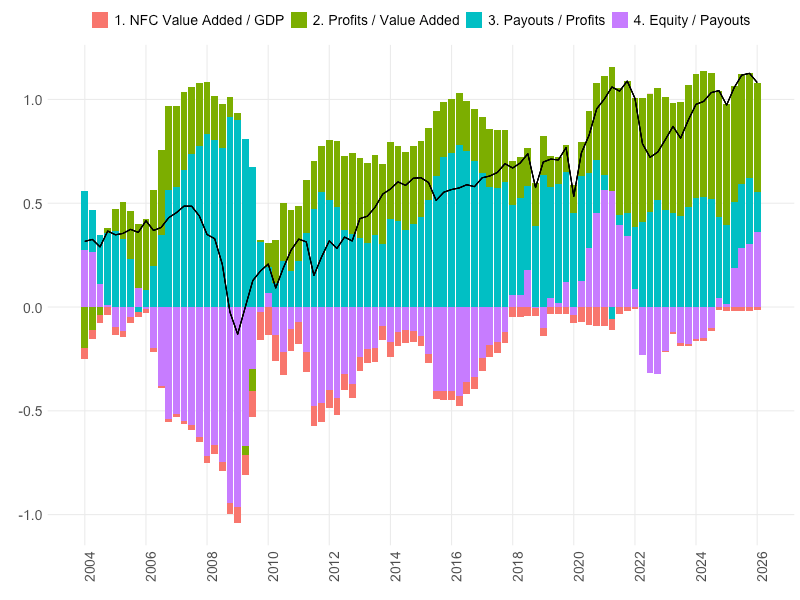
Logically, the value of corporate equity relative to GDP must reflect a combination of four factors: value added in the corporate sector as a share of GDP; corporate profits as a share of their value added; payouts to shareholders as a percentage of profits; and the value placed by markets on each dollar of payouts. 

In other words, if corporate stock is worth more relative to GDP, that can be either because more of GDP is now happening in the corporate sector; or because more of the income from that activity is going to profits; or because more of those profits are being paid out to shareholders (rather than retained in the firm); or because financial markets place a greater value on each dollar of payment. Or of course some combination of those.

We can write this as an accounting identity:

equity/GDP = value added/GDP * profits/value added * payouts/profits * equity/payouts

As with any accounting identity applied historically, it is useful insofar as it corresponds to (1) categories in the relevant data, and (2) distinct causal factors we believe to be at work.

For the first term, we are, again, using all nonfinancial corporate equity, which includes closely held as well as publicly-traded corporations, and the BEA’s estimate of potential GDP. (Both are in current dollars.) Value added is defined, as usual, as sales less the cost of non-labor inputs. Profits are after tax (and of course also after depreciation); conceptually, these are the funds potentially available for distribution to shareholders.2

Payouts I am defining as dividends less net new equity issues. That share repurchases are conceptually equivalent to dividends is not, I think, too controversial at this point (though it creates a lot of headaches). We are also adding shares retired through cash acquisitions, and subtracting shares issued whether in IPOs or otherwise. This might seem odd at the level of an individual firm, but at the aggregate level these other flows seem clearly equivalent to buybacks and dividends. If firm A buys up all the shares in firm B for cash, that is a payment from the corporate sector to shareholders, just as if firm A were buying back its own shares. Similarly, new shares issued are a reduction in the aggregate payments from the corporate sector to shareholders just as a reduction in dividend payments would be.

It might sound strange to define IPOs (which  generally are quite exciting for stock market participants) as equivalent to dividend reductions (which generally are not.) But this is where the aggregate perspective matters. Shareholders as a whole already own all the equity of the corporate sector as a whole. An IPO is a payment from shareholders to the corporate sector, exactly like buyback is a payment from the corporate sector to shareholders, without in either case any change in aggregate ownership rights. Or looking at it from another point of view, new corporations are in general competing with existing firms;  the profits flowing out to shareholders of the new firm are to a first approximation deductions from the profits flowing to claimants on existing firms. Nice for the shareholders in the new firm, if it succeeds; but no use to shareholders as a class.

Finally, the valuation term asks, in effect, what is the market price of a dollar of income from the corporate sector. It’s analogous to the price-earnings or price-dividend ratios one sees at the level of individual corporations or indexes, though not identical given the nonstandard (but, I would argue, appropriate) way I have defined payouts. Here it also functions as the residual term, reflecting any change in the value of equity not explained by the other factors.

The figures below show the values of each of these terms over the past 80 years. What do we see?

We will start with the first term, corporate value added as a share of GDP. This shows how much of economic activity takes place in the corporate sector, and is potentially available for shareholders.

As it turns out, the corporate value added term does not do anything interesting. Yes, it is modestly lower (around 50 percent) after 2000 than its average in the earlier decades (53 percent), suggesting that all else equal, we might expect the value of corporate equity to be slightly lower relative to GDP in the 21st than in the 20th century. But this change is very small compared with the movements in the other terms. This factor might be important if we were comparing the US to other countries, but it is not part of the story here.

Next, profits:

Profits as a share of value added shows much more variation, falling by half in the 1980s, then rising in this century, in two big jumps — one after 2000 and the second over the past five or so years. While the corporate share of GDP doesn’t vary by even 10 percent over the whole period, profits as a share of value added are fully three times greater today than they were for much of the 1980s. 

The third term is payouts.

Payouts (as I’ve defined them) also show large variation, rising from a bit under 40 percent of profits in the early decades to over 80 percent in more recent ones. The timing here is a bit different — though there is plenty of short-term variation, the long-run shift happens in a single big jump in the early 1980s. (This was the topic of an essay in my dissertation, which I never managed to publish as an academic article but did turn into a report for the Roosevelt Institute.) This term gets relatively little attention in discussion of stock prices, but it seems to me that it is as fundamental as profits to any discussion of long-term trends in the value of corporate equity.

Finally, the valuation term shows a lot of short- and medium-term variation but, perhaps surprisingly, no long run trend. Today’s ratio of around 40 is close to what we see in the 1950s and 1960s.

Again, what we are measuring with this last term is the ratio of equity value to shareholder payouts, including net share repurchases. The big spikes in the early 1970s and in 2000 are because those years saw exceptionally high new equity issues, which means very low payouts by my metric, and therefore very high ratios of equity value to payouts.

It is more common to talk about equity in relation to earnings, on the implicit assumption that profits are of equal value to shareholders whether they are paid out or not. I’ve shown this latter ratio below. But personally, I do not think that that is a good assumption. Shareholders evidently care a great deal about payouts — why else would companies pay dividends and make share repurchases? I think it is important to distinguish between corporations and the shareholders who exercise claims on them — the former are not simply the personal property of the latter. From this point of view, it is more natural to talk about valuation in terms of the price shareholders place on the income they actually get from corporations, as opposed to the underlying profits.

All of these series (except the last one) are combined in the next figure, which is really the whole point of this post. If you take one thing from one I’ve written here, this picture is it.

Equity value relative to GDP and its components, 1947-2026:

For this figure, I’ve converted the values to logs. This has the big advantage of converting the multiplicative relationship to an additive one, so that we can visually see the contribution made by each of them. But it can make interpreting the figure a bit tricky. Here, zero is the average value over the full period; positive one is a value about 2.7 times greater than the average, while negative one is a value about one-third of the average. The black line similarly describes the deviation of the equity-GDP ratio from its full-period average; the heights of the bars correspond to the contribution each term makes to that deviation. The data is quarterly; for all the terms except equity, I use rolling one-year averages.

As we can see, the log of the equity-GDP ratio is currently about 1.1 above its long-run average, corresponding to a value nearly three times greater. (2.2 today, versus a long run average of 0.85.) Just over half of this (0.53) is explained by higher profits relative to value added, 0.19 is explained by higher payouts relative to profits, and 0.36 is explained by the valuation term. 

So already we can see that a simple explanation of today’s high equity values is going to be incomplete. Relative to the long-run average, we have three distinct factors each of which explains a significant share of today’s higher values.

Another thing that jumps out from the figure is that the previous historical peaks in equity values reflect quite different mixes of these components.

In the 1960s, profits as a share of value added were, for a while, well above average, though not as high as today; but the fraction of those profits flowing out to shareholders was much lower. Thus the much lower ratio of equity to GDP, despite comparable valuation ratios.

In the late 1990s, profits as a share of value added were much lower — less than 5 percent at the height of the tech bubble, compared with 10 percent in the 1960s and 15 percent today. But the fraction of profits paid out to shareholders was historically high, averaging over 100 percent for the 1998-2000 period. It’s worth noting in this context, also, that the collapse of equity value in the 1970s reflected a fall in shareholder payouts much more than in profitability; this is perhaps important context for the shareholder revolt that followed.

The big takeaway from this decomposition is that we should be cautious about assuming the stock market is overvalued — that we’re in a bubble, that this is another bout of irrational exuberance — simply because equity prices are high relative to the historical norm. Shareholders have it better than the historical norm, too. Corporations are more profitable. And more of those profits are flowing out to them. A bit of exuberance might be rational, under the circumstances.

On the other hand: If we focus on just the past 20 years, as in the figure below, the picture looks a bit different.

Yes, both profits and payouts are high relative to their long-run averages; but those shifts mostly came earlier, while the big rise in equity prices is more recent.  Apart from the relatively brief collapse in profits during the Great Recession, almost all the variation in equity prices over the past two decades comes from the valuation term, rather than changes in the underlying payments to shareholders.

This is even more true over the past two years — equity values have increased sharply while profits have been stable and aggregate payments to shareholders have fallen, as dividend growth has stalled and net equity issue has turned positive.  As a share of GDP, the net payments flowing from corporations to shareholders today are very close to where they were a decade ago; but corporate equity is worth 60 percent more. It’s hard to avoid the conclusion that either equity was undervalued in the mid-2010s, or it is overvalued now. 

So which side do we focus on? Over the long run, most — tho not all — of the increase in the value of wealth in the form of corporate equity, is explained by what we might call fundamentals — the flow of payments to owners of that wealth. Over the short to medium run, on the other hand, almost all of the increase in the value of equity comes from valuation, and whatever financial-market dynamics drive that. Or as the old saying goes, in the short run the market is a voting machine, but in the long run it’s a weighing machine.

*

I want to say a bit more about the profits and payouts parts of the picture.

That high stock prices reflect to some extent a high level of corporate profits seems to be reasonably well understood, at least based on recent coverage in the Financial Times. This of course does not mean that high stock prices are justified, or sustainable; it just shifts the question to how justified or sustainable the high profits are.

This goes double to the extent that high valuations are based on an expectation of further increases in profits, as this recent FT piece suggests:

Wall Street’s expectations for company profit growth are rising at the fastest pace since the post-pandemic rebound, fuelling concern that an “earnings bubble” could be forming in the estimates that have underpinned the US stock market’s rally.

Analysts are now forecasting a 25 per cent increase in S&P 500 company earnings for the coming year, according to Bloomberg data, boosted by a resilient US economy and the AI boom.

However, just ahead of the second-quarter earnings season, some investors are growing concerned about the speed at which analysts’ estimates are rising…

This Alphaville piece goes further, saying that “supernormal profits are unsustainable, because they always are.” I don’t know about that. I don’t know if there’s any reason to think the profit share is stationary, to use the statistics jargon — apart from a dip in 2008-2009, profits as a share of value added have been greater than their long-run average in every year of this century, and seem to be getting farther from it. Capital really has won some lasting victories in the class war.

That is one natural way to look at profits — as a distributional variable. But there’s another way of looking at them, from the demand side.

We know, as readers of Keynes, that an increase in investment automatically creates an equal quantity of additional saving. If, furthermore, there’s little or no incremental saving out of wage income (a reasonable assumption, in my opinion) and if the fiscal balance and trade balance don’t change significantly (perhaps less reasonable,  but we’ll go with it) then this additional saving must take the form of an increase in profits. This relationship is often known as the Kalecki-Levy profits identity, and is one bit of heterodox economics that has established a foothold in finance and the business press. The same identity says that an increase in the fiscal deficit or trade surplus should similarly lead to an equal increase in aggregate profits.

Exploring the math of this and the extent to which it is a reasonable first approximation of real-world dynamics would be an interesting exercise for another post. But it raises another point which I think is very relevant for thinking about the current situation: Even if the AI companies themselves are not particularly (or at all) profitable, AI-related investment spending is probably an important factor in raising aggregate profits. Just like the California gold rush generated plenty of profits for somebody, even if the vast majority of prospectors themselves went broke.

Or as this recent FT piece puts it:

The AI boom is lifting the fortunes of hundreds of formerly drab industrial, utility and mining companies as investors turn to the “picks and shovels” needed to build and power vast data centres. …

The companies benefiting include Caterpillar, best known for construction equipment but now supplying generators for data centres, 150-year-old German engineering company Hochtief, which will enter the Dax later this month, and Nucor, a steel supplier that has credited “white hot” AI demand for a “tsunami of earnings power”. …

The vast amounts of electricity needed for AI training are also fuelling demand for specialised power management, high-voltage electronics and cooling technologies. This has led to big interest in traditional suppliers of electrical equipment…

You could think of it like this: As long as there is strong investment demand and easy financing for it, the profits will be there …. but not necessarily for the companies carrying out the investment and getting the financing.

And this, perhaps, is the point where the macro perspective needs to give way to the micro one. Because it may be that, yes, in the aggregate, an ease in financing brings forth additional investment, which generates enough profits to justify the initial financing. But debt must be paid back not in the aggregate, but by the specific companies that incurred it. If the investment is one place and the profits are somewhere else, then at some point somebody’s survival constraint is going to be violated.

And I think I will end this post here.

I very much want to discuss the payouts piece of the equation, which in my mind is as important as profits, and much less discussed. But this post is already too long, and has taken much too long to write. So the payouts piece should be along, well, if not this month, then next month, or soon.

The Case Against Hard Rules for City Reserve Funds

The following is a somewhat expanded version of testimony I presented on June 23 before the New York City Commission on Government Efficiency.

My name is Josh Mason. I am an associate professor and chair of the economics department at John Jay College, CUNY, and a senior fellow at the Groundwork Collaborative. It’s a pleasure to address the Committee  on Government Efficiency, several of whose members I worked with back in my days as the Policy Director of the New York Working Families Party.

I am here today to speak in opposition to any measure to create stricter rules for the use of City reserve funds, or to enshrine limits on reserve-fund withdrawals in the New York City Charter. I believe that the City needs greater short-term flexibility in budgeting, not less.

Economics suggests two broad principles for thinking about the City budget position. 

First, over the long run, growth city expenditure needs to match growth in revenue. Unlike the federal government, the city cannot run deficits indefinitely, nor can it use long-run debt to fund current expenditure.

Second, over the short run, adjustments in response to unexpected shocks to revenue or program costs should fall on those areas of spending with the greatest intertemporal substitutability. In other words, when faced with a mismatch between current revenues and current expenditure, the adjustment required in order to bring them into balance should as much as possible fall on those budget items for which a dollar of spending next year is a close substitute for a dollar of spending this year. 

The first of these principles, presumably, is accepted by everyone here. The second one is less familiar. But it is also implicitly accepted by everyone when it comes to periods of a year or less.

New York City, like many governments has very large short-term fluctuations in revenue. Between quarters, the average change in tax receipts is 13 percent; the average change in total receipts is 10 percent. It is not unusual to see total City revenues fall by 10 percent from one quarter to the next, or to see tax revenues fall by as much as 15 percent over a quarter, as they did between the first and second quarters of this fiscal year. 3 (See Figure 1.)

Figure 1. Source: New York City Comptroller, New York City Quarterly Cash Report; and author’s analysis

No one believes that short-term variation in the timing of city receipts should lead to city departments cutting (or increasing) spending by 10 or 15 percent, simply because relatively little tax revenue comes in the second quarter compared with the first. Everyone, I think, agrees that these short-term fluctuations should be entirely absorbed on the city’s balance sheet via short-term borrowing or changes in the city’s cash holdings. 

That is not controversial. But what I would add is that, economically, there is no sharp line separating periods of less than a year from periods of more than a year. The same logic that tells us that variations in revenue or program costs over the course of the year should be entirely absorbed on the balance sheet, suggests that variation over a period of few years should also be primarily absorbed in this way.  

It is true that the timing of tax revenue means there are greater fluctuations in revenue from quarter to quarter than from year to year. But the city still faces substantial variation in revenue from year to year, much of which is temporary. In recent years, we’ve seen city revenues increase by over 10 percent in some years, by as little as 1.5 percent in other years. It is far preferable to see spending rise steadily at the average rate of revenue growth, than to have big increases in spending in some years and cuts in real terms (which a 1.5 percent growth in spending would be) in other years, in an effort to achieve balance in each fiscal year. Variation in revenue from year to year is often temporary, and reverses the next year; and even if slower revenue growth turns out to be persistent, a gradual adjustment to the new situation is almost always preferable to an abrupt one.

Again, this principle is well understood at the level of practical budgeting. That is the reason that the city has reserve funds in the first place. And it is why, historically, the city has often used surpluses to prepay future years’ expenses rather to increase spending. 4

The items in the city budget that are most intertemporally elastic — most substitutable between one year and the next — are fund contributions. A dollar contributed to the fund next year is almost as good as a dollar contributed this year. 5 If we were to contribute nothing to a given fund this year, and double the contribution next year, the overall funding position would be almost the same. In general, if the total contributions over some period are unchanged, there is very little economic cost to shifting those contributions around in time. 

This is much less true of other city expenditures. If we were to shutter the city’s libraries this year, and double library spending next year, the overall value of library services provided to the public would be far less than with a stable level of spending. Additional hours of libraries open next year are a very poor substitute for hours the libraries are closed this year. The same goes for fire and police services, education, and most other public services. 

In principle, capital expenditures are more substitutable — a major road improvement, say, is almost as valuable if it is carried next year as this year. But in practice, the process by which projects are approved makes them hard to shift around in time — a project that has passed all the necessary hurdles to go forward in one year cannot necessarily be deferred to a later year or advanced to an earlier one. So in practice, the least costly way to address unexpected changes in City revenues or program costs is via contributions to or withdrawals from the city’s reserve funds — a category in which I would include the Retiree Health Benefit Trust and the Budget Stabilization Account as well as the Revenue Stabilization Fund and General Reserve.

The proposals to mandate contributions to the reserve funds and limit withdrawals from them would reduce this flexibility, and create greater instability in other categories of city spending. Perversely, they would force the burden of adjustment onto budget items that have less intertemporal substitutability. This is the opposite of what we should be trying to achieve. The budget needs more short-term flexibility, not less.

A number of these proposals involve formulas that are intended to allow flexibility when economic conditions warrant it, but not otherwise. For example, a recent proposal from the Comptroller’s office suggests that except in the event of natural disasters or similar catastrophic events, withdrawals from reserves should be permitted only once there have been two quarters of declining employment in the city. 6

Since the idea of tying withdrawals to economic conditions may seem appealing, I want to explain why it is not a workable solution in practice. There are four reasons, in my view, why hard rules based on economic data are not a practical solution.

First (as the Comptroller’s proposal acknowledges, but other similar proposals do not), reliable macroeconomic data is often unavailable in real time; most economic data is subject  to substantial revisions which can dramatically change the initial numbers.

For local employment, the final data are not released until a full year after the period which it covers, and are often quite different from the initial data. For example, in 2025, the jobs data as initially released showed a respectable gain of 50,000 jobs over the year. But the numbers have been subsequently revised downward and the most recent numbers show no job growth over the year at all. (See figure 2.)

Figure 2. Source: Bureau of Labor Statistics, State and Metro Area Employment, Hours, and Earnings; and author’s analysis

This does not mean that we should not use the most current economic data, of course. But data whose final value is not available until a year after the fact, and where the initial release may be very different from the revised value, needs to be used cautiously and weighed alongside other evidence on the state of the economy. It is not a suitable basis for imposing hard rules on the city budget. 

Second, while national economic data is available sooner than for local areas, these are also unsuitable for budget rules, since business cycle dynamics in New York City can be quite different from national dynamics. For example, the 1990 recession was quite mild at the national level — employment fell by only about 1 percent and had fully recovered within two years of the end of the recession. But in New York, it was much more severe, with fully 10 percent of jobs lost and employment not returning to pre-recession levels until a decade later. This was also the case for the 2000 recession. The 2007-2009 recession, on the other hand, was milder in New York City, with employment returning to pre-recession levels two years after the recession ended, compared with five years nationally. So a rule based on national economic data may be a poor fit for local conditions.

Figure 3. Source: Federal Reserve Bank of St. Louis

A rule based on recessions, which has also been suggested as a trigger for drawing down reserve funds, combines both of these problems. The National Bureau for Economic Research often does not announce recession turning points until a year or more after the fact, and the timing of downturns may be significantly different at the local and national levels. 

Third, even if we had reliable data, economic indicators do not move in sync, and it is not always obvious which is the appropriate one to use.

For New York City, as for most local governments, the single most important source of revenue is the property tax,  which in recent years accounts for between 40 and 50 percent of all City tax revenue. Property tax receipts depend on property values, and these can move quite differently from employment or output. For example, while the 2007-2009 recession was, as noted, fairly mild in New York in terms of employment, home prices saw a steep and lasting fall — average New York home prices were lower in 2017 than they had been a decade earlier in 2007. (See Figure 3.) Given the city’s reliance on property taxes, this is arguably more important than employment conditions. A rule based on employment would not necessarily give a good sense of the economic conditions that are most relevant for the city budget position.

Finally, in practice, data-based rules create arbitrary cutoffs and thresholds. The nature of rules is to impose hard binaries — either withdrawals from the reserve funds are permitted or they are not. But in practice, economic conditions may be quite similar in periods when the threshold is not quite reached as in periods when it is, and whatever indicator is used as the basis of a rule will, in reality, only be one of many pieces of information relevant to economic and budget conditions. Policymakers in the moment can weigh various considerations to decide whether it is appropriate to draw down or to add to reserves; a predefined rule does not allow this flexibility.

More generally, advocates of rules for city reserve funds need to grapple with the full implications of such rules. The city will, inevitably, face unforeseen changes in its revenues and in the cost of the services it provides. The impact of these changes must be absorbed somewhere in the budget. Given the city’s limited ability to control its revenue, especially in the short run, shocks that are not absorbed in the balance sheet will in general, be absorbed by changes to the level of city services provided.  Ensuring a steady rate of contributions to the employee retiree health benefit fund sounds like a good thing, in isolation. But, obviously, stable contributions to the fund do nothing to reduce instability in city revenues or program costs. So a rule imposing a more stable path of contributions to the fund necessarily imposes more instability elsewhere in the city’s budget. And cutbacks to funding for the school system, or for public safety, will have persistent costs that cannot be made good in future years in the way that a shortfall in fund contributions can be.

A myopic focus on stabilizing contributions to city trust funds (which is of course desirable in isolation) can blind us to the very large costs of instability in the provision of public services. It is certainly true that the City, unlike the federal government and even more than the State, is constrained in its ability to issue debt, and cannot fund ongoing deficits through new borrowing. Nor, of course, can the city’s financial assets be spent down indefinitely. In this sense, it is absolutely correct that public expenditures must be managed so as to keep them in line with revenue growth over time. It is unfortunate, however, that the idea of responsibility has been narrowed to mean only a focus only on financial outcomes, and not on the no less critical responsibility for consistent provision of the public services that New York’s residents and businesses depend on.

Even short-term reductions in the provision of education, public safety, transportation, health and other services can have lasting effects. Among other things, public services are directly relevant to decisions by both families and businesses about whether to move to, or remain in, the City, and thus have important consequences for the City’s future tax base. When faced with a tradeoff between consistent contribution to city reserve funds and consistent provision of public services, the former has no better a priori claim to be considered the “responsible” course than the latter.

A related mistake, in my view, is the idea that policymakers will systematically err on the side of overspending unless restrained by hard budgetary rules. Both common sense and history suggest that while this sort of error certainly occurs, there is no reason to think it is any more common than the opposite error, of excessive resort to spending cuts to close budget gaps and insufficient use of balance-sheet flexibility.

There is no reason to assume policymakers will systematically err on the side of irresponsibly drawing down reserves; it is just as plausible that they will underutilize them. This is clearly the case at the state level, where the State made no drawdowns  from the Tax Stabilization Fund or Rainy Day Reserve Fund in either the 2000 or 2007-2009 recessions despite substantial falls in tax revenue, instead resorting to other, more costly measures to close the state budget gap.7 In general, there is no reason to think that today’s policymakers, who would impose this rule, are any more likely to strike the right balance between the balance-sheet position and public service provision than the future policymakers who would be bound by it. The one thing we know for sure is that future policymakers will be better informed about future economic and budget conditions than we are today.

To be clear, I think the existence of city reserve funds is a very good thing. Given the constraints on city borrowing, adequate reserve funds are essential to maintaining stable provision of city services in the face of unexpected shocks.  It is appropriate for the City to contribute more to these funds in years when revenues are usually high, while drawing them down in years when revenue growth is weaker. And it may well be that the ideal funding of city reserves is greater than it has been historically.

There is nothing wrong with thinking about guidelines or targets for reserve funds. What I urge you to reject, however, is enshrining a hard limit on the use of reserves in the City Charter. The goal of maintaining reserves should be to provide future administrations with greater flexibility, not less, in responding to future challenges.

No use was made of “AI” in preparing this post.


At Vox, a Conversation on Rent Control

(I had a long conversation yesterday with Eric Levitz of Vox about the New York City rent freeze and the economics of rent regulation. I have posted the interview below just as it appeared there, for my archives and in case people want to read it without dealing with the paywall.)


An economist makes the case for Zohran Mamdani’s rent freeze

A new look at an issue that frequently divides voter and experts.

by Eric Levitz July 7, 2026 at 6:00 AM EDT

gettyimages-2274493525.jpg.webp

As America’s housing crisis deepens, policymakers are increasingly turning to an old idea for improving affordability: making large rent increases illegal.

In recent years. Oregon, Washington, and California have enacted statewide rent controls. In 2024, the Biden administration floated a nationwide cap on rent increases for large buildings. And last month, New York’s Rent Guidelines Board approved a two-year rent freeze on the city’s roughly 1 million stabilized units, fulfilling one of Mayor Zohran Mamdani’s signature campaign promises.

While rent control has long had some appeal to voters, it has historically provoked consternation among economists. In one 2012 survey, just 2 percent of economists agreed with the statement that local rent regulations “had a positive impact over the past three decades on the amount and quality of broadly affordable rental housing.”

The reasoning behind such skepticism is simple: When you make it less profitable to provide rental housing, people produce less of it. As a result, rent control reduces the supply of housing — and thus tends to make cities less affordable in the long run.

But this orthodoxy may soon be overturned – or so argues J.W. Mason, chair of the economics department at New York’s John Jay College of Criminal Justice and a senior fellow at Groundwork Collaborative, a progressive think tank.

In Mason’s view, the evidence that rent regulations discourage construction has been widely overstated: When designed well — and paired with zoning reforms — rent controls can protect tenants from displacement without reducing the long-term supply of housing.

We spoke this week about the case for (and against) rent control in general and New York City’s policies in particular. Our conversation has been edited for clarity and concision.

Among mainstream economists, conventional wisdom holds that rent control measures are misguided, partly on the grounds that they reduce the long-term supply of housing. In your view, what does that analysis get wrong?

When we talk about rent regulation, we’re typically talking about markets where there are already very substantial constraints on housing supply. Nobody is trying to pass rent regulation in exurban Texas or the Atlanta suburbs, where you have a lot of new housing construction.

Where it’s relatively easy to build housing, rents are going to be closely tied to the cost of building and operating new housing because, if you charge a lot more than that, then you create an opportunity for competitors.

The markets where you have rent regulation are markets like New York City, San Francisco, and a lot of European cities — places where there’s already really hard constraints on the capacity to build new housing. And in cases like that, where supply is already constrained by land use rules or just by an absolute scarcity of buildable land or by other factors, you’re not going to get any additional limitation on supply from rent regulation.

In that context, owners of existing housing collect rents in the broad, economic sense — income that doesn’t derive from any contribution they’ve made to production, but merely from others’ inability to build. Under those conditions, the only thing rent regulation does is redistribute some of that economic rent from property owners to tenants.

Most critics of rent control oppose restrictive zoning too. So, I think they might say that we should focus on ending the conditions that allow landlords to extract economic rents in the first place, rather than on redistributing them.

There’s an argument that, if we could achieve deep supply-side improvements in housing, we wouldn’t need rent regulation to the extent that we currently do. And I think that’s a perfectly reasonable argument. But it does not do any good for tenants who are facing displacement today. The fact that you have a different long-term goal does not remove the need for dealing with the short-term problem.

And there are good reasons to think that rent regulation is desirable, even if we think the real problem is on the supply side. For one, I think the politics of dealing with supply issues are much easier if you also have rent regulation. A lot of opposition to addressing supply-side problems is a perception that if you get new development, then that’s going to lead to displacement of people in the areas where development is taking place.

We can debate how true that is. But it’s a very deeply held perception. So, to the extent that you can offer real security to existing tenants, you remove one of the big sources of public opposition to supply-side measures: You don’t need to oppose removing restrictions on new housing because you are locked in. You are safe. Your landlord cannot kick you out to get somebody higher-paying in.

And honestly, I think that politics is very clear here in New York. I think that you would not have gotten the City of Yes land-use reforms, or the zoning reforms that passed on the ballot initiatives this past year, or a progressive like Zohran Mamdani coming out in favor of supply-side measures to increase housing production, if we had not strengthened the rent laws back in 2019.

Putting the politics to one side, do you think there is any tension between restricting rents and increasing construction? Say a city rolls back some of its restrictions on homebuilding, and new construction stops being effectively capped by zoning rules. If that city adopts rent controls, will that reduce the supply of housing at the margin? Or is that supposed tradeoff entirely illusory, in your view?

There’s no deterrent effect to many rent regulations, including those in New York City. Obviously, you can hypothetically imagine a much more rigorous form of rent control that could discourage new construction. I’m not going to say that it is impossible for that to happen. I think that we’re just very far from that point.

This is largely because new construction is typically exempt from rent control. In New York City, you are only required to comply with rent regulations if your building is more than 50 years old. And developers aren’t deciding whether to build based on how much rent a project will yield 50 years in the future.

The longevity of housing just makes it different from other goods. People often say, “If you impose a hard cap on milk prices, people will find it less worthwhile to produce milk. And we’re going to have shortages of milk in the stores.” We can debate whether that’s always true. But it’s a reasonable argument, since milk is consumed shortly after it’s produced. So your decision to produce more milk really is based on the price that you can get for that milk today.

But housing is at the opposite extreme. The median building in New York is 80 years old. When that housing was first produced, the price it’s going for today was not a factor.

Now, I should add that in New York City, the buildings with the highest rates of rent regulation are actually newer buildings. But that’s because developers voluntarily opt into the rent regulation system, as a condition of getting tax subsidies. At that point, clearly you’re not having a negative effect on supply when this is a voluntary decision.

Is that necessarily true? In theory, the tax subsidies are supposed to encourage housing investment. And developers weigh the benefit of those subsidies against their costs: If you accept them, you need to provide some units at below-market rates. So, if New York City makes providing rent-stabilized units less profitable — by freezing rents — then don’t the subsidies become less valuable? And wouldn’t that theoretically make investors slightly less inclined to fund new housing, all else equal?

Well, we’re seeing more new housing constructed in New York City right now than we’ve seen in many decades. So clearly something is working. And maybe what’s working is just that incomes are rising, that demand for housing in the city is rising.

But in my opinion, the tax abatements are badly structured. I really would not support housing development that way. But a huge fraction of new housing that gets built in the city uses these tax credits. So I think clearly they’re attractive to developers. Clearly, it’s a worthwhile trade-off from their point of view.

For critics of rent control, one study looms especially large: In 2018, a team of Stanford economists examined the impact of San Francisco’s rent control expansion in the 1990s. And they found that the policy led to a 15 percent reduction in the rental housing supply, which pushed up rents in the city by 5.1 percent. But in my understanding, you think the implications of that research are widely misinterpreted.

Yeah. I think that’s really a study about poor regulatory design. What it shows is: If you impose strict rent regulations but you don’t restrict people’s ability to convert rental properties to other uses, that may encourage landlords to convert rental housing into condos.

In the study, rental housing supply did not fall because of a decline in new construction. It fell because of condo conversions. And that distinction is important. If you have rental housing that’s converted to condos, that’s not reducing the overall supply of housing, but only that of rental housing. And it’s not necessarily increasing the cost of housing: It may be increasing market rents in the unregulated sector, but decreasing the cost of condos for condo buyers.

In any case, a well-designed rent regulation, like New York City’s 2019 reforms, can simply disallow people from moving housing out of the rental market in that way.

Many have argued that rent stabilization in general and New York City’s 2019 reforms in particular have negatively impacted the quality of the housing stock. Specifically, the argument is that landlords respond to rent restrictions by cutting back on maintenance. Is that a serious risk?

Of all of the concerns that you’ve raised, that is the most legitimate. I don’t think that we’re really seeing that yet. If anything, we’re seeing a reduction in a number of units that seem to have severe maintenance problems in New York. But you know, some people think we should not just have a rent freeze here, but a rent rollback. So, you roll back rents by five, 10, 15, 20, 25 percent, you’ll eventually reach a point at which you have real problems with building owners not doing basic maintenance and buildings falling into disrepair.

I’m not sure what the number is. Clearly there is a number where that happens. But I think we’re a very long way away from that. The vast majority of buildings are renting for much more than their operating and maintenance costs. The Rent Guidelines Board does studies. They suggest that the median margin is on the order of 40 or 50 percent.

As you’ve written, there is a minority of stabilized buildings in which maintenance and operating costs already exceed their total rents. But you attribute that primarily to the poverty of such buildings’ tenants, rather than to excessive restrictions on market rents?

I think that’s generally the case. There’s a sector of nonprofit-owned buildings, which tend to be the ones with the lowest rents and the lowest-income tenants. And in many cases, those buildings do face real problems with maintenance and upkeep. But they’re often not increasing rents even by the regulated amount, since tenants in these places simply can’t afford to pay more. In those cases, I think at some point you need either targeted subsidies or a change in ownership. But this is a very small fringe of buildings.

To name one last criticism of rent control: Some economists argue that it promotes an inefficient allocation of housing. The argument being: If you let people pay a below-market rent — on the condition that they don’t move — then you’re encouraging them to stay in place. And this leads to things like, for example, empty-nesters continuing to occupy three-bedroom apartments, which would have more utility for younger families.

I think we should recognize that there is a legitimate social interest in saying: Somebody who’s lived in an apartment for 15 years has a right to remain there, even if their landlord decides they could get a higher income by renting to somebody else. I think that’s a perfectly reasonable social goal.

And I think doing that actually makes the housing market more flexible and efficient. Why? Because it means that there’s less pressure to become a homeowner in order to get that security. Right now, in most markets, if you want security of tenure, the only way to get it is through ownership.

And ownership really locks you in. The transaction costs from buying and selling a house are very large. And obviously, in many cases, you get a financial risk, since a house is your main form of savings. If you sell at the wrong time, you lose a lot of money. So we get people who are locked into houses. They don’t have the same degree of geographic mobility. They can’t move to where the job opportunities are better. They stay in a big house even after their children are grown, which would really be better used by a younger family. If we give more security of tenure to renters, more people will choose to rent, and we’ll have actually, I think, a more flexible and efficient housing market.

At John Jay, We Study Economics to Change the World

Last week, the Rent Guidelines Board voted for a freeze on the rent for New York City’s one million rent-regulated apartments, fulfilling one of Mayor Mamdani’s defining campaign promises.

There has been plenty of discussion of the decision, both supportive and critical. But there’s one aspect of it, of particular interest to me, that has not been mentioned: Two out of the mayor’s six appointees to the board are recent graduates of the John Jay MA program in economics, where I teach.

I’m very proud of Sina Sinai and Lauren Melodia, who I know carefully studied the evidence and considered the full range of options before voting for the freeze. Lauren is also doing important work as the Director of Economic and Fiscal Policy at the Center for New York City Affairs, where she is producing a great deal of valuable research, most recently on working conditions in childcare. She’s recently been joined by David Lee, another John Jay graduate, who formerly worked as Legislative Director for New York Assemblymember Ron Kim and is now writing about fiscal policy at the Center.

Meanwhile on the rent regulation front, Anisha Steephen, a current student at John Jay, just released a major report from the Roosevelt Institute on rent regulation as financial regulation, which I hope to be writing more about soon.

This is what students  from the John Jay economics program do. For a small program that’s existed for less than ten years, we have an impressive number of students out in the world contributing to progressive political projects.

Also in the housing space, consider Paul Williams. After finishing his MA with us a few years ago, he established the Center for Public Enterprise, where he now has a dozen staff, and has done as much as anyone to make the case that local government can be a major investor in housing, as well as in energy and other areas. This is a critical part of the both-and approach — boost supply and protect tenants — that defines the Mamdani agenda on housing. 

Other current and former John Jay MA students include policy staff for socialist elected officials like State Senator Julia Salazar and former Representative Jamaal Bowman; the legislative director for the UAW; the chief of staff for former New York City Councilmember Carlina Rivera and State Senator Kristen Gonzalez; and analysts and researchers at various government agencies, including several at the Bureau of labor Statistics. Journalists like Aída Chavez (of The Intercept and The Nation) and Kate Aronoff (of The New Republic, and author of A Planet to Win: Why We Need a Green New Deal) were also students here. Jack Gross, founder of the outstanding web journal Phenomenal World, and Nathan Tankus, of the essential newsletter Notes on the Crises, were also briefly students here. (Neither got degrees, but the work and the community matter more than the credential.)

Why am I sharing this? Is it just to brag? Well, partially. I am very proud of what we’ve done with this program over the past decade, and of the students who have passed through it. And to update Hillel, if you don’t talk about your own work, who will talk about it? 

But there’s also a more specific and timely reason: For the next two weeks, we are still accepting applications for Fall 2026. And I suspect that readers of this blog must know a few young (or not so young) people interested in studying heterodox economics at a public university in New York City.

If you do know someone who might fit that description, here is the pitch. 

Unlike most economics programs, John Jay is unapologetically committed to a progressive, policy-oriented approach, and to the heterodox traditions of Marxian, Keynesian and feminist economics. Our students and faculty see the study of economics both as an end in itself and as a way of contributing to the most pressing struggles in our society.

While many of ours students take up roles in politics, advocacy, journalism and policy research (like on the Rent Guidelines Board) many others continue on to PhD programs. In one recent year, we had an entering class of 15 and eight students who went on to PhD programs, a proportion I suspect very few other MA programs in the country could match, even at much more prestigious institutions.

John Jay College is located at 59th St. and 10th Ave., near Columbus Circle in the heart of Manhattan. All classes in the MA program meet in person one day a week in the evening. Most students take three classes per semester and finish the program in two years, but there is no penalty for going at a different pace.

For anyone who has lived in New York State for at least one year as of September, full-time tuition is $5,545 per semester. This is pro-rated for those taking fewer classes, so the total cost for the program is approximately $22,000 regardless of the time over which it is completed. (This is less than a quarter the tuition at many comparable programs.) For non-resident full time students tuition is somewhat higher, but still cheap compared with most graduate programs.  

There’s an online application here. Only the statement of purpose and transcript is required by July 15; recommendation letters can come in later.

There is no requirement to have previously studied economics; our students come from a wide range of backgrounds and many have undergraduate degrees in the humanities, physical sciences or other fields. We are less interested in what classes people have taken than in their intellectual curiosity, a willingness to work hard, and a commitment to using economics training to help change the world. 

Does coming to John Jay guarantee that you’ll play a leading role in building municipal socialism? Obviously not. But based on our track record, it does seem to improve the odds. 

Responses to Against Money

The other day, Laura and I were standing on the subway platform, on our way to see Boots Riley’s I Love Boosters8, when a young man walked up to us. Well, up to me. “Are you the author of this book,” he asked; he had a copy of Against Money. I said that I was, and asked him if he’d read much of it. Two chapters in so far, he said; he used to follow me on Twitter; he had a pen if I could sign it.

I feel like this is an experience authors of academic books don’t get to have very often. Though I suppose it’s more likely than most places in Park Slope.

I had another nice experience at a reading at Pilsen Community Books in Chicago, a lovely little collectively-owned bookstore I had never been to before. Not a lot of people showed up, but Gabe Winant and I had a good discussion with those who were there. One person in the audience introduced himself as an organizer for UNITE-HERE. We had a good conversation about what motivates workers to join unions, which, today, is practically a matter of defying a totalitarian surveillance state. It’s not mainly about pay, we agreed, it’s about self-respect; or as an organizer I worked with years ago put it, it’s the one’s chance in someone’s life to say “Fuck you” to their boss. 

Anyway the discussion went on and toward the end of it a young man in the back asked the question people always ask: ok, but what can I do? What is there to do? I had some answers; Gabe had some better ones, but still not fully satisfactory. Afterwards the young man came up to talk to us. So did the union organizer: What do you do for a living, he asked him. “Oh, well, I just quit my old job” the young guy said. “So, how would you like to work in a hotel?” Afterward they were adjourning to a coffee shop nearby. If the event results in that guy becoming a salt for HERE, then I would say it was an evening well spent.

There are some other responses to Against Money that I am also eager to share.

Our first two reviews are out. One, in Jacobin, is by Mona Ali, whose scholarship on international finance and power I’ve long admired. The second is in Reuters, by Jon Sindreu.  Jon is someone I’ve interacted with online for a number of years. He’s a journalist professionally; despite (or because of) that, I feel like he is more in tune with Arjun’s and my particular Keynesian vision than almost any economist I know.  

Both reviews are insightful and generous and thoughtful – exactly the kinds of reactions to the book I would have hoped for. One thing I particularly appreciated about both of them is that they don’t just respond to what is in the book, but take its core idea  — the difference between money -world with its own internal logic, and the world of productive activity that it interacts with but is distinct from — and carry it in new directions. I think it reflects well on the usefulness of this perspective that they are both able to apply it to other questions that we might have discussed in the book but did not.

Both of them highlight global imbalances as an area where the conflation of money payments with material things is especially pervasive. At the aggregate level, “saving” is just an accounting residual, the difference between total incomes generated from production and consumption spending. As Keynes long ago pointed out, saving is never a constraint at the macro level; any change in investment spending (or the government fiscal balance or the trade balance) mechanically generates an equal change in aggregate saving. Mistaking this accounting category for a quasi-physical substance that can move from place to place — a misapprehension that is ubiquitous in discussion of international trade and finance — leads to all sorts of wrong conclusions, like the idea that financial conditions in the United States are a function of our trade balance with China. 

Another area Mona’s review points toward is the idea of degrowth. There is a longstanding desire among economists to regard measures like GDP as reflecting in some sense human wellbeing or happiness, an impulse we criticize at length in the book. But there is a somewhat analogous tendency on the part of some environmentalists to see GDP as a measure of physical throughput or real resource use, so that decarbonization and other sustainability goals necessarily imply a lower path for GDP.  The original outline for the book had a chapter called “Planet Money and Planet Earth,” which did not make it in. But we would have argued, as Mona suggests, that to think clearly about the economy and the environment, we need to give up on the idea of a single scalar and turn toward more granular, physical measures, like say, to use her example, the area of tree coverage. 

Among other things recognizing money as autonomous and self-referential change the way we think about the productive side of the economy. (This is something Arjun and I have written about elsewhere, but also didn’t get into this book; maybe the next one.) 

The view that you get from an economics textbook is that output is effectively a homogeneous substance merging from a production function — a certain quantity of labor and capital goes in one side, and a certain amount of stuff comes out the other. This is an example of seeing concrete reality in the image of money, which really is homogenous — the equivalence of one unit of money to any other unit of money is one of its defining characteristics. 

But in reality, production consists of all kinds of complicated forms of specialized cooperation between people; changing what people are making or the conditions under which they make it involves frictions which grow more severe the faster the changes must be made. We may be able to ignore this in the case of  gradual, incremental changes in production, and just say that the next unit of spending results in the next most valuable thing that can be produced. In that case, we can describe the system in terms of a level of spending and a corresponding level of aggregate output. But as soon as the changes get larger or faster, the frictions imposed by the real-world heterogeneity and embeddedness of production become impossible to ignore. 

As Sindreu highlights in his review, the conflict between the money-like vision of production and its concrete social reality has come more sharply into view in recent years. 

Take the Covid 19 pandemic. Governments had no trouble conjuring $11 trillion for fiscal stimulus. Yet most of the money went to keeping the economy humming, with only about a tenth overall going to the health sector. No amount of paper wealth could procure nurses, masks, hospital beds and vaccines in time to make a difference to the virus’ early spread. Consider also the energy shocks of 2022 and this year, U.S. President Donald Trump’s trade spats, the AI revolution and the war in Ukraine. The relevant metrics in these cases have been barrels of oil, critical minerals, computing power and stockpiles ​of ammunition. A larger GDP helps fund such purchases, but doesn’t necessarily translate into a greater capacity to build or procure them when they’re actually needed.

To me, an interesting aspect of this is the way it challenges the sort of Keynesian macroeconomics that I teach as well as the standard production-function view. The high ground on which retreating Keynesians made their last stand a generation ago was that short-term fluctuations in activity are the result of shifts in the volume of spending, not the productive capacity of the economy. When output falls in a recession or depression, it’s because something has reduced the capacity to make money payments, not the capacity for real production. The alternative, advancing from the freshwater redoubts of Chicago and Minnesota and Rochester, was the “real business cycle” view — that scarcity and allocation are the only economic problems at the macro as well as the micro level, in the short run as well as the long. For people like me, rejecting this view was the starting point for our engagement with macroeconomic theory.

And yet … wasn’t the pandemic downturn a kind of real business cycle? Thanks to the fiscal response (in the US at least), the flow of money payments was not interrupted. The loss of employment and output was precisely due to a sudden loss of capacity for real productive activity. 

As Sindreu stresses, the possibility of disruption on either side — in the web of money payments or in the concrete activity of production — reinforces the need to maintain the conceptual distinction between them. The two cases are very different! What is harder to say is whether the pandemic and subsequent disruptions were a one-off; or whether they were a harbinger of future and especially climate related disruptions to the supply side, as Isabella Weber has suggested; or if they should lead us to rethink historical fluctuations as well. It’s not an easy question! For my part, what I still say in the classroom is: “business cycles are always the result of changes in demand … except for the pandemic.”

One more example: the importance of distinguishing between real and financial provision for the future. At an individual level, they are equivalent: If I want to eat in retirement, the way I provide for that is by amassing claims against society in some financial form. But this does not carry over to aggregate level. Many economists, notes Sindreu, think that funded pension schemes, which back promises to retirees with a pot of financial assets, are more sustainable than pay-as-you-go scheme. 

but they’re wrong. … If higher measured wealth doesn’t map onto more physical production in the future…, the ageing problem remains unsolved: while an individual retiree may be able to run down assets to boost consumption, society as a whole will still ⁠need enough workers ​to produce the goods and services demanded. 

Here as elsewhere, the problem is that from the point of view of the individual participant in the system, the mapping of money payments on real things is an objective fact: If I pay for so much more of this, I will have to accept less of that. But at the level of the system as a whole, it is not.

Of course you don’t need to read Against Money to observe that GDP is as fetishized by degrowth as by growth for its own sake, or to note that employing people to plant trees boosts measured output and employment just as much as employing people to cut them down. You don’t need to read Against Money to understand that a disruption to production like the pandemic is quite different from the financially-mediated falls in demand of other recessions, or to see that the meals eaten by tomorrow’s retirees must be cooked by tomorrow’s workers, regardless of what is in the Social Security trust fund. 

What I hope the book contributes, is to show how these points are connected — that there is a larger worldview implicated in them. Our goal was to bring into light the ideas about money-world and its relationship to concrete production and other social domains, that are implicit in various debates but seldom foregrounded. 

So, for example, rejecting a hard tradeoff between decarbonization and meeting people’s immediate material needs should change the way you think about global imbalances. Or — to take another example offered by Sindreu — if you see the strong element of conscious planning driving investment data centers in the US and green energy in China, this awareness of finance as planning should put you on guard against attempts to disguise the actions of the Bank of England as the objective judgement of decentralized bond markets. 

Based on the range of fascinating questions that both Mona Ali and Jon Sindreu were able to connect to the arguments of the book, I think we had some success with this. The kinds of issues they brought up point in exactly the directions that we hoped conversations around the book might go. Along with the young people and union activists, these are the readers we were hoping for.

A few other bits of Against Money  content. 

Arjun was on the “This Is Hell” podcast, with Chuck Mertz, which also airs on WNUR 89.3FM Chicago and Lumpen Radio. I’m especially tickled by the latter, since I was friends with Ed Marszewski and the Lumpen crowd back in the 1990s, and used to hang out at the Marszewski family bar in Bridgeport. 

I was on UpFront on KPFA for a 45-minute interview, which is very generous for radio. (The interview itself starts about 12 minutes in.) Brian Edwards-Tiekert of UpFront is a dream interviewer — he had read the book deeply, summarized its key arguments better than I could, and asked thoughtful questions that connected these more abstract debates to the real world debates that are why we care about them.

Finally, I feel compelled to share this review from Amazon. Not just because it’s our first five-star review (though one might pause to consider how the motivating power of prestige and recognition points to the limits of money as a coordination device). But mainly because verified purchaser MudHen so clearly gets what we were trying to do:

Since everything is priced in money, it is all too easy to think, for example, that an object priced at $50,000 has $50,000 of “value” in it somewhere. The equation of price and value simultaneously reifies money (making it a commodity) and casts a veil over the entire material world. This causes us to confuse money and things. That confusion is the bedrock foundation of modern (marginal utility) economics.

Money-is-credit-is-debt points to an end to capitalism. Eventually the entire world is commodified and money is left just valorizing itself in an M-M1 loop which becomes increasingly divorced from use value. At some point, this becomes so ridiculous that everyone can see the problem: uses values are no longer increasing, while nominal (money) wealth is skyrocketing. The Americans are bonkers for their stock market, which is increasingly just a debt (M-M1) financial loop. As the country falls apart, it will become astonishing “wealthy” — and tens of millions of people will slide into functional poverty.

The penalty for confusing money and things is severe, but this book is hopeful. It may not be a matter of envisioning an alternative to capitalism (the hard problem of Jameson/Fisher), so much as the simple realization that most of our growth today is merely financial (number go up). To improve life for everyone, we will have to look beyond money.

Yes, that’s it. The road to a freer, more democratic and egalitarian society doesn’t involve redistributing money claims, but recognizing and building on the ways in which those claims are already and increasingly irrelevant to the activity through which we meet our collective needs.

Talking about Against Money

In the front window of McNally Jackson, one of my favorite NYC bookstores.

Against Money is now out. It’s been spotted in a number of bookstores, including the Union Square Barnes and Noble, where it turns out to be shelved next to Marx’s Capital in the Business section.

As my friend Suresh said to me the other day, as writers we should think of books as landmarks for a larger body of thought, rather than self-contained arguments in themselves. That is certainly the case with this book. But I am glad to see this piece of the larger project out in the world.

We had two very nice launch events, one at the University of Massachusetts (where both of us went to graduate school) and one at John Jay College, my academic home now. Both events had a great turnout, and I very much appreciated the discussion with Christine Dean, Jerry Epstein and Perry Mehrling at the UMass event, and with Zach Carter at the John Jay one. For me, it was like celebrating the holidays first with your family of origin and then with your own family. 

Unfortunately, we were not able to record the John Jay event; there was video of the UMass one, but I am not sure when it will be available. But there are a couple other conversations we’ve had about the book recently that I can share.

First is an episode that Arjun and I did with The Climate Pod back in April. Despite the name (and usual focus) of the podcast, host Ty Benefiel had a lot of sharp and insightful questions about the nature of money and its relationship to the social and material world. 

Second is an online roundtable we did with members of the Philosophy, Politics and Economics Society. This was a very nice conversation — I think philosophers and political theorists with a deep interest in money  are perhaps the ideal readers for the book.

One thing I appreciated about both these conversations — and the two launch events — was the pressure our interlocutors put on us to bring out the real-world implications of our arguments, which the book itself is a bit light on. There is naturally a discussion of climate policy on The Climate Pod, but we also get into the pandemic response, democratizing the Fed, and other more real-world questions.

The book itself is primarily an attempt to get out of the flybottle of economic thinking about money, to borrow a phrase from Wittgenstein. But of course this is not just an academic critique — as Christine Desan observed at the UMass event, economics is not just another discipline, it offers a vision of the world that corresponds to the logic of life under the rule of capital. Or as she put it, “We are all in the flybottle.”

We’ve also recorded interviews with Nathan Robinson of Current Affairs, Brian Edwards-Tiekert of UpFront on KPFA, and Doug Henwood for his show Behind the News. I’ll post the links to those as they come out. As we mentioned to Doug, our original title for our book, at the very start of the project, was The Tyranny of Money. This was a nod to the closing lines of his Wall Street, which describes it as “a first draft for a project aiming to end the rule of money, whose tyranny is sometimes a little hard to see.” Like the fly in the bottle, it’s hard to escape when we can’t see the thing we are trapped in.

Investment, Animal Spirits and Algae

Arjun and I did a webinar recently on our book Against Money, organized by Merijn Knibbe. We’re very grateful to him for putting it together, and should have video to share soon.

Even in a friendly setting like this, it can be a challenge to explain what the real-world stakes are in debates over money. But as it happens, there was a Matt Levine column the same day as the webinar, that offers a perfect application of one of the central themes of the book.

To be honest, this is not really surprising. You could even think of our project as backfilling the economic theory behind Levine’s columns, which the textbooks certainly don’t help with. “How Keynes explains last week’s Money Stuff” could be an elevator pitch for the book.

The lead item in this Money Stuff was about a hypothetical algae farming startup, and the financing thereof:

You start a startup with a far-fetched idea like genetically engineering algae to produce clean renewable fuel. You go out to investors to raise money. You say “we are going to genetically engineer algae to produce clean renewable fuel, if we succeed we will make a bajillion dollars, you want in?” The investors think that sounds cool, because it does. But they are responsible investors, they do their due diligence, they ask questions like “is that a thing” and “can you actually produce fuel algae” and “will it be cost-effective?” You do your best to answer their questions.

Do you exaggerate? Oh sure. That is the job of a startup founder. I once wrote, approximately:

What you want, when you invest in a startup, is a founder who combines (1) an insanely ambitious vision with (2) a clear-eyed plan to make it come true and (3) the ability to make people believe in the vision now. “We’ll tinker with [algae] for a while and maybe in a decade or so a fuel-[producing strain of algae] will come out of it”: True, yes, but a bad pitch. The pitch is, like, you put your arm around the shoulder of an investor, you gesture sweepingly into the distance, you close your eyes, she closes her eyes, and you say in mellifluous tones: “Can’t you see the [algae producing clean fuel oil] right now? Aren’t they beautiful? So clean and efficient, look at how nicely they [float in this pond], look at all those [genes], all built in-house, aren’t they amazing? Here, hold out your hand, you can touch the [algae] right now. Let’s go for a [swim].”

Of course, you are a startup founder; you are in essence a salesperson. Back at the lab, the algae scientists and chemical engineers and accountants are looking at your pitchbook in disbelief. “Wait, you’re telling investors that we can produce the fuel oil now? You’re telling them that we’ll have large profits in two years? Did you not read our latest status report?” The scientists and accountants are boring and conservative; it is their job to try to make the dream work in dreary reality. It is your job to sell the dream now.

(The brackets are there because he is repurposing text from an earlier column on AI.)

This is a story about finance, not venture capital specifically. The details would be different if the algae company were getting a loan from a bank, but the fundamental situation would be the same.

I want to make a few points about this.

First, what’s being described here is not a market outcome. Nobody has yet purchased any fuel made from genetically modified algae. To the extent there are market signals here, they point in the wrong direction — at current prices, the cost of producing this fuel would be greater than what it would sell for. Nor has this business shown profits in the past — it’s a startup. Right now, the market is saying this is a value-subtracting activity. Funding it anyway is the opposite of what market signals are saying to do.

Funding the algae project is an explicit decision by someone in authority. It is a decision based on promises. It is based, precisely as Levine says, on dreams.9

Joseph Schumpeter compared the function of banks under modern capitalism to Gosplan, the central planning agency of the old Soviet Union. Banks, through a conscious, deliberate decision, dedicate some fraction of society’s resources to some project that they have decided is worthwhile. “The issue to the entrepreneurs of new means of payments created ad hoc” by the banks, he writes, is “what corresponds in capitalist society to the order issued by the central bureau in the socialist state.”

What’s more, as Arjun and I write in Against Money, banks

are stronger in a certain way than any real central planner, because they have the authority to redistribute anything. A Soviet planner might assign a plant this many tons of some raw material, that much electricity, use of those parts of the transportation network. Money as the universal equivalent is a token granting the holder use of whatever they need. A loan then is a ticket to the entrepreneur saying, you have the authority to take whatever labor and other resources your project requires.

In this sense, markets are not an alternative to planning, they are a tool for planning. Money is the substrate within which planning takes place.

People used to talk about a “soft budget constraint” as a defining feature of the Soviet economy — enterprises could continue operating even if their costs exceeded their sales, as long as the planners saw some social value in their continued operation.10 Startups like the algae power company have the softest of budget constraints — they are able to incur substantial costs, often over many years, without any sales at all.

This is not some weird quirk of venture capital. This is a central purpose of finance – to direct society’s resources to one activity that has not yet been successful in the market, but that somebody think could be. The defining characteristic of an entrepreneur is that they undertake some new activity, something that is not already being done, with funding provided by someone else. An entrepreneur in this sense definitionally faces a soft budget constraint.

This is not, again, an anomaly, it is not a breakdown of the normal operation of capitalism. It is essential to what makes capital such a powerful force for transforming our material existence. And it needs to be central to our theoretical accounts of capital and of the investment process.

It certainly was for Keynes. As he famously observed in Chapter 12 of the General Theory,

a large proportion of our positive activities depend on spontaneous optimism rather than on a mathematical expectation, whether moral or hedonistic or economic. Most, probably, of our decisions to do something positive, the full consequences of which will be drawn out over many days to come, can only be taken as a result of animal spirits—of a spontaneous urge to action rather than inaction, and not as the outcome of a weighted average of quantitative benefits multiplied by quantitative probabilities.

Enterprise only pretends to itself to be mainly actuated by the statements in its own prospectus, however candid and sincere. Only a little more than an expedition to the South Pole, is it based on an exact calculation of benefits to come. Thus if the animal spirits are dimmed and the spontaneous optimism falters, leaving us to depend on nothing but a mathematical expectation, enterprise will fade and die;—though fears of loss may have a basis no more reasonable than hopes of profit had before.

It is safe to say that enterprise which depends on hopes stretching into the future benefits the community as a whole. But individual initiative will only be adequate when reasonable calculation is supplemented and supported by animal spirits.

Markets and the pursuit of private profit have existed for much longer than the their fusion with long-lived means of production command over wage labor that we call capital. One important reason for the failure of profit-seeking, through most of its history, to revolutionize production, is that these activities were subject to hard budget constraints and forced to adhere closely to market signals. Through most of their history, they couldn’t create new forms of production on the basis of dreams.

The algae company is getting access to real resources — authority over other people’s labor — because they have convinced a planner that their project is worthwhile.

Market socialists — whose belief in the virtue of markets is exceeded only, perhaps, by 19 year olds who have recently discovered Ayn Rand — like to ask how socialism can maintain the material accomplishments of capitalism without markets. But it isn’t markets that that produce the genuine and immense material accomplishments of capitalism.

The initial investments in AI or algae farming — or automobiles or airplanes or antibiotics — are not a response to market signals. They are conscious choices by some group of people to try something that hasn’t been done before. We might like algae and dislike AI (I do), but the solution is some substantive improvement in the planning system. It’s not an issue of planning versus markets.

Now, some people might say: This planning is based on the hope of future profit, it will eventually have to be validated by markets. But it is not incidental that the market outcome and the pursuit of profit are mediated by conscious planning.. They do not happen automatically. The judgement of the market can be deferred, in principle indefinitely.

We must also reject the idea that the assessment of future profitability is rational or objective. This is one reason the Levine story is useful – it focuses our attention on the ways that financing decisions are made in practice. Making energy from algae is cool! As he says, this an important part of the investment process. That should not be abstracted from.

There are many potentially profitable businesses that never get access to financing. The required return for most startups is very high, or effectively infinite. Manias may be essential to maintain an adequate level of investment. The irrationally high discount rate applied to future returns can only be offset by an irrationally high expectation of future profits. (See, as for much of this post, the current AI boom.)

Nor is it clear that future profit always is the motivation, certainly not the only one, and certainly in the early stages. It’s not incidental that Levine emphasis that algae energy could get funding in part because it is cool. It’s not, perhaps, incidental that OpenAI started its existence as nonprofit. The pursuit of profit is not always what motivates investment, especially when it involves fundamental departures from existing forms of production.

This conflict between the pursuit of profit and large-scale fixed investment goes back to the beginning of industrial capitalism. As Eric Hobsbawm observes in his classic account of the Industrial Revolution, the textile industry — small scale, labor-intensive — could develop through largely self-financed improvements on existing production methods serving existing markets.But the large-scale capital-goods industry, using novel techniques to serve a market that was only brought into existence by the Industrial Revolution itself, was a different story. There, the pursuit of profit was an inadequate spur in the absence of some additional non-pecuniary motive.

No industrial economy can develop beyond a certain point until it possesses adequate capital-goods capacity. … But it is also evident that under conditions of private enterprise the extremely costly capital investment necessary for much of this development is not likely to be undertaken… For [consumer goods] a mass market already exists, at least potentially: even very primitive men wear shirts or use household equipment and foodstuffs. The problem is merely how to put a sufficiently vast market sufficiently quickly within the purview of businessmen.

But no such market exists, e.g., for heavy iron equipment such as girders. It only comes into existence in the course of an industrial revolution (and not always then), and those who lock up their money in the very heavy investments required even by quite modest iron-works … are more likely to be speculators, adventurers and dreamers than sound businessmen. In fact in France a sect of such speculative technological adventurers, the Saint-Simonians, acted as chief propagandists of the kind of industrialization which needed heavy and long-range investment.

Th Saint-Simonians driving the investment boom of the 19th century, the rationalists and long-termists and Zizians driving investment in the 21st — perhaps it’s not such a far-fetched analogy. (Though personally I find Saint Simon more appealing.) However different the content, they are filling the same essential function. And that is the key point here — a system that relies on private initiative for irreversible commitments to projects that transform production, cannot be based on rational calculation, on objective market signals. The market outcomes of these kinds of projects cannot be known until long after the die is cast. A different kind of motivation is needed.

A related point: Nobody knows, right now, if the algae thing will work. Nobody knows if AI will turn out to be useful (I think not, or not very, but I am well aware I could be wrong.) The tradeoff is not about allocating real resources to their best use, among the known uses available. If the algae thing doesn’t get funding — and we can be sure that many, many projects as well founded are not getting funded — the reason will not be because society had a more urgent use for those resources. It will be because people couldn’t figure out a way to cooperate — that the mechanisms to convert promises (or dreams) into command over labor did not operate in that case.

(A flip side of this vision, which I can’t go into here but is essential to the larger argument, is that society has resources to spare. Many people’s time is being spent much less usefully than it could be.)

There’s another, more subtle point. It is not just that we don’t know how profitable these projects will be until someone finances them and they are carried out. There is not any fact of the matter about how profitable these projects will be, independent of how they are financed.

This is the point where Arjun’s and my argument may be challenging for a certain strand of Marxists. (It is not, I think, a challenge to Marx himself, who said a lot of different things on these questions, at different levels of abstraction.)

There is an idea — Anwar Shaikh offers a contemporary example — that the rate of profit is determined first, and then the rate of interest is secondary, a special case of profit, governed by it, or a deduction from it. But we can’t say what the profitability of the algae business even is, prior to the question of what terms it is financed. At one rate of interest it may be very profitable, at another less so or not worthier pursuing at all.

Now maybe you will say: sure, anyone can make a profit if they get that free Fed money. But it’s not just that. The relative profitability of different projects depends on the term on which they can be financed.

Let’s consider two projects. One will make energy from burning oil, the other from growing algae. The oil project is straightforward: 100 dollars laid today will yield 120 dollars worth of fossil-fuel energy a year from now. The algae project requires a lot more upfront costs — you have to first, you know, figure out how to make energy from algae. But your best guess is that $100 invested today will allow you to produce $50 worth of fuel from $10 worth of inputs every year starting 15 years from now.

So, which of these two projects should you commit your capital to? Which of them is more profitable?

The answer, of course, is that you can’t say until you know what terms the projects will be financed on.

Partly this is just a simple matter of discount rates. In these narrow terms, the algae project is more profitable if the interest rate is 5 percent; the fossil-fuel project is more profitable if the interest rate is 10 percent.

More broadly we have to consider, for instance, whether the financing will have to be rolled over, if, say, the project takes longer than expected. What are financing conditions are likely to be at that point? If the loan is due and can’t be rolled over and the project has not generated sufficient returns to repay it, then the return on whatever capital the undertaker put in themselves will be negative 100 percent. The chance of this happening — which, again, depends as much on future financial conditions as on the income generated by the project itself — has to be factored in to the expected returns.

We also have to consider the terms of the financing — what kind of collateral will be required? Will it have to be periodically marked to market? What control rights are demanded by investors or lenders? The viability of the project from the point of view of the person carrying it out depends as much on these considerations as on the physical problem of converting algae to energy.

I recall a Wall Street Journal article years ago — I’m sorry, I don’t have a link here — on the economics of putting power plants on barges. There are technical issues pro and con, but the decisive advantage of putting a plant on a barge is that it is better collateral. Lenders are more willing to finance a power plant when they can physically tow it away in the event of default.

So if we are going to evaluate the profitability of a power plant on a barge versus one on land, we have to consider how important it is to keep lenders happy — how scarce or abundant financing is. We also have to consider other monetary factors. A big utility, or one guaranteed by a state, can be counted on to pay its debt, so collateral is less important than it is for a smaller business without public backing.

Another way of looking at this is that the distribution of profits has a variance as well as a mean. How much the higher moments matter, depends how confident we are that contracts will be honored in alls states of the world. It depends on how confident we are that short-term deficits can be financed and that only the long-term outcome matters.To the extent that that’s true, we should just focus on mean expected profits. But if defaults are possible, then the higher moments matter too — again complicating the question of what it means for one project to be more profitable than another.

This is the fundamental point Hyman Minsky was making with his two-price model. It’s why he insisted that money is not neutral. The price of long-lived assets depends on the interest rate (or as he put it, the supply of money), in a way that the price of current output does not. The price of a factory relative to the stuff coming out of it will shift as money becomes scarcer or more abundant.

And of course it’s not just two prices. It’s a whole set of prices, for capital goods that are more and less long-lived and are more or less specialized to particular production processes. The more scarce money is, the higher will be the price of the power plant on the barge relative to the power plant on land.

Again, this is not just a time discount. It’s a discount for uncertainty. It’s a discount for commitment. It’s a discount on hopes and dreams versus money on the table.

For every interest rate there is a different schedule of labor values. For every interest rate there is a different set of market signals. A tight-money market socialism does different things from a loose-money market socialism.

This is a version of Sraffa’s argument that one can’t calculate labor inputs for different commodities unless we already know the profit rate, which must be determined from outside the production process, for instance “by the rate of money interest.” Even if we assume that all production possibilities are already known and available, we can’t decide which are most profitable unless we know the terms on which production will be financed.

In the real world, again, the possibilities for production are not known in advance. And contrary to Sraffa’s preferred assumption of content returns to scale, industrial production tends to have increasing returns, implying the existence of multiple equilibria. But directionally, all these considerations point the same way. Easy money makes projects with longer-term returns, higher-variance or more uncertain returns, more specialized capital goods, more increasing returns, and greater departures from current production processes more attractive. Tight money, the opposite.

A central function of discourse around finance, and the stock market in particular, is to obscure this role of finance in shaping and directing production. The stock market creates the situation it pretends to reflect, in which one production process can be smoothly traded off against another.

If the algae-company investment is successful, it will eventually result in the creation of a listing on a stock market, creating a tradable claim on the future profits from algae trading. At that point, income from algae energy will have a market price reflecting its exchangeability with all sorts of other incomes. You will be able to swap one future dollar of algae-energy income with a future dollar of income from any of thousands of other listed companies. It is tempting to treat this as simply a fact of nature, to retroactively project it back to the whole process of building this company, and treat it all as a process of market exchange just like swapping one share for another.

That the delimitation of exchangeability is a distinct problem from the allocation of real resources — that, in a sense, is what our book is about.


UPDATE: Bluesky user temphorraire points out the 1996 (!) Wall Street Journal article I was thinking of. Gratifyingly, it says exactly what I recalled it saying:

The risk of default in the developing world has long been an impediment to financing power plants, whose prices start in the hundreds of millions of dollars. But basing the plant on a barge takes away some of the risk. If a borrower defaults, the plant can be towed away and sold elsewhere.

People complain about social media (and about Bluesky in particular), but this is an example of what is great about it.

At the New School: Against Money

This is the edited transcript of a talk I delivered on March 5 at the Heilbroner Center for the Study of Capitalism at the New School for Social Research in New York, at the invitation of Julia Ott. The talk is an attempt to explain what Against Money (my forthcoming book with Arjun Jayadev) is about, and why it matters. Earlier attempts can be found here and here. You can listen to the full recording of this talk, including some quite interesting questions from the audience, here:


Since we are at the Heilbroner Center, I thought I would begin with Robert Heilbroner. 

Heilbroner is best known for his book, The Worldly Philosophers, a popular history of economic thought. There’s an interesting discussion in the introduction to later editions of the book about his struggle to come up with a title for it. 

He did not want a title that included the word economist — he understood that a book about economists would have, at best, limited appeal. His initial thought was to call it “The Money Philosophers.” But after considering that, he decided that it didn’t really fit his subjects, because, money, for the most part, was not a major concern for them.

I think he was right to have those misgivings, and to instead choose the title he did. Because money, perhaps surprisingly, plays a rather small part in the history of economic thought. 

The dominant view on money among economists, which you can find in almost unchanged from the 18th century down to any contemporary textbook, is that money is neutral. There is a real economy, a concrete existing world of labor, of technology, of human needs and of resources that can meet them, which all exists prior to and independently of money. It’s in this real world that relative values are established, and where the possibilities for production exist prior to any sort of measurement in terms of money. Things would be exchanged in the same proportions in the absence of money, or with any other difference form or quantity of money. Money is at best a numeraire,  a mild convenience to help us describe relative values and simplify exchange that would happen on essentially the same terms without it. 

Going back to 1752, we find David Hume writing:

Money is nothing but the representation of labour and commodities, and serves only as a method of rating or estimating them. Where coin is in greater plenty; as a greater quantity of it is required to represent the same quantity of goods; it can have no effect, either good or bad…

What we have here is the idea, first, that there is a quantity of goods already existing in the world before we measure it or rate it with money, and second, that the use of money to coordinate the exchange of goods, to measure the quantity of goods, has no effect on that quantity, either good or bad. 

Now Hume himself went on to complicate this argument in interesting ways. But for many economists down to the present, this is where the story stops.

Variations on this are the central throughline in economic thought around money. Coming down to our century, we find Lawrence Meyer, who was recently a member of the Fed’s Federal Open Market Committee, saying,

Monetary policy cannot influence real variables, such as output and employment. This is often referred to as the principle of neutrality of money. Money growth is solely the determinant of inflation in the long run. Price stability, in some form, is the direct, unequivocal, and singular long-term objective of monetary policy.

Again we see the same notion that control over money or credit cannot affect real outcomes, such as output or employment. At most, it can affect the measurement of those outcomes in terms of prices, that is, inflation.

I could multiply many similar quotes from the centuries in between these two. The great exception  is, of course, Keynes.

If you got an economics education in the Keynesian tradition, as Arjun Jayadev and I did at the University of Massachusetts, then you probably spent a great deal of time thinking about money. You might even have imagined yourself as a money philosopher, or on the path to being one, or at least you were interested in what the money philosophers had to say. And you will have seen, more or less clearly, that there’s an important connection between the organization of money, the form of money, and real outcomes in the economy. 

As Keynes himself put it in a 1932 article, which was arguably the opening salvo of the Keynesian revolution, the theory he was looking for was

a theory of an economy in which money plays a part of its own and affects motives and decisions and is one of the operative factors in the situation so that the course of events cannot be predicted, either in the long period or in the short, without a knowledge of the behavior of money. 

The Keynesian vision is one where the operation of money is central in driving real outcomes, that money plays an active organizing role in the economy, and that one can’t understand real outcomes without an understanding of money. 

Of course, Keynes was not by any means the first person to think this way, to think that the world of money and the concrete organization of production cannot be separated. There’s a kind of samizdat tradition, “the army of cranks and brave heretics” that Keynes acknowledges as his predecessors, who have made similar arguments. 

One very interesting early figure in this tradition is John Law. John Law is remembered today as a sort of con artist, or as an early example of the dangers of trying to manipulate real outcomes by the use of money, because of his proposals adopted by the French government to set up a bank that would issue paper currency backed by land in the New World and other proposals for financial reform, and for what we might even today call industrial policy. 

These proposals were not successful. Their failure contributed to the problems of the French monarchy in the 18th century. But the interesting thing about him is that he was not just a monetary reformer, that he was a genuine theorist. Joseph Schumpeter even puts him in “the front rank of monetary theorists of all time.”

Law’s proposals were motivated by a vision of money, as he put it, as not being merely “the value that is exchanged” but “the value in exchange” — the activity that happens through the use of money creates new value that does not exist prior to it. Coming from a background in Scotland, he writes about a situation where there is both vacant land and idle labor. They can’t be put together, they can’t be used productively, in the absence of money — to provide coordination, as we would say today.

The existence of coordination problems, creates the possibility that money is not just a yardstick for exchanges that would have happened regardless, but opens up new possibilities for cooperation — that there can be new value created by money that did not exist in the world prior to it. This is the opposite of the argument made by Hume and others and in principle opens up the possibility of creating real wealth, of transforming the real world through the manipulation of money. 

We can trace a line forward from Law to Alexander Hamilton, a more successful advocate for financial reform in the context of a program of national development. Hamilton is not usually thought of as an economic theorist, but his writing in the “Report on Manufactures” and other proposals for developing American industry drew importantly on a vision of a more elastic and flexible monetary system.

Interestingly, one suggestion that Hamilton made for increasing the supply of “monied Capital” was for the federal government to permanently maintain a large debt. Anticipating contemporary heterodox economists, he argued that rather than crowding out private investment, federal borrowing would in effect crowd it in, because government debt was a close substitute for money — a source rather than a use of liquidity, as we might say.

We can follow this line on to Henry Thornton and the anti-bullionists in the early 19th century, who saw a flexible system of bank money as better suited than a rigid gold standard for promoting real economic activity. And then on to Thomas Tooke, who Karl Marx considered “the last English economist of any value,” and to  Walter Bagehot and American monetary economists like Allyn Young, and then on to Schumpeter and of course Keynes himself and his successors. 

What do these heterodox thinkers on money have in common? 

From our point of view, first, they all see money not as a distinct object existing in a definite quantity, but as one end of a continuum of financial instruments or arrangements. They see money as a subset of credit. Schumpeter says that when thinking about money we “should not start from the coin,” we should not start from the discrete object that we call money. Rather we should, as all of these thinkers did to one degree or another, imagine a whole system of credit arrangements, some of which can be classified for various purposes as money. He distinguishes a “money theory of credit,” which most economists hold, from a “credit theory of money,” which is what he prefers. The starting point, the atomic unit, is the promise, not the exchange.

Second, and this is a central theme of our book, these thinkers all saw the interest rate as the price of money, rather than the price of savings. An important part of John Law’s argument for his financial reforms was that it would allow a lower rate of interest by making money more abundant. Walter Bagehot insisted that interest was the price of money, not of saving as orthodoxy has it.

The liquidity theory of interest is arguably the analytic keystone of Keynes’ General Theory. This question of whether the interest rate represents a real constraint, a trade-off between stuff today and stuff tomorrow, the price of savings or loanable funds, versus whether it is a fundamentally financial price set in financial markets as the price of money or liquidity, is a  through line in debates over money. 

More broadly, there is the idea of money as a facilitator or enabler of economic activity, as a vehicle for transformation of the real world, versus the idea of money as a passive measuring rod or numeraire. Connected with this is the idea that money requires some form of active management. The orthodox view of money, along with seeing it as fundamentally or at least ideally neutral, has always looked for some kind of automatic rule to regulate credit and money. 

Going back to Hume again at the beginning of this tradition, he at some points argued that banks should not exist. He wrote that the best bank would be one that took coins and kept them locked up until their owner came back for them, without creating credit in any form.

That is the extreme version of this position, but in less extreme forms there’s a constant attraction to the idea that bank credit should reproduce some natural logic of exchange, and not have any independent effect on economic activity. We can see it in the 19th century in the form of the real bills doctrine and of the gold standard — two different approaches to creating an automatic mechanism for regulating the creation of money and credit. Later in the century there were ideas of strictly capping the amount of paper money that could be produced, or separating the lending and payments functions of banks — an idea that constantly recurs in right-wing ideas for monetary reform. Behind this there was often the idea of an “ideal circulation,” where whatever the concrete form that money took, it should mimic the behavior of a pure metallic currency. 

Then in the 20th century we get Milton Friedman’s idea that central banks should follow a strict money supply growth rule — an updated version of the cap on banknote issuance imposed on the Bank of England in the 1840s. And more recently we have the Taylor rule and similar rules that are supposed to guide the behavior of central banks. Some right-wing legislators have even proposed writing the Taylor rule into law, so the Federal Reserve would no longer have any choice about monetary policy. 

What all these rules have in common is the idea that there is some kind of autopilot that you can put the management of money and credit on, so that it no longer involves any active choices, public or private — so that money will manage itself. 

This goes with the idea that even if money is not always neutral in practice, that it ought to be neutral. It goes with the the idea that there is some set of natural outcomes dictated by the real material choices facing us, by the problem of scarce means and alternative ends that Lionel Robbins defined as the problem of economics, that there is an objective best solution to the trade-offs facing us as a society —  and if money is telling us to do something else or allowing us to do something else, that is a problem. We need to make money automatic so that we can return to this genuine non-monetary set of trade-offs that we are trying to solve. 

In other words, when we think of money as neutral, that implies a specific kind of views about social reality in general. If we think of money as a transparent window onto a pre-existing world of goods, a pre-existing set of relative values, a pre-existing set of opportunities and resources facing us,  then we are going to see the world itself as fundamentally money-like. We are going to see the existence of prices, the division of social reality into discrete commodities with ownership rights attached to them, as a basic fact about the world, which money is simply revealing to us. 

When we see money as a distinct institution, as a distinct social technology of coordination, then we can see the rest of the world as being different from that. We can see all the ways in which the process of production, all the ways we organize our society are different from what happens in markets and different from what is mediated by money. We can see the world not as a set of existing commodities that need to be allocated to their best use to satisfy human needs but as an open-ended collective project of transforming the material world. 

This second view is what Keynes called the monetary production paradigm. 

In the 1932 article that I earlier suggested could mark the beginning of the Keynesian revolution, Keynes distinguished a real exchange view of the economy from a monetary production view. The real exchange view he associated with the traditional view of money as neutral — it’s a vision of a world in which fundamentally the economic problem is barter. So for instance Paul Samuelson’s famous textbook, the most influential economics textbook of the 20th century, says that we can reduce essentially all economic problems to problems of barter. 

In this world, the economic process is fundamentally about exchanging real things. Production is just a special case of exchange. You put in your  capital, I put in my labor, we get a definite amount of output out that we divide in proportion to what we put in, on terms that we all knew and agreed on in advance.

The real exchange view of production was perfectly expressed by Keynes’ Swedish contemporary Knut Wicksell, the originator of  the modern approach to monetary policy. He described economic growth as being like wine aging in barrels. We’d like to drink the wine today, because that would be nice; but on the other hand if we leave it to age in the barrel for longer it will improve in quality. The wine is already there, we know how much there is and how much better it will be next year. All the possibilities are defined in advance. We just have to decide what pace of drinking it will bring us the most pleasure. 

A monetary production view of the world, on the other hand, is one in which the economic process is a one of collectively transforming the world. This is an active process that structured and mediated by money, and organized around the accumulation of money.  In this view of the world, production is a cooperative human activity whose possibilities are not knowable in advance. 

In this monetary-production paradigm, the fundamental constraint is not scarcity; the economic problem is not allocation. The fundamental constraint is coordination. When we stop imagining the world in terms of discrete commodities being combined in different ways, and start imagining it in terms of human beings cooperating (or not) to do things together,  the problem becomes: How do we coordinate the activity of all these different people? What does it take to allow cooperation on a larger scale, between people who don’t have pre-existing relationships? 

That is the problem that economic life is seeking to solve. And in particular, we argue, it is the problem that money helps solve. By its nature, this is not a problem that we can know where the opportunities are in advance. This uncertainty about the possibilities of the future is a fundamental component of Keynes’ vision, and is linked to the centrality that money has in his vision. 

So far all of this has been pretty abstract. Let’s turn now to some of the implications of these questions for the real world. Because, after all, these debates are only interesting insofar as they help us become masters of the happenings of real life. They’re interesting insofar as they give us some ability to intervene in the world around us. The reason that Arjun and I wrote this book is that we came to feel that many of the concrete problems that we were interested in, and that other people are interested in, require a different view of money to make sense of them. 

Let me give an example. The two of us wrote a number of papers some years ago, which were in some ways the starting point of this book, about the rise in household debt between 1980 and 2007. Between 1980 and 2007, household debt in the United States rose from roughly 50 percent of GDP to 100 percent of GDP. This was something you were very aware of if you were beginning your life as an economist in the 2000s, and it became even more interesting in the wake of the financial crisis of 2007–2009, which the rise in household debt seemed like one of the underlying causes of. 

In general, when people talk about rising household debt they attribute it to rising household borrowing. Much of the time, people don’t even realize that those are two different things. There are articles where the title of the article is something like “explaining the rise in U.S. household debt” and then the first sentence of the article is, “why are U.S. households borrowing more than before?” Or even, “why are households saving less than before?” But these are different questions!

Of course it is true that insofar as someone borrows more money, their debt will rise; and if their income is unchanged their debt to income ratio will rise. This might in principle involve dis-saving, if the debt is financing increased consumption. In reality, though, it almost certainly doesn’t, since the great majority of debt is incurred to finance ownership of an asset. 

Setting aside the dissaving claim — which is almost always wrong, though you hear it very often — it is true that an increase in borrowing implies an increase in debt. But your debt-income ratio can change for other reasons as well.

Think about two people who buy houses: If one person buys a larger house, or a house in a more expensive area, or if they make a smaller down payment, then they will certainly owe more money over time than the other person. But if one person buys a house when the prevailing interest rate is low and the other buys an identical house with an identical downpayment when interest rates are high, and they each devote an identical part of their income to paying their mortgage down, then over time the debt of the person who bought when interest rates were low will be lower than the debt of the person who bought when interest rates were high. If you are fortunate enough to buy a house with a low mortgage rate then over time your debt will be lower than somebody who wasn’t so fortunate.

This is even more true in the aggregate. If you see households devoting a certain share of their income to purchasing the services of homes that they live in that they own, those same payments are going to result in in more debt when interest rates are high and less debt when interest rates are low. 

We also know that if you’re looking at a debt to income ratio, then as a ratio that has a denominator as well as a numerator. A more rapid increase in incomes — either what we call real incomes or incomes that rise because of inflation — will reduce that ratio of debt to income. And we know that if debt is written off, if the borrower defaults, then the debt ratio will also come down. 

All of these are factors that influence the level of debt independent of what we think of as the real flows of expenditure and the income. So what Arjun and I did — which is very simple once you think of doing it — is take various periods of time and see how much of the change in debt income ratios over each period is due to changes in borrowing behavior and how much is due to these other factors. We called the other factors, the ones independent of current expenditure and income, Fisher dynamics, for Irving Fisher. 

Fisher, incidentally, is an interesting figure in this context. On the one hand he was a very important advocate of this sort of neutral-money real-exchange vision we are criticizing. But he also in the 1930s wrote very persuasive account of the Great Depression in terms of financial factors — “The Debt Deflation Theory of Great Depressions” — where he explained the depth of the Depression by the fact that debt burdens rose even as borrowing fell, because prices and nominal incomes fell much faster than interest rates 

Our point was that this dynamic is not unique to the Great Depression. Any time you have higher or lower inflation, or higher or lower interest rates, that is going to affect debt burdens exactly the way it did in the Depression. And what we found is that if you’re looking at this rise in household debt to income ratios between 1980 and 2007, essentially all of it is explained by these other factors, these Fisher dynamics, and none of it is explained by increased borrowing. If you compare the period of rising household debt after 1980 to the previous two decades of more or less constant debt-income ratios, people were actually borrowing more in the earlier period than in the later period. 

The difference is that the interest rates facing households were much lower in the 1960s and 1970s than they were after the Volcker shock. The Volcker shock raised interest rates for households, and they stayed high for longer than the policy rate did. And during the 60s and 70s compared with the 1980 to 2007 period as a whole, inflation was significantly higher. (Real income growth was also a bit higher in the earlier period but that plays a smaller role.) 

So what we have here is not a story about real behavior. It’s not a story about borrowing, about income and expenditure. All of these stories that we heard from both the left and the right about why household debt had risen — it’s because people have grown impatient, their time preferences shifted or they are competing over status or it’s inequality — none of this is relevant, because people were not in fact borrowing more. 

Stepping back here, we can think of a set of monetary variables that scale up or scale down the weight of claims inherited from the past. Both interest rates and inflation function to change the value of claims in the form of debt inherited from the past, relative to incomes being generated today; and by the same token interest rates change the value of promises about future payment relative to incomes today. In an environment of abundant credit and low interest rates a promise about something you can deliver in the future, or an income you will receive in the future, is more valuable — it gives you a greater claim on income today. In an environment of low interest rates, what you will do, or can promise to do, in the future matters more; in an environment of high interest rates, and low inflation, what you did do in the past, the income you did receive, matters more.

This monetary rescaling of claims inherited from the past and claims generated by promises about the future, relative to income in the present — this is something that is constantly going on, in addition to whatever real activity people are carrying out. And many of the monetary outcomes that we’re interested in — like debt-income ratios — are fundamentally driven by this rescaling process and not by real activity. 

So these historical changes in household debt are a concrete application of the larger perspective that we’re trying to develop in this book. 

Another important application is the interest rate. How we think about the interest rate is central to a lot of the debates between different perspectives in economics, or maybe more precisely, it’s where the differences between them become visible, become unavoidable. 

One way I think about it: Imagine trying to lay a flat map over globe. You can do it  if your map is of just a little portion of the globe — we all know we have flat maps of various places that all exist on a sphere in reality, and they work okay.  But if you try to put your flat map over the whole globe it’s not going to work — either you’re going to have to crumple it up somewhere or it’s going to rip somewhere. The interest rate then is one of the sites where the flat map of this vision of the economy as a process of market exchange rips, when we try to fit it over a world of active transformative production through human cooperation into an unknown future. 

The way that you’re taught to think about the interest rate, if you get an economics education, is that it’s the price of savings, or loanable funds — it’s a trade-off between using the pot of resources that currently exist for consumption or for making the pot bigger in the future. We think, so much stuff was produced, some people have it, and if they don’t need it right now they can lend it to somebody else who’s going to use it to carry out production, which will mean more stuff in the future. In this view the interest rate is the price of consumption today in terms of consumption tomorrow. 

Interest, in this view, is a fundamentally non-monetary phenomenon: It’s a question of the real trade-offs imposed by people’s material needs and the material production they’re capable of.

This is a long-standing view — we can go back 200 years to Nassau Senior describing interest and profit as the reward for abstinence. By “abstinence” he means the deferring of enjoyment. The term has a nice moralizing religious tone to it, but the fundamental point is that the interest rate is the return on consuming later rather than earlier. We can find exactly the same thing in, let’s say, Gregory Mankiw’s textbook today. To quote:

Saving and investment can be interpreted in terms of supply and demand. In this case, the ‘good’ is loanable funds, and its ‘price’ is the interest rate. Saving is the supply of loanable funds    Investment is the demand for loanable funds—­ investors borrow from the public directly by selling bonds or indirectly by borrowing from banks. 

Here, again, we have a certain amount of stuff — it already exists  — and you can either use it now, or defer your enjoyment of it by lending it to somebody else who will use it productively. One striking thing about Mankiw’s formulation is that he makes a point of saying that it’s a matter of indifference whether this happens through banks or not. 

So in this vision, the interest rate is a trade-off between goods today and goods tomorrow, or goods used in consumption and goods used in production. But the fundamental problem, as soon as we start thinking about this in a real-world setting, is that it doesn’t seem to match up at all with the interest rate as we actually observe it.

One of the first things you learn if you get a Keynes-flavored economics education, but also something that anyone who deals with this stuff practically realizes, is that when you go to the bank to get a loan, the bank is not making that loan out of anybody’s savings. A bank makes a loan by creating two offsetting IOUs. There is the bank’s IOU you to you, which we call a deposit, and your IOU to the bank, which we call a loan. The deposit is newly created in the process of making the loan — it’s what used to be called fountain pen money, it’s ledger money, it consists of two offsetting entries in a ledger. Nobody’s savings are involved. Nobody else needs to defer their consumption to allow you and I to write IOUs to each other.  

There’s a very nice explainer from the Bank of England on how banks create money which you can look up online, that lays this out very clearly. I assign it to my undergraduates every year. It’s not a secret that loans, in the real world, do not involve somebody taking some goods that they have in their possession and bringing them to some kind of central clearing house where somebody else can check out the goods to use in some production process. When you get a loan, you’re not receiving a bag of cash that someone else brought into the bank. You’re getting a deposit, which is just a record kept by the bank. Fundamentally, a loan is the creation out of thin air of two offsetting promises of money payment. 

Now of course when you receive your promise from the bank — in other words, your deposit — you will normally use that to acquire title to some goods and services, or authority over somebody else’s labor. But the loan itself did not require anyone to have already decided to let you use those goods. It did not require anyone’s prior act of saving.

Of course anybody can write an IOU. You and I could sit down and write promises to each other, just as you and the bank do when you get a loan. The key thing about the bank, here, is that its promise is more credible than yours. If I ask for your bicycle and promise to give you something of equal value down the road, you probably won’t agree. But I can make that same promise to bank, and the bank can then make that promise to you. And that’s fine. 

This is why Hyman Minsky, the great theorist of finance, said that the defining function of banks is  not intermediation, but acceptance. You can’t get a claim on labor, on real resources, simply by promising you’ll do something useful with them. But a bank might accept your promise, and then the promise that it makes to you in return can can be transferred on to other people in return for a claim on real resources, which you can use to create new forms of production that otherwise wouldn’t exist. And this is the other side of the Keynesian vision — the fact that banks can create money by lending allows for the reorganization of productive activity in new ways that wouldn’t be possible otherwise.

If you’re a business owner, say, you can now expand your business, because the bank’s promise is more credible than your promise. You as a business owner cannot hire workers simply by saying this business is going to be successful and I’ll give you a share in it — well,  if you’re in Silicon Valley sometimes you can, but most businesses can’t. The bank’s promise is more credible — unlike yours, it will be accepted by workers as payment. You can use this loan created out of thin air to carry out new activities, to create things that did not exist before.

The problem for the orthodox view is that banks exist. Banks exist and, to anyone taking a naive look at capitalism, they seem rather important. Trading money claims is evidently pretty central to the way that we organize our activity. 

Central banks also exist, and influence the terms on which banks make loans, even though they themselves don’t do any saving or investing. If you believe the story in the Mankiw textbook that the supply of savings is being traded against the demand for investment and that’s what determines the interest rate — well, a central bank is neither providing loanable funds nor is it using loanable funds for investment, and it doesn’t restrict the terms on which anyone is allowed to make private contracts. So how could it influence the price of loanable funds?

Wheres if we think of the interest rate as being a combination of the price of liquidity — flexibility — and a conventional price set in asset markets, then it is much easier to see the critical role of banks, and why central banks are able to influence it.  This is something we spend a lot of time on in the book.

Now, once common way of reconciling the idea of a savings-determined “real” interest rate with the monetary interest rate we see in the real-world financial system is through the notion of a “natural interest rate”. This is the idea that, ok, there is here on Earth an interest rate that is set within the banking system that has to do with the terms on which promises of money payments are made. But there’s another interest rate that exists in some more abstract world, which we can’t see directly, but somehow corresponds to the way goods today trade off against goods tomorrow, or the way they would trade off if markets functioned perfectly. This second interest rate is what’s called the natural rate. The actual rate might not always follow it. But it should. 

As an aside, I should say that this sort of transformation of a descriptive claim, that is supposed to be a statement about how things actually work, into a prescriptive claim about how things should work, is very common in economics. 

We can find a very nice statement of this view from Milton Friedman on the natural rate of interest and its cousin the natural rate of unemployment, where he describes them as the rates that would be

ground out by the Walrasian system of general equilibrium equations, provided there is embedded in them the actual structural characteristics of the labor and commodity markets, including market imperfections, stochastic variability of demands and supplies, the cost of information about job vacancies and mobility, and so on.

In other words, if we could somehow make a perfect model of the economy, then we could calculate what the natural rate would be, and that’s the thing we should be trying to achieve with our policy influencing the interest rate. Obviously, as soon as you start thinking about it, this doesn’t make sense on multiple levels. But it’s a very attractive formulation precisely because it papers over this gap between a theoretical and ideological vision of interest that sees it as a real trade-off between the present and future, and the actual concrete reality of interest that is determined in financial markets on the basis of liquidity and convention. 

So again, if you come more recently, you look at Jerome Powell talking about monetary policy in a changing economy, a speech he gave a few years ago. There he introduces the idea of r*, the natural rate of interest, by saying, “in conventional models of the economy, major economic quantities such as inflation, unemployment, and the growth rate fluctuate around values that are considered normal, natural, or desired.” 

I think that’s a very nice illustration of the thinking here, because normal, natural, and desired are three different things, and this r* is conflating them all together. Which is it? Is it normal, as in typical or average? Is it natural? (What would it mean for an interest rate to be artificial?) Or is it desired? In fact, it’s whatever the central bank wants. But the slippage between these different concepts is essential to the function of ideas like the natural rate. 

Think of the transmission in a car: You’ve got a clutch, because the engine is turning at one speed, and the wheels are turning at a different speed. If they just join up, you’re going to shatter your drive shaft. So you have two discs that can turn independently of each other, but also exert some force on each other, so you get a smooth connection between two systems that are behaving in different ways. In this case r* is the clutch between theory that’s going one way and the reality, which the central bank has to acknowledge is going in a different way. The ambiguity of the term is itself normal, natural, and desired.

So then Powell continues, these natural values are “operationalized as views on the longer-run normal values of the growth rate of GDP, the unemployment rate, and the federal funds rate, which depend on fundamental structural features of the economy.” Here again there is a conflation between the things that the central bank is trying to do, things that are the sort of normal, average, expected, long-run outcomes, and things that are in some sense determined by some set of non-monetary fundamentals independent of monetary activity. And again, you get a controlled slippage between these different concepts.

There’s another nice version of this from a group of economists associated with the European Central Bank. They say, at its most basic level, the interest rate is the price of time, the remuneration for postponing spending into the future. So this, again, this is Nassau Senior.

It’s abstinence. It’s the price of waiting for your enjoyment. So this sounds like something that should be purely non-monetary.

This is r*. And then the ECB economists say, “while unobservable, r* provides a useful guidepost for monetary policy as it captures the level of interest rates which monetary policy can be considered neutral.” 

I just love the idea of an unobservable guidepost. It’s a perfect encapsulation of how the natural rate concept functions. 

Because, of course, what’s really going on here is the central bank sets the interest rate at a level that they think will achieve their macroeconomic objectives, whatever they are. Inflation is too high. We need a higher interest rate. Unemployment is too high. We need a lower interest rate. Maybe we’re concerned about the exchange rate. Maybe we’re concerned about the state of financial markets. Whatever they’re most worried about, they choose an interest rate that they hope will help. 

And then after the fact, they can say, well, we wrote down a model in which this would be the interest rate, so therefore it is the natural interest rate. There’s no genuine content there — r* and the associated models are just a way of describing whatever you’re doing as conforming to a natural outcome that is dictated by the fundamentals out of your control, as opposed to a conscious political choice that prioritizes some outcomes above others. This sort of ideological construct is fundamental in depoliticizing one of the main sites of economic management in modern economies. 

And this is an important part of the story that we’re trying to tell in this book. The problem, if you believe in a more egalitarian, democratic, or socialist vision of the economy, is not simply, is not even mainly, that right now the world is organized through markets, and we’re going to have to come up with some better economic system to replace markets. The reality is the world is not primarily organized through markets. What we have, very often, are imaginary market outcomes being claimed as the unobservable guideposts so that people with authority claim to be following them. We have an ideological system that allows processes of power and planning to present themselves as somehow representing or standing in for market outcomes. 

Another area where I think this comes through very clearly is in the history of the corporation. We wrote a lot on this which we were, unfortunately, not able to fit into this book — it will be in another book. But it’s a good illustration of the larger vision we are trying to develop.

If you look at the way people talk about our economy, almost across the political spectrum, they will describe it as a market economy. We have all kinds of outcomes that are dictated by markets, decisions about production are guided by prices, the economy is organized through market exchange. 

And, at least among economists, the way we talk about production implicitly treats it as just a special kind of market. 

This is certainly the way economic textbooks approach production. We talk about labor markets, and capital markets. We imagine production as a process where someone purchases a certain amount of labor and a certain amount of capital, puts them in a pot, and gets a certain amount of salable output at the other end.

But when you look at how corporations work, it’s very clear that they are not organized as markets. They’re not internally structured through money payments — yes, of course, workers have to paid a wage to show up, but once they are there there isn’t some kind of market for their services. The boss just tells them what to do. Nor are corporations organized internally around the pursuit of profit, though that obviously guides how they relate to the outside world.

Now, historically, we can find cases of businesses whose internal structures are more market-like. Some of the first large corporations were organized through what were called inside contractors. You would you hire a skilled craftsman, artisan, who comes and works in the physical space, but is responsible for hiring their own assistants, buying their own materials, working them up and then selling them on to  the next inside contractor. 

That turned out to be not a very good of organizing a corporation, even when they were they producing the sort of thing — clothing, say — that could in principle be made by independent artisans. It didn’t work at all for large-scale industrial production. It’s obviously not the way corporations are organized today. We would argue that a central through-line of the history of the corporation is a fundamental conflict between the organization of production in large-scale, ongoing, socially embedded forms, and the logic of money and markets that surrounds them, and that the claims upon them by wealth holders continue to be exercised through. 

If we go back to what many people would consider the first modern corporation, the East India Corporation, we find right at its beginning the first conflict between shareholders and managers. The original structure had been a kind of pooling of resources between a number of independent merchants for joint operations in the East for 20 years, after which they would sell any remaining assets, divide up the profits, and dissolve the corporation. That was the legal form. 

But the East India Corporation turned out to be very successful at its mix of trade and piracy. People have argued that this hybrid of trade and warfare was really Europe’s specialty, the one thing it did better than the rest of the Old World. In any case, East India Company was very successful at it. But — and this is the key thing — it required a big investment in forts, soldiers, local political alliances. Things that can’t just be sold off and divided among the partners.

So after 20 years, this is a very successful enterprise, and the people running it would like to keep operating it and believe they can do so profitably. And now the shareholders are saying, it’s time to divide everything up. But of course, if you sell off the forts and so on, they’re no longer of any value. And so there was a long conflict —legal, political —  that ended with the managers winning, the shareholders losing, and the corporation being allowed to continue operating. 

Losing the legal fight turned out to be good news for the shareholders. The company  continued paying out large dividends. It never once raised any funds in the stock market. It continued operating and paying dividends for hundreds of years out of its own profits.

There are two interesting things about this story, to me. 

First of all, right from the beginning, we have a conflict between an ongoing process of production which has real material benefits, and the claims by the elite against that process, which they would like to exercise in the form of money. If you operate forts and you have ships and you have your local allies, then you can carry out trading and trading-slash-piracy activities that you can’t do without those things. But once you’ve laid out money to build a fort, you own a fort. It remains a fort. You can’t turn it back into money. And you, as a wealth owner, put your money out to get more money. You don’t want to be master of a fort. You want a liquid financial claim that you can trade. 

The other point is that the financial side of the operation is not about pooling money. It’s not about raising capital. 

The East India Company, again, continues having shareholders, continues paying dividends in order to satisfy their claims, despite never raising funds from the stock market over the next 200 years of their existence. Whatever the stock market is doing here, it’s not a system for getting real resources into the corporation. 

We can find this same principle down through the history of the corporation. When in the beginning of the 20th century we see the generalization of the corporate form, it’s not a process where large-scale investment required raising more funds. The problem that the corporation is solving is that you have large-scale enterprises with long-lived specialized fixed assets, on the one hand, and wealth owners, on the other hand, with claims on those enterprises — often the owners of smaller enterprises that merge into one larger one, or the heirs of the founder — who don’t want an interest in this particular company. They want money. And so the function of the corporate form is to allow the conversion of ownership rights into money — to enable payments that will satisfy these claimants, so that their authority over the production process can be pooled, their smaller interests can be assembled into a larger whole. 

This is not a system for raising funds for investment. It’s a system for consolidating authority. It’s a system for reconciling the need for large-scale, long-lived organizational production, on the one hand, with the desire of the wealthy to hold their wealth in a more money-like form, on the other. As William Lazonick says, the corporation is not a vehicle for raising funds for investment, it’s a vehicle for distributing money to the wealthy. The origin of the corporation as we know it is as a vehicle for moving funds out of productive enterprises to asset-owners. 

We can see this same conflict in the shareholder revolution of the 1980s, where people like Michael Jensen argued that the existing managers of corporations were too focused on the survival and growth of the enterprise as such. Managers were too interested in the particular productive process that they were stewards of, as opposed to generating money payments to shareholders, to finance.

What we see again and again is that  production depends on ongoing relationships — many of them, obviously, hierarchical, others based around cooperation, or on what David Graeber calls baseline communism, or on people’s intrinsic motivation to do their work well. But not on arm’s-length market relationships. 

Our argument is that, yes, under capitalism, money expands itself by being committed to production. But there is a fundamental conflict between the logic of production and the logic of money. 

Through the whole history of capitalism we have this conflict. Owners of money want more money. So they commit their money — their claim on society — to some particular enterprise, which they hope will return more money to them in the future. But in the meantime, the participants in that enterprise want to operate it, expand it, according to its own particular logic. Almost everyone here has probably encountered Marx’s formula M-C-P-C-M’. But the point that Arjun and I are trying to call attention to, is, how, or whether, C’ turns back into M’ is a tricky political question. 

From the point of view of  particular enterprise, the conversion back to money appears as a kind of imposition, a demand from outside. The enterprise can reproduce itself on its own terms with a claim on certain use values for which it produces other use values in return. 

Where money is necessary — this is important — is where something new is being done, where there’s a need to organize production in some new way, for coordination between strangers who don’t have a relationship with each other. Money is genuinely productive insofar as the development of our productive capacity requires breaking up existing ways of organizing production, dissolving existing relationships, extinguishing obligations, and starting from square one. 

Money should be seen as a specific kind of technology of social coordination. It’s a way of organizing human activity in new ways that it hasn’t been organized before. 

One way to think of this is of money as a sort of catalyst. On the one hand, it acts as a social solvent. It breaks up existing relationships, as Marx and Engels famously described in the Communist Manifesto — “all that solid melts into air”. It replaces social ties with the callous cash nexus. 

We can all think of examples of this. Money is a way of erasing relationships. A money payment replaces some ongoing connection between people. It takes an existing obligation and it extinguishes it. Money is a tool for breaking social ties, for replacing production that’s organized through ties of affinity, of affection, of kinship, of obligation, with arms-length cooperation between strangers, who could walk away from each other and never see each other again. Money says, we are done, we are settled, we owe nothing more to each other. 

But that is only the first step. Because after we have broken up these smaller social molecules, these smaller-scale structures of production, after we have broken up the organization of production through a family, a village, a guild, that is not the end of the story. 

Money facilitates cooperation among strangers, and it makes strangers out of family and friends. But people do not remain strangers. People who are engaged in cooperative activity of whatever kind form new social ties and new connections. This is partly because, organically, human beings connect to each other, and partly because the activity of production requires it. 

Production requires cooperation beyond what you can get through arms-length transactions. It requires intrinsic motivation, it requires trust, it requires people’s desire to do their job well and their loyalty to other people. And it requires, at least in our society, command and hierarchy, which in turn requires some form of legitimacy. People have to know who can give what commands. 

All of that involves the creation of social relationships. You can see money as a moment, in which older, smaller-scale forms of cooperation are broken up, creating the possibility for the reassembly of their components into larger forms of cooperation, larger-scale cooperation. The organization of society through money is a temporary stopping point. 

What’s interesting is that if you go back to the  late 19th century, the early 20th century, this was something many people perceived as almost inevitable. If you read the next-to-last chapter of Capital,  Marx’s vision is essentially this: Having broken up the older forms of small-scale property and small-scale production and reassembled human activity in the form of large-scale cooperation, an extensive division of labor, production based on conscious scientific knowledge — after all that,  it will be, he says, “infinitely less violent” to replace that with socialism than it was to break up all of those smaller structures earlier. Does Marx say that we’ll just look out the window one day and say, oh, hey, it’s socialism? No. But it’s not that far off.

Or similarly, you can find Keynes writing in the 1920s saying that the most striking fact about the world that he sees around him is the tendency of large enterprises to socialize themselves. Corporations, having been established to carry out some particular purpose, to produce some concrete use value, becomes oriented towards the production of that use value. They cease to be oriented towards producing profits for their shareholders. 

This is, in some sense, the same story that shareholder advocates like Michael Jensen told  in the 70s and 80s. Except that they saw it not as the march of history, but as a problem to be overcome. And this is the point that we come back to in our book. In practice, productive activity is overwhelmingly organized in non-market ways. But acknowledgment of this fact is profoundly threatening to elites, whose claim on society is expressed in terms of money.

This is the point. We don’t see how much of our life is already organized in non-market ways.  

We all of us in this room came here for non-market reasons. None of us was paid to be here. None of us came here because a market signal told us to. 

There are, obviously, payments that organize the operation of this building. But there is also an activity taking place in this room, in this building, that is not a market outcome, that is not organized through money payments, that doesn’t produce or respond to price changes. 

Education is an activity that is particularly resistant to organization through markets and money payments and the pursuit of profit. But it’s not unique. Many of us came here on the MTA, an institution that was set up originally according to the logic of markets and money payments. But that didn’t work for running a transit system. The MTA didn’t become public because of an ideological crusade to socialize it. It became public because it could not simultaneously fulfill its social function while still being operated profitably. So the state had to take it over. 

What we see around us is that the organization of production in practice calls for non-market forms — money does not perform the coordinating role that it purports to. But what we also see is that the structures of hierarchy and authority in our society very often justify themselves and legitimate themselves as if they were forms of market coordination. Money and property rights become badges of authority that are worn by the people who in fact issue commands through systems of hierarchy and personal domination. 

The great challenge that we face if we wish to transform this system is not that we need to find new ways of non-market coordination. It is to find ways of democratizing the forms of planning and hierarchy that exist. We do not have to ask, well, how do we organize production without markets? — because we already do. 

The great challenge is the enormous resources of violence in the hands of money owners,  and their willingness to see the existing organization of collective action wrecked rather than allowing it to socialize itself, no matter how strongly the actual needs of production point in that direction. 

The problem — the fundamental problem,  at this moment it feels clearer than ever — is how to overcome the enormous powers of coercion and violence in the hands of those whose status and authority is expressed through money. 

After the Rent Freeze

(This piece was originally published at Phenomenal World, in cooperation with the New York Policy Project.) 

With the failure of Eric Adams’s last-ditch effort to stack the Rent Guidelines Board (RGB), Mayor Zohran Mamdani is now in a position to fulfill his promise to freeze the rent. The nine-member RGB sets maximum rent increases for New York’s million-plus rent-regulated apartments, determining rents for over half of the city’s renters.

The RGB is tasked with balancing the interests of tenants and building owners, considering a wide range of factors including the cost of operating rent-regulated buildings, the cost of living for tenants, and the overall state of the housing market. In practice, they have wide discretion. The RGB delivered a 0 percent increase in regulated rents three times during the De Blasio administration. Most discussion of rent regulation in New York City focuses on the legal intricacies of who, where, and when the RGB guidelines will bite. But this risks losing sight of the bigger-picture questions about the financial terms on which housing is bought, owned, and sold in New York City—terms which may have to fundamentally change to make affordability possible in New York City.

To understand the implications of Mamdani’s rent freeze, we must consider the broader economics of housing in New York. Any discussion of rent regulation has to grapple with the fact that owners of residential buildings pay most of their rent earnings not on maintenance or operations, but to service their debts to their creditors. With the kind of leverage typical for investor-owned residential buildings, any significant slowing of rent growth is likely to see many building owners unable to make their mortgage payments.

The great majority of residential buildings have rental income well above their operating costs, and they could be profitably operated even with rents much lower than today’s. So in principle, there is space for the RGB not just to freeze the rent, but roll back regulated rents by some significant percent. The big obstacle to a mandated rent reduction is not the real costs of providing housing, but the financial commitments inherited from the past. A building underwater on its mortgage is unfortunate for the owner; it can be disastrous for tenants. A plan to freeze regulated rents, or even to limit them to modest increases, needs to be combined with a plan to ensure a quick resolution for apartment buildings in financial distress.

Waiting for a market solution to this dilemma through the bankruptcy courts would be disastrous for tenants, who would bear the brunt of cost savings in the form of decaying living conditions while landlords wait for a better deal. Instead, the city’s plan to freeze or reduce rents must be combined with a quick resolution for apartment buildings in financial distress. This resolution must take account of the major dynamics that shape the rental market in the city—high rent burdens, inadequate investment in previous decades, and the distinct circumstances of landlords controlling old buildings versus developers looking to build new ones. After a rent freeze, true housing affordability will call for a model of alternative, including public, ownership.

The rent-stabilized market

It’s easy enough to predict the argument against freezing the rent—without rent increases, many building owners will face financial distress, leading to deferred maintenance or abandonment. A recent piece in The City describes how property owners have struggled to make mortgage payments and cover operating expenses:

Every month, Langsam Property Services collects dozens of rent checks from two buildings it manages in The Bronx. But that’s not enough to cover the mortgage and operating expenses. So every month, the buildings’ owner sends another check—for at least $30,000, just to meet the mortgage.

The kinds of buildings…where all or almost all of the apartments are rent regulated…face extreme financial distress. Rent increases failed to keep up with costs for most of the last decade, and changes to state law in 2019 made it virtually impossible to renovate vacant units and raise the rents, putting such landlords in a bind…A four-year rent freeze could result in the kind of abandonment that happened in the 1970s.

It’s important to take these concerns seriously. The landlords quoted here are honest when they describe their difficulties paying their mortgages. But we should distinguish between debt service and other costs. Operating and maintenance costs reflect the actual costs of operating a building in the city. Debt service, on the other hand, reflects how much the current owner paid for the building. Combining these two sets of costs is common in discussions of rent regulation. Another recent story, for instance, quotes the executive director of the Association for Neighborhood and Housing Development: “You can’t continue to run a building without paying the mortgage and without paying your insurance.” Insurance is indeed a cost of running a building, but the mortgage is not. At most, it is a cost of owning it.

As we think about the economics of rent regulation, we should keep this distinction clear. Operating and maintenance costs are necessary costs of providing housing; mortgage payments are not. Essentially none of the debt owed by owners of rent-regulated buildings is construction loans, and very little of it is financed capital improvements. The cost of servicing that debt is not part of the cost of providing housing. It rather reflects how much the owner has borrowed against it. The problems faced by owners of rent-regulated apartment buildings look very different in this light.

There is plenty of data on the incomes and expenses of residential buildings in the city, in particular the detailed (though not always complete) records of the New York City Department of Finance (DOF). Research and advocacy organizations like the Furman Center and the Community Service Society regularly put out useful reports based on this. For present purposes, the RGB’s annual Income and Expense Study, based on the DOF data, is enough to give the broad picture.

Figure by Conor Smyth.


In buildings with rent stabilized apartments, reports the RGB, rent averaged $1,600 per unit; landlords on average collected another $200 per unit from other income sources—parking, retail space, cell-tower rent, and so on. Maintenance and operating costs, meanwhile, averaged a bit less than $1,200 per unit, including taxes (a bit over $300 per unit) and insurance (almost $100 per unit, and the component that has increased most rapidly in recent years). For the average rent-regulated building, net income is around $600 per unit, about 50 percent above operating costs.

This relationship between costs and income seems fairly stable over time, albeit with some short-term ups and downs. Over the past two years, landlord income has increased by 15 percent, while costs have increased by only 10 percent. But this was in large part making up for the pandemic period, when income increased more slowly than rents. Over the long run, the two have kept pace almost exactly—over the past twenty years, landlords’ incomes have increased at an average annual rate of 3.8 percent, while their costs have increased at 3.7 percent.

These averages mask a great deal of variation across individual buildings. Still, over 70 percent of buildings with rent stabilized units had operating and maintenance costs less than 80 percent of income, and fewer than 10 percent had operating and maintenance costs greater than income. This minority of buildings are a serious concern, and their numbers do seem to have increased somewhat in recent years, but they remain a fraction of rent-regulated buildings.

Yes, if rents on stabilized units were frozen forever, there would come a point when operating costs exceeded income for an increasing share of buildings. But why are building owners facing distress today? The answer in most cases is that they borrowed too much to buy buildings at inflated prices, based on an expectation that rents would rise faster than they actually did.

Landlord economics

The price that an investor will pay for a building, and the size of the mortgage that bank will give them to do so, is a function of the rent that the building is assumed to generate in the future. Lenders will typically accept a debt-service ratio of 1.25, and some will go as low as 1.1, meaning that they will lend as long as the expected rental income net of operating costs is 1.1 to 1.25 times as great as the payments the mortgage requires each month. To say that a building’s net rental income is 1.25 times its debt service costs is the same as saying that 80 percent of rental income after operating costs will go to mortgage payments, if the building performs as expected.

Furthermore, investors in multifamily buildings often refinance in order to extract equity when a building has increased in value. Say a building is valued at $10 million and is currently carrying a mortgage of $7 million, meaning that the owner’s equity is worth $3 million. If a lender would be willing to accept the building as collateral against $8 million of debt, the owner can take out a new mortgage, reducing their equity to $2 million and leaving them with $1 million in cash—which they will presumably put toward acquiring another building.

This sort of “cash-out” refinancing was seen as a troubling aberration when it became popular among homeowners during the 2000s housing boom. But for real-estate investors, it is an established business practice—borrowing against one’s existing properties is the easiest way to finance the acquisition of new ones. From an investor’s point of view, a building carrying a smaller mortgage than what lenders would accept is money left on the table. Careful observers of the housing market believe that this kind of equity extraction may account for the bulk of the debt carried by rental properties in the city.

This means that even buildings that have not changed hands in many years often carry mortgages close to the maximum debt-service ratio that lenders will allow. Research by the University Neighborhood Housing Program based on data from the government-sponsored enterprise Freddie Mac (which purchases a large share of mortgages on New York apartment buildings) finds that residential buildings in the city, on average, pay out about 80 percent of their net operating income as interest payments. This suggests that building owners are normally operating close to maximum leverage. For most buildings in the Freddie Mac sample, interest payments are a larger cost than all operating expenses put together.

Figure by Jacob Udell. Note that it is mostly smaller buildings with loans through Freddie Mac’s Small Balance Loans (SBL) program, so this is different from the universe of all rent-regulated buildings.

Whenever rents rise more slowly than expected when a building was purchased or refinanced, there is a good chance that the owner will be unable to meet their mortgage payments, even if rental income is still comfortably above operating costs—as is the case in the majority of buildings.

Rent growth below buyers’ (and lenders’) expectations is a particular problem with buildings that were bought or refinanced prior to the 2019 reform of the New York State rent laws. These investors hoped to win substantial increases in rents for regulated units or remove them from regulations entirely, using a number of loopholes that allowed landlords to kick out their current tenants and rent out the units at a higher rent. Since the 2019 reform, this is nearly impossible. As a result, many buildings purchased in the 2010s cannot generate income commensurate with what was paid for them.

To be clear, the rent reforms were a major positive step for housing affordability. The expected increases in rental income could only have been realized, in most cases, by evicting current tenants and attracting higher-income ones. But losing the possibility of replacing current tenants with higher-paying ones has left the owners of these buildings in a financial hole.

A future with lower rents?

This overhang of overvalued, overmortgaged buildings is presumably a major reason why there has been so little activity in the market for multifamily buildings in recent years, with the volume of sales less than a third of what it was a decade ago. How then should we think about landlord complaints—many of them genuine — that a rent freeze will leave them unable to service their debts?

First of all, it should be clear that if buildings’ rental income is inadequate given their debt payments, the reason is lower than expected rents—not rent regulation per se. If an Abundance-style program of supply-side reforms delivered enough new construction to substantially bring down rents, building owners like those quoted in The City would face the exact same difficulty. Any slowing of rent growth will create financial distress for building owners who borrowed on the expectation of rising rental income.

There might be steps the city can take to reduce costs for building owners—insurance being the most promising avenue—but the potential savings are limited. Major improvements in housing affordability will entail reducing rental income for existing buildings. At the end of the day, tenants’ housing costs are owners’ incomes; lower gross income for landlords is just the flip side of more affordable rental housing. The housing agenda must then explicitly include a strategy for property owners whose debts cannot be paid in an environment of lower rents.

One might ask, why does the public need to be involved? Perhaps this is an issue to be left to owners and lenders. Either the bank writes down the loan, or else it forecloses, and the building is sold to someone else at a more realistic price. The trouble is what happens during the transition: the foreclosure process can drag on for years, and financially distressed owners are likely to prioritize mortgage payments over maintenance and upkeep, allowing buildings to fall into disrepair at great cost to their tenants and to whomever ends up owning the building. Landlords will stop paying for gas before they give up control of their buildings.

The lower the rent increases allowed by the RGB, the more urgent code enforcement becomes as a complement to housing affordability measures. Otherwise, what landlords give up in rent increases, they will try to claw back in reduced maintenance. At the same time, a successful affordability policy means that many buildings will be worth less than what their owners paid for them. Someone is going to have to bear those losses. It’s important to proactively shape how that happens, rather than wait for the market to work itself out.

One approach would be for the city to work with landlords and creditors to negotiate mortgage write-downs in return for hard commitments to a higher standard of maintenance and improvements. The response to the failure of Signature Bank could be a model. Signature was a major lender for multifamily buildings in New York; a considerable part of its portfolio of loans to owners of rent-regulated apartments ended up in the hands of the Community Preservation Corporation (CPC). CPC agreed to loan modifications in return for clear commitments by landlords to address building and habitability code violations. The city could push other holders of mortgages on underwater buildings to make similar deals.

CPC had the big advantage of already owning the loans. As a third party, the city government might struggle to bring lenders and building owners to the table. Another option, promoted by the mayor’s new Director of the Office to Protect Tenants, Cea Weaver, would be for the city to move aggressively to take ownership of buildings that can’t make their mortgage payments.

There are also a nontrivial number of buildings where operating costs exceed rental income. These are especially common in the Bronx, where past underinvestment may have contributed to today’s costs, and many are already owned by nonprofit Community Development Corporations (CDC). CDCs have a fundamentally different business model than the investors who own most of the city’s rental buildings. They use far less leverage, and, while almost all are rent-regulated, they tend to charge rents below the legal maximum.

The economic challenge here is quite different from that of most buildings in the city. The problem is less financing, and more the very low incomes of families living in these buildings, combined in many cases with underinvestment and neglect by prior owners. The solution here will involve operating subsidies. While the details of this are beyond the scope of this piece, subsidies to building operators are generally to be preferred to subsidies to tenants, which may be captured by landlords in the form of higher rents. (The city’s Multi-Family Water Assistance Program is a good example of a targeted subsidy to affordable housing operators.)

The situation of these genuinely distressed buildings should not be confused with that of the larger group of rental buildings where net income is positive, but insufficient to cover mortgage payments. In these cases, we must avoid two outcomes. The first is weakened rent regulations, which would make tenants pay for landlords’ speculative overborrowing. The second is allowing buildings to remain for an extended period in the hands of owners who will eventually lose them. If the current owner is going to give up the building, that needs to happen as quickly as possible. The threat of forced sale can be helpful to incentivize a quick settlement, even when it is not carried out.

Expanded public ownership is not just a long-term vision; it is an essential part of the solution to an immediate problem. The fundamental issue is that landlords are being squeezed by high debt costs from one side, while they aren’t able to charge higher rents, and they can’t cut costs without sacrificing habitability, which effective code enforcement will prevent. Under these conditions, some building owners will indeed face unsustainable losses. The role of public ownership, in this sense, is to provide an escape valve, a way for owners to exit their position without running the danger of an extended foreclosure process. The pressure on landlord incomes will be a source of great anger and scare stories in the press, but this is also precisely what gives the city leverage to force creditors to write down debt and move toward alternative models of ownership. It is worth pursuing genuine savings that the public can deliver, like pooling insurance.

It would be a big mistake to simply offer relief to stressed landlords by exempting buildings from the rent laws. That would only pass the costs off to tenants without resolving the structural problem that undergirds the rental housing market—the mismatch between debt loads and affordable rent growth. Even worse, allowing higher rents in response to financial distress would give other landlords hope that if they hold out longer, they will be able to avoid a resolution. Any hint of flexibility on the rent freeze could leave us in the worst of both worlds—a situation where building owners cannot pay their bills, but won’t give up ownership because they are hoping for higher rents in the future. An ironclad commitment to the rent freeze and to stringent code enforcement is essential to bring landlords and creditors to the bargaining table.

Landlords vs. Developers

The city’s leverage in negotiations with private landlords will implicate the broader politics of housing. Building more housing was a central plank of Zohran Mamdani’s platform. For the foreseeable future, that will require private developers and contractors, who control the specialized expertise, labor and resources required. NYCHA, for all its challenges, successfully operates buildings for over half a million New Yorkers. But it doesn’t put up new housing, nor is there yet any non-profit developer equivalent to the CDCs that manage so much of the city’s affordable housing. So if the city is going to gain more affordable housing, it has to offer sufficient returns to the businesses that will put it up.

The case of private landlords is different. The market rent for apartments in New York does not reflect the cost of construction; rather, it is determined by the balance between the demand for housing and an effectively fixed supply. Market rents in much of the city are significantly higher than the cost of maintaining and operating buildings. Unlike the payments to developers and contractors, most payments to landlords are rents in an economic sense.

In a recent post, the conservative journalist Josh Barro describes the emerging Mamdani-DSA housing policy mix as capitalism for developers, communism for landlords. He intends this provocative phrase to express skepticism about the coherence of the program. But it seems to me that, from an economic perspective, this is exactly the combination we want.

From the standpoint of private business, to lay out $10 million to build a new apartment building that you will operate or sell for a profit or to buy a similar existing building for $10 million may be roughly equivalent options. But from a social perspective, these options are completely different—one is creating something valuable for society, the other is trying to divert existing value in your direction.

Can we really split developers and landlords in this way? After all, even if very few buildings are owned by the same entity that developed them, the developer’s profit comes from selling the building. If old buildings generate lower net incomes and sell at lower prices, won’t this discourage new development?

Politically, the alliance between developers and landlords may be difficult to break. But economically, it is absolutely possible to reduce the rents on old buildings without meaningfully reducing the incentive to build new ones. The reason is discount rates.

Housing is distinct from other commodities in its lifespan: the median age of a New York apartment is about eighty years. A building’s major costs—construction and land acquisition—were often incurred decades ago. This means the link between price and production costs is much weaker.

Economists conventionally count interest costs as part of the cost of production. This is reasonable for a business that issues debt to finance inventories or relatively short-lived capital goods. But it is emphatically not the case for housing in an older city like New York, where the vast majority of debt owed by landlords was incurred to finance ownership of a long-existing building rather than the construction of a new one.

Looking at it from the other direction, a typical investor in a new housing development might expect a return of 20 percent; lenders accept an interest rate that might be on the order of 8 to 10 percent. These returns are equivalent to discount rates; to say that a developer requires a return of 20 percent, is equivalent to saying that they put a value of about 80 cents on a dollar of income a year from now. At a discount rate of 8 percent, a dollar fifty years from now has a present value of about 2 cents; at a discount rate of 20 percent, it’s worth one-hundredth of a cent. This means that the rent a building will command decades from now plays essentially no role in the decision of whether it’s worth building today.

No rational investor would pay money to build an apartment that will come into existence decades from now. But the nature of real estate is that ownership today implies ownership into the indefinite future. If you put up a building in order to rent it out next year, the building ten, twenty, one hundred years from now comes along for the ride. Given the age of the city’s housing stock, this means that the rent paid in a typical New York apartment has no relationship to the building’s construction costs; those were paid long ago. To the extent that landlord income exceeds the operating and maintenance costs of the building—and, again, it does on average by a margin of 50 percent—then that rent is also a rent in an economic sense: a payment in excess of the cost of producing something. The fact that these economic rents are not necessarily captured by the current building owner does not change this.

In this sense, buildings are a bit like intellectual property, which also lasts longer than the economic horizon of the businesses that produce it. The economic argument for rent regulation is a bit like the argument for limiting patents and copyrights to a finite period.

For housing in a city like New York, there is no reason to think that the market price provides a useful signal about the balance between value to consumers and cost of production. What, then, is a reasonable rent for older residential buildings? Arguably, it should be limited to operating costs plus a moderate margin. Rent payments above this are simply a transfer from tenants to building owners (and their creditors).

Housing as a public utility

Real estate investors generally expect much of their returns to come from capital gains—an increase in the property’s market value rather than the rental income it generates. Since buildings are normally valued at a multiple of their rental income, this means that owners expect not just high rents relative to operating costs, but steadily rising rents over time. If rent growth shifts onto a more affordable trajectory, owners will see lower returns, even if their buildings continue to generate a positive income for them. Under these conditions, the kinds of private investors who currently own much of New York’s housing stock might prefer to not.

This is not an argument against moving in that direction. But it is a reason for thinking carefully about how the losses will be shared out, and how to ensure that lower returns for investors and creditors do not hinder the ongoing payments that are needed to operate housing—utilities, maintenance, and so on. Public ownership is an essential tool here. So too is tenant organizing, including demands that landlords open their books as a condition of any kind of relief.

On January 1, after Mayor Mamdani was sworn in at the old City Hall subway station, the Washington Post crowed that his midnight inauguration was actually a tribute to private industry, since the city’s first subway system, the IRT, was built by a for-profit company.

It is true that New York’s first subway system, the IRT, was privately owned. But one could read this history in a different way. City government did not take over the subways out of any ideological commitment to public ownership. Most city leaders in the early twentieth century (the IRT-hating John Hylan excepted) were happy to leave the subway in private hands. The problem was that a comprehensive system with affordable fares became incompatible with acceptable returns to private investors. The need to rescue the private system from financial crisis was why the city took over, and the state later established the MTA.

Perhaps decades from now, we will be able to tell a similar story about housing. Today, New York City’s rental market is defined by two colliding forces: tenants’ need for affordable rents, and landlords’ need to repay their creditors. Only public ownership offers an escape from the mounting pressure. If New York moves towards a model of social housing, it will be because public ownership is consistent with stable rents in a way that ownership by private investors fundamentally is not.

Thanks to Michael Kinnucan and Jacob Udell for helpful comments on this piece, and to Conor Smyth for research assistance.

2025 Books, Part 1

Every year, I try to write a post about books that I’ve read in the past year. This time, I found myself writing so much about some of the books, that the post was getting unmanageably large. So I’ve split it in two. This is part one; part two will follow. 

Geoff Eley, Forging Democracy: The History of the Left in Europe, 1850–2000. This book should be required reading for anyone who wants to build on the traditions of radical politics, especially those in conversation with Marxism. If you read this blog, and you haven’t read this book, you should go read it. (You can come back here in a month or whenever when you’re done.)

This is a genuine history of movements, not of parties or political leaders or theorists. It’s striking how many of the quotes are attributed to roles (“a contemporary union leader”, “a Vienna suffragist”) rather than to named individuals. The book’s title is well chosen: The central theme is that the project of socialism is the extension of collective self-government to all of social life, including the organization of production. Socialism, in other words, is simply a continuation of the struggle for political rights. 

The term social democracy — which today suggests an anodyne reformism — meant originally a program to extend democratic principles from the demarcated political sphere to the rest of society, in particular the economy. The party, let’s not forget, that the Bolsheviks and the Mensheviks were factions of, was the Russian social democratic party. This continuity between from the battle for democratic rights — and later against fascism — to socialist politics comes through very clearly here.

This is not just a history of socialist parties, and much of the book — especially in the earliest and the latest, post-1968 sections — is devoted to non-electoral formations. But party politics is central, and for good reason. In many ways it was socialists who invented modern political parties. Electoral politics was originally an arena for competition between personality- and patronage-based fractions of the elite. It was only once socialists and their labor allies invented mass organizations for contesting the ballot that centrist and conservative parties developed in response. There is an important figure-ground reversal here from the Whiggish liberal conventional wisdom in which parliamentary politics is the ground on which socialist politics occupies (usually small) part. 

One thing you will come away from this book with is a sense of how much the terrain of political struggle has shifted over time. It’s like a 500-page working-out of the William Morris line that “men fight and lose the battle, and the thing that they fought for comes about in spite of their defeat, and when it comes turns out not to be what they meant, and other men have to fight for what they meant under another name.” It is tempting, today, to look back on the debates of the past as having had right side and wrong side, and to think that what we learn form them is to take correct position rather than the incorrect one. But what a history like this makes clear is that the right and wrong positions, to the extent we can identify them even in retrospect, were right and wrong with respect to conditions at the time of that debate. What was wrong at one time may very well be right at another — or simply irrelevant.

Which doesn’t mean that we shouldn’t learn from the past, or that there isn’t a great deal to learn from it. 

One lesson that comes through clearly is how much the progress over the past 200 years has been won in a few brief windows. Advances for human freedom and equality are real and, so far, irreversible; but they have been episodic rather than incremental. Besides the period of the French Revolution (outside of the scope of the book), the two great periods of revolutionary change are the decade or so during and following each of the world wars. The basic contours of electoral democracy were only firmly established in the wake of the revolutionary transformations of the First World War; the welfare state, the recognition of women’s humanity and the end of colonial empires in the wake of the Second.  

The thing to remember here is that these changes were not inevitable. They did not just happen. They were the result of titanic struggles from below — struggles which however were often aiming at other goals, which they often failed to achieve. 

A few other throughlines. One is that working-class movements have been led by relatively privileged workers. Unskilled workers are capable of occasional convulsive uprisings, but at the the core of sustained working class institutions have been workers with some degree of autonomy and social power — skilled artisans in the 19th century, machine workers and then educated white-collar white workers in the 20th. Another sustained theme: Utopians are essential to more practical movements. A vision of a radically different world provides the energy required for even incremental improvements. 

Perhaps the most important lesson of the book is that the great left victories have come when radical, disruptive anti-systemic mass movements have worked in concert with parties of government. The same people, the same organizations can never be both; but each requires the other.  To put it another way: The content of elections comes from the possibility of riots and barricades, the value of riots comes from the possibility of state power. The existence of political democracy in any substantive sense is the flip side of the possibility of disruptive challenge from below.

All this is very broad-brush and abstract; most likely you either already agreed with it, or you don’t. If you want nuance, evidence, concrete examples — well then you have to read the book.

Han Kang, Human Acts and We Do Not Part. Thanks to Arjun for introducing me to Kang; these are two of the most powerful novels I’ve read in quite a while. 

The two books have a similar structure:  Each takes a historic atrocity by Korea’s US-backed military governments — the Gwangju uprising of 1980 in Human Acts, the lesser known but even bloodier Jeju massacres of 1948-49 in We Do Not Part — and follows the aftermath down to the present, exploring how people live with its memory. In both there is a certain supernatural aspect to the afterlife of the victims. Both ask how it is possible to live when one knows that one’s government, one’s country, the respectable people in authority, have committed indescribable crimes that have never been accounted for. 

Human Acts begins in the midst of the Gwangju uprising and then moves forward in time, looking at the events from the perspective of various participants — two young men who were killed, a blue-collar worker who was imprisoned and tortured, a journalist, a publisher struggling with military censors, a writer who resembles Han Kang. We Do Not part goes in the other direction, starting with a Kang-like writer (perhaps the same one) in a personal crisis, whose act of kindness for a friend carries her backward to the mass murder of suspected communists at the start of the Korean War. It ends with an indelible image of hope in darkness that is almost, but not quite, extinguished. 

Both are beautiful books; I cannot recommend them too highly. 

Brett Christophers, The Price is Wrong: Why Capitalism Won’t Save the Planet. I originally picked this up with the intention of writing something about it, which I did not end up doing. It was a frustrating read to me — I like the author and am very sympathetic to his broader worldview, and there’s a lot of specific information in this book that is valuable and compelling. But I am unconvinced by the book’s central argument. 

A proper critique of the book deserves far more space, which I still hope to give it at some point. But here’s the short version.

The core of Christophers’ argument is that while the cost of renewable energy is falling rapidly, that does not mean that the private power companies will adopt it. They are motivated by profit, and renewables, despite being cheaper, are not more profitable. So a transition away from fossil-fuel based electricity generation will also require a transition to public ownership, or to a non-capitalist economy more broadly.

I believe down to my bones that moving away from the pursuit of profit as the organizing principle of social life is possible, and necessary, and matters for almost everything. But I don’t think Christophers’ argument gets you there.

There are a couple basic problems with his argument. First, profit is the difference between the sale price of a commodity and its cost of production. So to say anything about differences in profit, across technologies or industries or over time, one needs to analyze the determination of cost and price independent of each other. But Christophers doesn’t do this. He instead frames his analysis in terms of the awkward portmanteau “cost-price.” 

If you wanted to take his analysis seriously, you would focus on the fact that in a competitive market, price tends toward marginal cost. If marginal cost is constant or falls with the level of production, and if fixed costs are substantial, then producers in a competitive market will face losses; such an industry won’t be viable in the long run. This was the situation of railways, for instance, in the late 19th century, which experienced repeated episodes of vicious price wars ending in general bankruptcy.

But capitalism is, of course, capable of producing railroads; this is because capitalism, despite some of its defenders’ claims, does not in general involve competitive markets. What we can say is that an industry like renewable energy, or railroads, requires a sufficient degree of monopoly power to enable it to recover its fixed costs. This is less of a problem for fossil fuels, where costs of production are a larger part of overall costs.

This problem is exacerbated by the specific way that electricity is priced in many markets, where the price is determined by the marginal producer. This was fine in an era where high-cost facilities would come online only when demand was high, raising profits for the rest of the industry. But when the marginal producer is a solar or wind facility, the price won’t cover fixed costs and the industry will make a loss. Christophers lays this out very well, and there’s no question it’s a real problem. But we should be clear: It’s a problem with how electricity prices are currently regulated. Not with clean energy or capitalism as such.

Second, let’s suppose that price-setting is such that a lower-cost production method will definitely lead to lower profits. Does that mean that profit-seeking capitalists will not adopt that method? Well no. Because there’s a critical distinction here between the individual enterprise, where production techniques are chosen, and the industry as a whole, where prices are set. If I can produce the same commodity at a lower cost than my competitors, then my profits will definitely increase. Perhaps, once the new method is generally adopted, everyone’s profits will be lower. But so what? I’m a capitalist! My own profits, now, are what I care about.

I admit that I am a little surprised that someone writing in the Marxist tradition doesn’t seem to have considered this possibility. This sort of collective-action problem among capitalists is the whole story of the tendency of the rate of profit to fall in Volume III of Capital. And it’s been a central subject of debate for Marxist economists ever since. I don’t necessarily expect Brett Christophers to have a settled view on the validity of the Okishio theorem. But I would kind of hope that he knows this conversation exists. 

This is all very critical; but, to be clear, there’s a great deal in the book that is useful and insightful. The problem is, the conclusion that the concrete material points to is that we need better rules for regulating electricity prices. If you want to get to an argument against organizing production on the basis of profit, you would need to start from somewhere else.

Cixin Liu, The Three Body Problem. There was some mix-up at Christmas last year, where two copies of this were purchased and no one was sure whether they were for me, the 13-year old, or my college-age nephew. I think I was the only one of the three of us who eventually read one.

For all the attention it’s gotten, I thought it was … ok. Or rather, the first two-thirds, which combined a slice of life from the last 50 years of Chinese history with a weird and unsettlingly out-of-focus mystery, was pretty good; and the last third, which rushed to tie up and explain everything, deflated most of what the first part had promised. At the end of the day, real human history and relationships offer much richer alien world than anything might work out about a hypothetical civilization on some other planet.

Michael Lewis, Who Is Government? I sent my post on teachers — which I was very pleased with; you should read it if you have not — to N+1 before putting it up on the blog; they didn’t go for it, but they did ask me to review this book. I read the book, but never wrote the review: I’d kind of got the larger points I wanted to make out of my system with the teachers post, and there wasn’t enough substance in the book to do much with on its own. 

The book, anyway, is edited by Michael Lewis; it’s a collection of admiring essays on federal employees, two by Lewis himself, the half-dozen others by various AtlanticHarper’sWashington Post type writers. Lewis’s essays are by a wide margin the best — whatever else you say about him, he really is a master of this type of storytelling. It helps that he chose interestingly offbeat subjects — a mine safety enforcer and an infectious-disease specialist — rather than the standard cop-astronaut-soldier palette of approved public occupations that the rest of the portraits are drawn from. I wouldn’t necessarily recommend buying this book; but if you see a copy in one of those little free library boxes on the street, you should take it out, read the two Lewis pieces, and then donate it to another one. 

John Kay, The Corporation in the 21st Century. As I’ve mentioned, Arjun’s and my next book is on the contradictions of the corporation. (Our working title is Relations of Production.) So I’ve been reading a bit on that, for instance this. This book has a tremendous number of fascinating stories and sharp observations — it’s a goldmine for someone else writing on the corporation — but the whole is perhaps less than the sum of its parts. Still, there are lots of good bits. Here is one passage that I appreciated:

Neither Amazon nor Apple has raised any money from shareholders since their IPO, and neither is ever likely to in the future. Past stockholder investment represents less than .01 per cent of the current value of these businesses. Modern companies are typically cash-generative before they reach a scale at which they become eligible for a listing on a public market. The purpose of the IPO is not to raise capital but to demonstrate to earlier investors and employees that there is value in their shareholdings and to enable some to realise that value. The objective of listing on a stock exchange is not to put money into the business but to make it possible to take money out of the business.

Kay has some interesting ideas about the diminishing importance of capital ownership as such to the organization of production and the generation of profits. But to me, anyway, the book is more interesting for the examples than for the larger argument they’re meant to support.

Katya Hoyer, Beyond the Wall: East Germany, 1949-1990. This is a history of East Germany that strives for a sympathetic perspective without flinching from the facts. Unfortunately, the latter are not very cooperative with the former.

I am probably an ideal reader for this book — you will find few people more willing to dispute the idea that the good guys won the Cold War, or to defend the record of actually existing communism. And Hoyer does a good job complicating the story of East versus West. She emphasizes, for example, that Stalin had no interest in creating a separate German puppet state, and consistently directed Communist leaders there to focus on maintaining their legitimacy in an eventual united Germany; the idea of building a separate socialist state in the East was a local initiative. She notes that expropriation of private businesses in the East was not nearly as immediate or complete as Cold War mythology suggests, with many former owners willingly remaining as managers of their enterprises under state ownership. Not so different from an IPO, when you think about it.

She also makes the interesting and, to me, convincing argument that in the early years, migration to the west was the result of success as much as failure — the East combined an excellent technical education and training system with a very flat distribution of income, creating a large stratum of moderately privileged engineers and skilled workers who saw the opportunity for greater privilege in the West. 

But ultimately, despite the successes (gender equality is another important one) it’s hard to find much positive to say about the East German leadership, and Hoyer’s story ends up being a rather dismal one. Keynes was very far from a Communist, but when he looked at the Soviet Union 100 years ago, he recognized that something new and important and genuinely promising was being attempted — that “beneath the cruelty and stupidity of New Russia some speck of the ideal may lie hid.” It would be much harder to say that about the cruelty and stupidity of the Ulbricht-Honecker regime. 

Alice Munro, The Progress of Love. This is not Munro’s very best work — I would give that to Dear Life, Friend of My Youth, Friendship, Courtship, Loveship, Marriage and perhaps Runaway — but it’s certainly not her worst. And honestly even her worst is good. 

As I noted on last year’s list, while I am generally on the side that says you can and should judge artistic work by the author’s personal conduct, I haven’t been able to give up Munro; I’ve been rereading her work since the revelations about her daughter came out. I dipped into various collections this year but this is the one I reread in full. 

When you read her in that light, it’s striking how many stories there are about neglectful mothers who lose, or almost lose a young daughter, or who could have lost one if not for some miracle. (Very often it’s to drowning — I don’t know what that means.) The self-involved mother and (nearly) drowned child moment is one of a number of situations and characters she keeps coming back to in her stories — rereading, it’s more striking how many of them are variations on a few themes.

This repetition to me is one of the things that’s fascinating about Munro. It’s almost like she’s a scientist— she has some fundamental problem she’s working over, an experiment she keeps rerunning under slightly different conditions to see if the results change. Which points to, I think, the difference between her and Allen, Polanski, etc. — like them she failed as a human being, but unlike theirs her art is conscious of that failure and struggles with it. If Woody Allen could make a movie from the perspective of a brilliant young female writer struggling with the attention of a lecherous older mentor, I might give him another chance.

Philip Stern, Empire, Incorporated: The Corporations That Built British Colonialism.  This is a comprehensive account of the role of corporations in creating the British Empire over the 16th to 19th century. This is a topic I’ve been interested in for a while but don’t have any real background in, and the book really clarified and reshaped my understanding of it. And as a book, it’s exhilarating.  It’s one of those impossibly comprehensive works of history by someone who seems to have read everything, and who has the perfect quote for any topic — the sort of book that makes you think that people in history graduate programs must learn some dark magic for note keeping.

From my point of view, it’s interesting for what it says about the idea that Arjun and I have been working on, as the corporation as a sort of social membrane between the logic of money and markets on the one hand and the socially embedded relationships through which production is actually organized, on the other. From this point of view — which we are hoping to developing in our next book, though I don’t want to put a date on it — the tensions between finance and production, between shareholders and managers, are not a recent historical development. On the contrary, a site of conflict between distinct social logics is just what a corporation is. 

Like several other books on this list, this deserves a long essay (and I had started to write one) but in lieu of that here’s a brief summary of some of the most interesting things I took from it.

First, the early modern corporations we are familiar with emerge out of a much broader and more diverse universe of organizations. This is I suppose obvious, but it tends to get effaced in accounts that are focused on the historical roots of modern corporations, which naturally focus on the lineages that survived. But for every East India Company or Hudson’s Bay Company, there are a dozen other joint stock companies organized around some mix of long distance trade and colonization, which weren’t successful enough to make it into most history books. 

Maybe more interesting is the diversity of institutional forms. Corporations have always combined public authority with private profit, but the exact mix has varied. One important divide in early colonizing corporations was between what one might call a feudal or seigneurial model, which involved the creation of communities with a distinct identity and local relations; versus a mercantile model in which claims were subdivided without any horizontal connections between franchisees. 

From the very beginning, there have been debates about whether corporations should be thought of as an extension of government or a form of private property. An important aspect of this debate was the question of whether corporations were created by public charters or patents, or whether the state was simply recognizing an existing set of relationships, as with the recognition of a marriage; or whether a corporation had no existence independent of the legal act that created it. 

This was linked to a larger question of whether sovereignty — legitimate political authority — was sanitary or dispersed throughout society. Or as Stern puts it: “To someone who imagined civil society as a conglomerate of concentric and intersecting corporate bodies … corporations were alternative and natural sites where people might choose to associate and govern themselves, produced in the first instance not by the state but rather by the people that formed them.”  

A central argument for organizing trade on the basis of the corporation — a delegation of sovereignty, or a recognition of existing organic connections — was, in the early modern period, a deep-seated idea that Europeans, or Christians (the equivalence of these categories is not a recent development) could not, as individuals, make any kind of agreement with non-Europeans. As Stern writes, paraphrasing Grotius, in Europe there was an existing political order that made private contracts possible; but “outside of Christendom,” Europeans could only make contracts unless they could first “bind themselves into a social contract under the protection of corporations.”

Historically, the corporate charter is cognate with both constitutions and patents; like the former, it was the basis of a delineated form of political authority, like the latter it gave exclusive rights to commercial activity in a certain sphere. Historically, there was a great deal of overlap in the  language and legal forms used for each of them. Seeing the patent, the corporation and the constitution as variations on the theme of delegated sovereignty, is one of the more valuable things I got from this book.