TLDR: The value of corporate equity relative to GDP is at a historical high. But this does not necessarily mean there’s a bubble: profits and shareholder payouts are also very high relative to historical values.
I first started thinking about economics thirty years ago, during the (first) tech boom.
This was the era of “irrational exuberance,” the phrase coined by the recently deceased Alan Greenspan and made famous by Robert Shiller. I wrote a review of Shiller’s book of that title for In These Times — one of my first published articles.My first paper in graduate school was a replication of a paper by Brad DeLong and Larry Summers1, which argued that seemingly excessive stock valuations could be explained by rational investors extrapolating recent earnings growth into the future.
All of which is seeming at least a little bit relevant today.
Between the start of 1995 and the end of 1999, the price-earnings ratio for the S&P 500, as measured by Shiller, more than doubled, from 20 to nearly 44. Then over the next three years, it fell back nearly as far. Today, price-earnings ratios by the same metric are just shy of 40, not far from the peak of the first tech boom. Everything old is new again, it seems. (Except that, as Paul Krugman notes, people generally liked the products of the first internet companies.) So the obvious question is whether this is also a bubble — whether the second half of the late-1990s story will get a rerun as well.
There are many people out there with highly specialized expertise whose whole job is to think about stock valuations. I am not one of those people! If you are looking for investment advice, you have come to the wrong blog.
But I do think I have something to add.
Most of what makes financial-analyst jobs hard has to do with specific companies and specific markets. Things get easier when we are looking at the stock market as a whole. (And that is where my own background in heterodox macro is more likely to help.) When we are talking about corporate equity in the aggregate, rather than individual securities, some arithmetic comes into play that helpfully limits the space of possibilities.
One way to think of a share is that it gives a claim on future payments by the corporation that issued it. This is not all that a share is — as Arjun and I stress in Against Money, it’s important to keep sight of financial assets’ existence as concrete objects with their own specific properties, and not reduce them to simply a future cashflow. But certainly the cashflow it gives claim to is one very important property of a share.
Again, the value of share is not reducible to present value of expected (in either the statistical and/or psychological sense) future payments. But those should act as an anchor. Unless we have good reason to think there is a change on value market participants put on future payments, we should expect share prices to vary roughly in proportion to them. And even if we think valuation of shares can vary indefinitely with respect to payments they give claim to, it’s worth knowing how much of current share prices would have to be explained in these terms, and how much can be explained by variation in the payments.
In the rest of this post, I am going to look at the US nonfinancial corporate sector. This means excluding the 20-25% of corporate equity issued by financial businesses, and including closely-held corporations as well as those listed on public exchanges. This is mainly because that’s the universe for which it’s easiest to get consistent data. But I also think it’s a reasonable thing to be interested in substantively.
*
If we look at nonfinancial corporate equity over the 80 years since World War II, here is what we see:
The figure shows the total value of nonfinancial corporate equity,as a share of potential GDP. (I am skeptical of potential as a measure of actual economic potential, but here it is just functioning as a trend, to smooth out short-term changes in the denominator.) This, I would argue, is the most straightforward measure of the value of the stock market in broad social terms — how much claim wealth in this form gives on social labor and its products.This is also, of course, the metric used by Piketty.
As the figure shows, stock market value in that sense has had three long upswings. The first peaked in the late 1960s at 0.9, the second in 2000 at 1.6, and the third is ongoing, with the ratio currently at 2.3. (The data in this post is drawn from the Fed’s Financial Accounts, and goes through the first quarter of 2026.) Over the long run, there is a clear upward trend, especially over the past 15 years. (The dotted line shows the post-WWII average.) By this metric, the current stock market boom has now run well ahead of the late 1990s one.
How should we think about this?
Logically, the value of corporate equity relative to GDP must reflect a combination of four factors: value added in the corporate sector as a share of GDP; corporate profits as a share of their value added; payouts to shareholders as a percentage of profits; and the value placed by markets on each dollar of payouts.
In other words, if corporate stock is worth more relative to GDP, that can be either because more of GDP is now happening in the corporate sector; or because more of the income from that activity is going to profits; or because more of those profits are being paid out to shareholders (rather than retained in the firm); or because financial markets place a greater value on each dollar of payment. Or of course some combination of those.
As with any accounting identity applied historically, it is useful insofar as it corresponds to (1) categories in the relevant data, and (2) distinct causal factors we believe to be at work.
For the first term, we are, again, using all nonfinancial corporate equity, which includes closely held as well as publicly-traded corporations, and the BEA’s estimate of potential GDP. (Both are in current dollars.) Value added is defined, as usual, as sales less the cost of non-labor inputs. Profits are after tax (and of course also after depreciation); conceptually, these are the funds potentially available for distribution to shareholders.2
Payouts I am defining as dividends less net new equity issues. That share repurchases are conceptually equivalent to dividends is not, I think, too controversial at this point (though it creates a lot of headaches). We are also adding shares retired through cash acquisitions, and subtracting shares issued whether in IPOs or otherwise. This might seem odd at the level of an individual firm, but at the aggregate level these other flows seem clearly equivalent to buybacks and dividends. If firm A buys up all the shares in firm B for cash, that is a payment from the corporate sector to shareholders, just as if firm A were buying back its own shares. Similarly, new shares issued are a reduction in the aggregate payments from the corporate sector to shareholders just as a reduction in dividend payments would be.
It might sound strange to define IPOs (whichgenerally are quite exciting for stock market participants) as equivalent to dividend reductions (which generally are not.) But this is where the aggregate perspective matters. Shareholders as a whole already own all the equity of the corporate sector as a whole. An IPO is a payment from shareholders to the corporate sector, exactly like buyback is a payment from the corporate sector to shareholders, without in either case any change in aggregate ownership rights. Or looking at it from another point of view, new corporations are in general competing with existing firms;the profits flowing out to shareholders of the new firm are to a first approximation deductions from the profits flowing to claimants on existing firms. Nice for the shareholders in the new firm, if it succeeds; but no use to shareholders as a class.
Finally, the valuation term asks, in effect, what is the market price of a dollar of income from the corporate sector. It’s analogous to the price-earnings or price-dividend ratios one sees at the level of individual corporations or indexes, though not identical given the nonstandard (but, I would argue, appropriate) way I have defined payouts. Here it also functions as the residual term, reflecting any change in the value of equity not explained by the other factors.
The figures below show the values of each of these terms over the past 80 years. What do we see?
We will start with the first term, corporate value added as a share of GDP. This shows how much of economic activity takes place in the corporate sector, and is potentially available for shareholders.
As it turns out, the corporate value added term does not do anything interesting. Yes, it is modestly lower (around 50 percent) after 2000 than its average in the earlier decades (53 percent), suggesting that all else equal, we might expect the value of corporate equity to be slightly lower relative to GDP in the 21st than in the 20th century. But this change is very small compared with the movements in the other terms. This factor might be important if we were comparing the US to other countries, but it is not part of the story here.
Next, profits:
Profits as a share of value added shows much more variation, falling by half in the 1980s, then rising in this century, in two big jumps — one after 2000 and the second over the past five or so years. While the corporate share of GDP doesn’t vary by even 10 percent over the whole period, profits as a share of value added are fully three times greater today than they were for much of the 1980s.
The third term is payouts.
Payouts (as I’ve defined them) also show large variation, rising from a bit under 40 percent of profits in the early decades to over 80 percent in more recent ones. The timing here is a bit different — though there is plenty of short-term variation, the long-run shift happens in a single big jump in the early 1980s. (This was the topic of an essay in my dissertation, which I never managed to publish as an academic article but did turn into a report for the Roosevelt Institute.) This term gets relatively little attention in discussion of stock prices, but it seems to me that it is as fundamental as profits to any discussion of long-term trends in the value of corporate equity.
Finally, the valuation term shows a lot of short- and medium-term variation but, perhaps surprisingly, no long run trend. Today’s ratio of around 40 is close to what we see in the 1950s and 1960s.
Again, what we are measuring with this last term is the ratio of equity value to shareholder payouts, including net share repurchases. The big spikes in the early 1970s and in 2000 are because those years saw exceptionally high new equity issues, which means very low payouts by my metric, and therefore very high ratios of equity value to payouts.
It is more common to talk about equity in relation to earnings, on the implicit assumption that profits are of equal value to shareholders whether they are paid out or not. I’ve shown this latter ratio below. But personally, I do not think that that is a good assumption. Shareholders evidently care a great deal about payouts — why else would companies pay dividends and make share repurchases? I think it is important to distinguish between corporations and the shareholders who exercise claims on them — the former are not simply the personal property of the latter. From this point of view, it is more natural to talk about valuation in terms of the price shareholders place on the income they actually get from corporations, as opposed to the underlying profits.
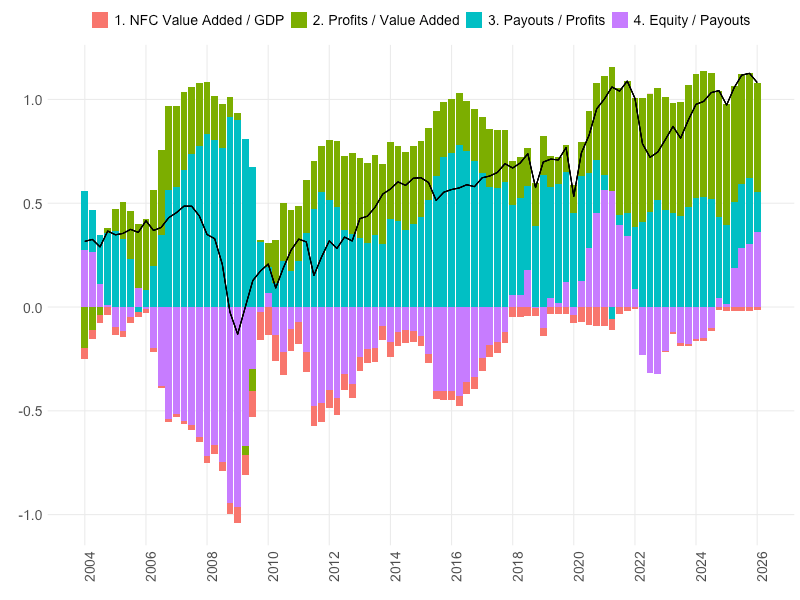
All of these series (except the last one) are combined in the next figure, which is really the whole point of this post. If you take one thing from one I’ve written here, this picture is it.
Equity value relative to GDP and its components, 1947-2026:
For this figure, I’ve converted the values to logs. This has the big advantage of converting the multiplicative relationship to an additive one, so that we can visually see the contribution made by each of them. But it can make interpreting the figure a bit tricky. Here, zero is the average value over the full period; positive one is a value about 2.7 times greater than the average, while negative one is a value about one-third of the average. The black line similarly describes the deviation of the equity-GDP ratio from its full-period average; the heights of the bars correspond to the contribution each term makes to that deviation. The data is quarterly; for all the terms except equity, I use rolling one-year averages.
As we can see, the log of the equity-GDP ratio is currently about 1.1 above its long-run average, corresponding to a value nearly three times greater. (2.2 today, versus a long run average of 0.85.) Just over half of this (0.53) is explained by higher profits relative to value added, 0.19 is explained by higher payouts relative to profits, and 0.36 is explained by the valuation term.
So already we can see that a simple explanation of today’s high equity values is going to be incomplete. Relative to the long-run average, we have three distinct factors each of which explains a significant share of today’s higher values.
Another thing that jumps out from the figure is that the previous historical peaks in equity values reflect quite different mixes of these components.
In the 1960s, profits as a share of value added were, for a while, well above average, though not as high as today; but the fraction of those profits flowing out to shareholders was much lower. Thus the much lower ratio of equity to GDP, despite comparable valuation ratios.
In the late 1990s, profits as a share of value added were much lower — less than 5 percent at the height of the tech bubble, compared with 10 percent in the 1960s and 15 percent today. But the fraction of profits paid out to shareholders was historically high, averaging over 100 percent for the 1998-2000 period. It’s worth noting in this context, also, that the collapse of equity value in the 1970s reflected a fall in shareholder payouts much more than in profitability; this is perhaps important context for the shareholder revolt that followed.
The big takeaway from this decomposition is that we should be cautious about assuming the stock market is overvalued — that we’re in a bubble, that this is another bout of irrational exuberance — simply because equity prices are high relative to the historical norm. Shareholders have it better than the historical norm, too. Corporations are more profitable. And more of those profits are flowing out to them. A bit of exuberance might be rational, under the circumstances.
On the other hand: If we focus on just the past 20 years, as in the figure below, the picture looks a bit different.
Yes, both profits and payouts are high relative to their long-run averages; but those shifts mostly came earlier, while the big rise in equity prices is more recent.Apart from the relatively brief collapse in profits during the Great Recession, almost all the variation in equity prices over the past two decades comes from the valuation term, rather than changes in the underlying payments to shareholders.
This is even more true over the past two years — equity values have increased sharply while profits have been stable and aggregate payments to shareholders have fallen, as dividend growth has stalled and net equity issue has turned positive.As a share of GDP, the net payments flowing from corporations to shareholders today are very close to where they were a decade ago; but corporate equity is worth 60 percent more. It’s hard to avoid the conclusion that either equity was undervalued in the mid-2010s, or it is overvalued now.
So which side do we focus on? Over the long run, most — tho not all — of the increase in the value of wealth in the form of corporate equity, is explained by what we might call fundamentals — the flow of payments to owners of that wealth. Over the short to medium run, on the other hand, almost all of the increase in the value of equity comes from valuation, and whatever financial-market dynamics drive that. Or as the old saying goes, in the short run the market is a voting machine, but in the long run it’s a weighing machine.
*
I want to say a bit more about the profits and payouts parts of the picture.
That high stock prices reflect to some extent a high level of corporate profits seems to be reasonably well understood, at least based on recent coverage in the Financial Times. This of course does not mean that high stock prices are justified, or sustainable; it just shifts the question to how justified or sustainable the high profits are.
This goes double to the extent that high valuations are based on an expectation of further increases in profits, as this recent FT piece suggests:
Wall Street’s expectations for company profit growth are rising at the fastest pace since the post-pandemic rebound, fuelling concern that an “earnings bubble” could be forming in the estimates that have underpinned the US stock market’s rally.
Analysts are now forecasting a 25 per cent increase in S&P 500 company earnings for the coming year, according to Bloomberg data, boosted by a resilient US economy and the AI boom.
However, just ahead of the second-quarter earnings season, some investors are growing concerned about the speed at which analysts’ estimates are rising…
This Alphaville piece goes further, saying that “supernormal profits are unsustainable, because they always are.” I don’t know about that. I don’t know if there’s any reason to think the profit share is stationary, to use the statistics jargon — apart from a dip in 2008-2009, profits as a share of value added have been greater than their long-run average in every year of this century, and seem to be getting farther from it. Capital really has won some lasting victories in the class war.
That is one natural way to look at profits — as a distributional variable. But there’s another way of looking at them, from the demand side.
We know, as readers of Keynes, that an increase in investment automatically creates an equal quantity of additional saving. If, furthermore, there’s little or no incremental saving out of wage income (a reasonable assumption, in my opinion) and if the fiscal balance and trade balance don’t change significantly (perhaps less reasonable, but we’ll go with it) then this additional saving must take the form of an increase in profits. This relationship is often known as the Kalecki-Levy profits identity, and is one bit of heterodox economics that has established a foothold in finance and the businesspress. The same identity says that an increase in the fiscal deficit or trade surplus should similarly lead to an equal increase in aggregate profits.
Exploring the math of this and the extent to which it is a reasonable first approximation of real-world dynamics would be an interesting exercise for another post. But it raises another point which I think is very relevant for thinking about the current situation: Even if the AI companies themselves are not particularly (or at all) profitable, AI-related investment spending is probably an important factor in raising aggregate profits. Just like the California gold rush generated plenty of profits for somebody, even if the vast majority of prospectors themselves went broke.
Or as this recent FT piece puts it:
The AI boom is lifting the fortunes of hundreds of formerly drab industrial, utility and mining companies as investors turn to the “picks and shovels” needed to build and power vast data centres. …
The companies benefiting include Caterpillar, best known for construction equipment but now supplying generators for data centres, 150-year-old German engineering company Hochtief, which will enter the Dax later this month, and Nucor, a steel supplier that has credited “white hot” AI demand for a “tsunami of earnings power”. …
The vast amounts of electricity needed for AI training are also fuelling demand for specialised power management, high-voltage electronics and cooling technologies. This has led to big interest in traditional suppliers of electrical equipment…
You could think of it like this: As long as there is strong investment demand and easy financing for it, the profits will be there …. but not necessarily for the companies carrying out the investment and getting the financing.
And this, perhaps, is the point where the macro perspective needs to give way to the micro one. Because it may be that, yes, in the aggregate, an ease in financing brings forth additional investment, which generates enough profits to justify the initial financing. But debt must be paid back not in the aggregate, but by the specific companies that incurred it. If the investment is one place and the profits are somewhere else, then at some point somebody’s survival constraint is going to be violated.
And I think I will end this post here.
I very much want to discuss the payouts piece of the equation, which in my mind is as important as profits, and much less discussed. But this post is already too long, and has taken much too long to write. So the payouts piece should be along, well, if not this month, then next month, or soon.
This is the edited transcript of a talk I delivered on March 5 at the Heilbroner Center for the Study of Capitalism at the New School for Social Research in New York, at the invitation of Julia Ott. The talk is an attempt to explain what Against Money (my forthcoming book with Arjun Jayadev) is about, and why it matters. Earlier attempts can be found here and here. You can listen to the full recording of this talk, including some quite interesting questions from the audience, here:
Since we are at the Heilbroner Center, I thought I would begin with Robert Heilbroner.
Heilbroner is best known for his book, The Worldly Philosophers, a popular history of economic thought. There’s an interesting discussion in the introduction to later editions of the book about his struggle to come up with a title for it.
He did not want a title that included the word economist — he understood that a book about economists would have, at best, limited appeal. His initial thought was to call it “The Money Philosophers.” But after considering that, he decided that it didn’t really fit his subjects, because, money, for the most part, was not a major concern for them.
I think he was right to have those misgivings, and to instead choose the title he did. Because money, perhaps surprisingly, plays a rather small part in the history of economic thought.
The dominant view on money among economists, which you can find in almost unchanged from the 18th century down to any contemporary textbook, is that money is neutral. There is a real economy, a concrete existing world of labor, of technology, of human needs and of resources that can meet them, which all exists prior to and independently of money. It’s in this real world that relative values are established, and where the possibilities for production exist prior to any sort of measurement in terms of money. Things would be exchanged in the same proportions in the absence of money, or with any other difference form or quantity of money. Money is at best a numeraire,a mild convenience to help us describe relative values and simplify exchange that would happen on essentially the same terms without it.
Going back to 1752, we find David Hume writing:
Money is nothing but the representation of labour and commodities, and serves only as a method of rating or estimating them. Where coin is in greater plenty; as a greater quantity of it is required to represent the same quantity of goods; it can have no effect, either good or bad…
What we have here is the idea, first, that there is a quantity of goods already existing in the world before we measure it or rate it with money, and second, that the use of money to coordinate the exchange of goods, to measure the quantity of goods, has no effect on that quantity, either good or bad.
Now Hume himself went on to complicate this argument in interesting ways. But for many economists down to the present, this is where the story stops.
Variations on this are the central throughline in economic thought around money. Coming down to our century, we find Lawrence Meyer, who was recently a member of the Fed’s Federal Open Market Committee, saying,
Monetary policy cannot influence real variables, such as output and employment. This is often referred to as the principle of neutrality of money. Money growth is solely the determinant of inflation in the long run. Price stability, in some form, is the direct, unequivocal, and singular long-term objective of monetary policy.
Again we see the same notion that control over money or credit cannot affect real outcomes, such as output or employment. At most, it can affect the measurement of those outcomes in terms of prices, that is, inflation.
I could multiply many similar quotes from the centuries in between these two. The great exceptionis, of course, Keynes.
If you got an economics education in the Keynesian tradition, as Arjun Jayadev and I did at the University of Massachusetts, then you probably spent a great deal of time thinking about money. You might even have imagined yourself as a money philosopher, or on the path to being one, or at least you were interested in what the money philosophers had to say. And you will have seen, more or less clearly, that there’s an important connection between the organization of money, the form of money, and real outcomes in the economy.
As Keynes himself put it in a 1932 article, which was arguably the opening salvo of the Keynesian revolution, the theory he was looking for was
a theory of an economy in which money plays a part of its own and affects motives and decisions and is one of the operative factors in the situation so that the course of events cannot be predicted, either in the long period or in the short, without a knowledge of the behavior of money.
The Keynesian vision is one where the operation of money is central in driving real outcomes, that money plays an active organizing role in the economy, and that one can’t understand real outcomes without an understanding of money.
Of course, Keynes was not by any means the first person to think this way, to think that the world of money and the concrete organization of production cannot be separated. There’s a kind of samizdat tradition, “the army of cranks and brave heretics” that Keynes acknowledges as his predecessors, who have made similar arguments.
One very interesting early figure in this tradition is John Law. John Law is remembered today as a sort of con artist, or as an early example of the dangers of trying to manipulate real outcomes by the use of money, because of his proposals adopted by the French government to set up a bank that would issue paper currency backed by land in the New World and other proposals for financial reform, and for what we might even today call industrial policy.
These proposals were not successful. Their failure contributed to the problems of the French monarchy in the 18th century. But the interesting thing about him is that he was not just a monetary reformer, that he was a genuine theorist. Joseph Schumpeter even puts him in “the front rank of monetary theorists of all time.”
Law’s proposals were motivated by a vision of money, as he put it, as not being merely “the value that is exchanged” but “the value in exchange” — the activity that happens through the use of money creates new value that does not exist prior to it. Coming from a background in Scotland, he writes about a situation where there is both vacant land and idle labor. They can’t be put together, they can’t be used productively, in the absence of money — to provide coordination, as we would say today.
The existence of coordination problems, creates the possibility that money is not just a yardstick for exchanges that would have happened regardless, but opens up new possibilities for cooperation — that there can be new value created by money that did not exist in the world prior to it. This is the opposite of the argument made by Hume and others and in principle opens up the possibility of creating real wealth, of transforming the real world through the manipulation of money.
We can trace a line forward from Law to Alexander Hamilton, a more successful advocate for financial reform in the context of a program of national development. Hamilton is not usually thought of as an economic theorist, but his writing in the “Report on Manufactures” and other proposals for developing American industry drew importantly on a vision of a more elastic and flexible monetary system.
Interestingly, one suggestion that Hamilton made for increasing the supply of “monied Capital” was for the federal government to permanently maintain a large debt. Anticipating contemporary heterodox economists, he argued that rather than crowding out private investment, federal borrowing would in effect crowd it in, because government debt was a close substitute for money — a source rather than a use of liquidity, as we might say.
We can follow this line on to Henry Thornton and the anti-bullionists in the early 19th century, who saw a flexible system of bank money as better suited than a rigid gold standard for promoting real economic activity. And then on to Thomas Tooke, who Karl Marx considered “the last English economist of any value,” and toWalter Bagehot and American monetary economists like Allyn Young, and then on to Schumpeter and of course Keynes himself and his successors.
What do these heterodox thinkers on money have in common?
From our point of view, first, they all see money not as a distinct object existing in a definite quantity, but as one end of a continuum of financial instruments or arrangements. They see money as a subset of credit. Schumpeter says that when thinking about money we “should not start from the coin,” we should not start from the discrete object that we call money. Rather we should, as all of these thinkers did to one degree or another, imagine a whole system of credit arrangements, some of which can be classified for various purposes as money. He distinguishes a “money theory of credit,” which most economists hold, from a “credit theory of money,” which is what he prefers. The starting point, the atomic unit, is the promise, not the exchange.
Second, and this is a central theme of our book, these thinkers all saw the interest rate as the price of money, rather than the price of savings. An important part of John Law’s argument for his financial reforms was that it would allow a lower rate of interest by making money more abundant. Walter Bagehot insisted that interest was the price of money, not of saving as orthodoxy has it.
The liquidity theory of interest is arguably the analytic keystone of Keynes’ General Theory. This question of whether the interest rate represents a real constraint, a trade-off between stuff today and stuff tomorrow, the price of savings or loanable funds, versus whether it is a fundamentally financial price set in financial markets as the price of money or liquidity, is athrough line in debates over money.
More broadly, there is the idea of money as a facilitator or enabler of economic activity, as a vehicle for transformation of the real world, versus the idea of money as a passive measuring rod or numeraire. Connected with this is the idea that money requires some form of active management. The orthodox view of money, along with seeing it as fundamentally or at least ideally neutral, has always looked for some kind of automatic rule to regulate credit and money.
Going back to Hume again at the beginning of this tradition, he at some points argued that banks should not exist. He wrote that the best bank would be one that took coins and kept them locked up until their owner came back for them, without creating credit in any form.
That is the extreme version of this position, but in less extreme forms there’s a constant attraction to the idea that bank credit should reproduce some natural logic of exchange, and not have any independent effect on economic activity. We can see it in the 19th century in the form of the real bills doctrine and of the gold standard — two different approaches to creating an automatic mechanism for regulating the creation of money and credit. Later in the century there were ideas of strictly capping the amount of paper money that could be produced, or separating the lending and payments functions of banks — an idea that constantly recurs in right-wing ideas for monetary reform. Behind this there was often the idea of an “ideal circulation,” where whatever the concrete form that money took, it should mimic the behavior of a pure metallic currency.
Then in the 20th century we get Milton Friedman’s idea that central banks should follow a strict money supply growth rule — an updated version of the cap on banknote issuance imposed on the Bank of England in the 1840s. And more recently we have the Taylor rule and similar rules that are supposed to guide the behavior of central banks. Some right-wing legislators have even proposed writing the Taylor rule into law, so the Federal Reserve would no longer have any choice about monetary policy.
What all these rules have in common is the idea that there is some kind of autopilot that you can put the management of money and credit on, so that it no longer involves any active choices, public or private — so that money will manage itself.
This goes with the idea that even if money is not always neutral in practice, that it ought to be neutral. It goes with the the idea that there is some set of natural outcomes dictated by the real material choices facing us, by the problem of scarce means and alternative ends that Lionel Robbins defined as the problem of economics, that there is an objective best solution to the trade-offs facing us as a society —and if money is telling us to do something else or allowing us to do something else, that is a problem. We need to make money automatic so that we can return to this genuine non-monetary set of trade-offs that we are trying to solve.
In other words, when we think of money as neutral, that implies a specific kind of views about social reality in general. If we think of money as a transparent window onto a pre-existing world of goods, a pre-existing set of relative values, a pre-existing set of opportunities and resources facing us,then we are going to see the world itself as fundamentally money-like. We are going to see the existence of prices, the division of social reality into discrete commodities with ownership rights attached to them, as a basic fact about the world, which money is simply revealing to us.
When we see money as a distinct institution, as a distinct social technology of coordination, then we can see the rest of the world as being different from that. We can see all the ways in which the process of production, all the ways we organize our society are different from what happens in markets and different from what is mediated by money. We can see the world not as a set of existing commodities that need to be allocated to their best use to satisfy human needs but as an open-ended collective project of transforming the material world.
This second view is what Keynes called the monetary production paradigm.
In the 1932 article that I earlier suggested could mark the beginning of the Keynesian revolution, Keynes distinguished a real exchange view of the economy from a monetary production view. The real exchange view he associated with the traditional view of money as neutral — it’s a vision of a world in which fundamentally the economic problem is barter. So for instance Paul Samuelson’s famous textbook, the most influential economics textbook of the 20th century, says that we can reduce essentially all economic problems to problems of barter.
In this world, the economic process is fundamentally about exchanging real things. Production is just a special case of exchange. You put in yourcapital, I put in my labor, we get a definite amount of output out that we divide in proportion to what we put in, on terms that we all knew and agreed on in advance.
The real exchange view of production was perfectly expressed by Keynes’ Swedish contemporary Knut Wicksell, the originator ofthe modern approach to monetary policy. He described economic growth as being like wine aging in barrels. We’d like to drink the wine today, because that would be nice; but on the other hand if we leave it to age in the barrel for longer it will improve in quality. The wine is already there, we know how much there is and how much better it will be next year. All the possibilities are defined in advance. We just have to decide what pace of drinking it will bring us the most pleasure.
A monetary production view of the world, on the other hand, is one in which the economic process is a one of collectively transforming the world. This is an active process that structured and mediated by money, and organized around the accumulation of money.In this view of the world, production is a cooperative human activity whose possibilities are not knowable in advance.
In this monetary-production paradigm, the fundamental constraint is not scarcity; the economic problem is not allocation. The fundamental constraint is coordination. When we stop imagining the world in terms of discrete commodities being combined in different ways, and start imagining it in terms of human beings cooperating (or not) to do things together,the problem becomes: How do we coordinate the activity of all these different people? What does it take to allow cooperation on a larger scale, between people who don’t have pre-existing relationships?
That is the problem that economic life is seeking to solve. And in particular, we argue, it is the problem that money helps solve. By its nature, this is not a problem that we can know where the opportunities are in advance. This uncertainty about the possibilities of the future is a fundamental component of Keynes’ vision, and is linked to the centrality that money has in his vision.
So far all of this has been pretty abstract. Let’s turn now to some of the implications of these questions for the real world. Because, after all, these debates are only interesting insofar as they help us become masters of the happenings of real life. They’re interesting insofar as they give us some ability to intervene in the world around us. The reason that Arjun and I wrote this book is that we came to feel that many of the concrete problems that we were interested in, and that other people are interested in, require a different view of money to make sense of them.
Let me give an example. The two of us wrote a number of papers some years ago, which were in some ways the starting point of this book, about the rise in household debt between 1980 and 2007. Between 1980 and 2007, household debt in the United States rose from roughly 50 percent of GDP to 100 percent of GDP. This was something you were very aware of if you were beginning your life as an economist in the 2000s, and it became even more interesting in the wake of the financial crisis of 2007–2009, which the rise in household debt seemed like one of the underlying causes of.
In general, when people talk about rising household debt they attribute it to rising household borrowing. Much of the time, people don’t even realize that those are two different things. There are articles where the title of the article is something like “explaining the rise in U.S. household debt” and then the first sentence of the article is, “why are U.S. households borrowing more than before?” Or even, “why are households saving less than before?” But these are different questions!
Of course it is true that insofar as someone borrows more money, their debt will rise; and if their income is unchanged their debt to income ratio will rise. This might in principle involve dis-saving, if the debt is financing increased consumption. In reality, though, it almost certainly doesn’t, since the great majority of debt is incurred to finance ownership of an asset.
Setting aside the dissaving claim — which is almost always wrong, though you hear it very often — it is true that an increase in borrowing implies an increase in debt. But your debt-income ratio can change for other reasons as well.
Think about two people who buy houses: If one person buys a larger house, or a house in a more expensive area, or if they make a smaller down payment, then they will certainly owe more money over time than the other person. But if one person buys a house when the prevailing interest rate is low and the other buys an identical house with an identical downpayment when interest rates are high, and they each devote an identical part of their income to paying their mortgage down, then over time the debt of the person who bought when interest rates were low will be lower than the debt of the person who bought when interest rates were high. If you are fortunate enough to buy a house with a low mortgage rate then over time your debt will be lower than somebody who wasn’t so fortunate.
This is even more true in the aggregate. If you see households devoting a certain share of their income to purchasing the services of homes that they live in that they own, those same payments are going to result in in more debt when interest rates are high and less debt when interest rates are low.
We also know that if you’re looking at a debt to income ratio, then as a ratio that has a denominator as well as a numerator. A more rapid increase in incomes — either what we call real incomes or incomes that rise because of inflation — will reduce that ratio of debt to income. And we know that if debt is written off, if the borrower defaults, then the debt ratio will also come down.
All of these are factors that influence the level of debt independent of what we think of as the real flows of expenditure and the income. So what Arjun and I did — which is very simple once you think of doing it — is take various periods of time and see how much of the change in debt income ratios over each period is due to changes in borrowing behavior and how much is due to these other factors. We called the other factors, the ones independent of current expenditure and income, Fisher dynamics, for Irving Fisher.
Fisher, incidentally, is an interesting figure in this context. On the one hand he was a very important advocate of this sort of neutral-money real-exchange vision we are criticizing. But he also in the 1930s wrote very persuasive account of the Great Depression in terms of financial factors — “The Debt Deflation Theory of Great Depressions” — where he explained the depth of the Depression by the fact that debt burdens rose even as borrowing fell, because prices and nominal incomes fell much faster than interest rates
Our point was that this dynamic is not unique to the Great Depression. Any time you have higher or lower inflation, or higher or lower interest rates, that is going to affect debt burdens exactly the way it did in the Depression. And what we found is that if you’re looking at this rise in household debt to income ratios between 1980 and 2007, essentially all of it is explained by these other factors, these Fisher dynamics, and none of it is explained by increased borrowing. If you compare the period of rising household debt after 1980 to the previous two decades of more or less constant debt-income ratios, people were actually borrowing more in the earlier period than in the later period.
The difference is that the interest rates facing households were much lower in the 1960s and 1970s than they were after the Volcker shock. The Volcker shock raised interest rates for households, and they stayed high for longer than the policy rate did. And during the 60s and 70s compared with the 1980 to 2007 period as a whole, inflation was significantly higher. (Real income growth was also a bit higher in the earlier period but that plays a smaller role.)
So what we have here is not a story about real behavior. It’s not a story about borrowing, about income and expenditure. All of these stories that we heard from both the left and the right about why household debt had risen — it’s because people have grown impatient, their time preferences shifted or they are competing over status or it’s inequality — none of this is relevant, because people were not in fact borrowing more.
Stepping back here, we can think of a set of monetary variables that scale up or scale down the weight of claims inherited from the past. Both interest rates and inflation function to change the value of claims in the form of debt inherited from the past, relative to incomes being generated today; and by the same token interest rates change the value of promises about future payment relative to incomes today. In an environment of abundant credit and low interest rates a promise about something you can deliver in the future, or an income you will receive in the future, is more valuable — it gives you a greater claim on income today. In an environment of low interest rates, what you will do, or can promise to do, in the future matters more; in an environment of high interest rates, and low inflation, what you did do in the past, the income you did receive, matters more.
This monetary rescaling of claims inherited from the past and claims generated by promises about the future, relative to income in the present — this is something that is constantly going on, in addition to whatever real activity people are carrying out. And many of the monetary outcomes that we’re interested in — like debt-income ratios — are fundamentally driven by this rescaling process and not by real activity.
So these historical changes in household debt are a concrete application of the larger perspective that we’re trying to develop in this book.
Another important application is the interest rate. How we think about the interest rate is central to a lot of the debates between different perspectives in economics, or maybe more precisely, it’s where the differences between them become visible, become unavoidable.
One way I think about it: Imagine trying to lay a flat map over globe. You can do itif your map is of just a little portion of the globe — we all know we have flat maps of various places that all exist on a sphere in reality, and they work okay.But if you try to put your flat map over the whole globe it’s not going to work — either you’re going to have to crumple it up somewhere or it’s going to rip somewhere. The interest rate then is one of the sites where the flat map of this vision of the economy as a process of market exchange rips, when we try to fit it over a world of active transformative production through human cooperation into an unknown future.
The way that you’re taught to think about the interest rate, if you get an economics education, is that it’s the price of savings, or loanable funds — it’s a trade-off between using the pot of resources that currently exist for consumption or for making the pot bigger in the future. We think, so much stuff was produced, some people have it, and if they don’t need it right now they can lend it to somebody else who’s going to use it to carry out production, which will mean more stuff in the future. In this view the interest rate is the price of consumption today in terms of consumption tomorrow.
Interest, in this view, is a fundamentally non-monetary phenomenon: It’s a question of the real trade-offs imposed by people’s material needs and the material production they’re capable of.
This is a long-standing view — we can go back 200 years to Nassau Senior describing interest and profit as the reward for abstinence. By “abstinence” he means the deferring of enjoyment. The term has a nice moralizing religious tone to it, but the fundamental point is that the interest rate is the return on consuming later rather than earlier. We can find exactly the same thing in, let’s say, Gregory Mankiw’s textbook today. To quote:
Saving and investment can be interpreted in terms of supply and demand. In this case, the ‘good’ is loanable funds, and its ‘price’ is the interest rate. Saving is the supply of loanable funds…Investment is the demand for loanable funds— investors borrow from the public directly by selling bonds or indirectly by borrowing from banks.
Here, again, we have a certain amount of stuff — it already exists— and you can either use it now, or defer your enjoyment of it by lending it to somebody else who will use it productively. One striking thing about Mankiw’s formulation is that he makes a point of saying that it’s a matter of indifference whether this happens through banks or not.
So in this vision, the interest rate is a trade-off between goods today and goods tomorrow, or goods used in consumption and goods used in production. But the fundamental problem, as soon as we start thinking about this in a real-world setting, is that it doesn’t seem to match up at all with the interest rate as we actually observe it.
One of the first things you learn if you get a Keynes-flavored economics education, but also something that anyone who deals with this stuff practically realizes, is that when you go to the bank to get a loan, the bank is not making that loan out of anybody’s savings. A bank makes a loan by creating two offsetting IOUs. There is the bank’s IOU you to you, which we call a deposit, and your IOU to the bank, which we call a loan. The deposit is newly created in the process of making the loan — it’s what used to be called fountain pen money, it’s ledger money, it consists of two offsetting entries in a ledger. Nobody’s savings are involved. Nobody else needs to defer their consumption to allow you and I to write IOUs to each other.
There’s a very nice explainer from the Bank of England on how banks create money which you can look up online, that lays this out very clearly. I assign it to my undergraduates every year. It’s not a secret that loans, in the real world, do not involve somebody taking some goods that they have in their possession and bringing them to some kind of central clearing house where somebody else can check out the goods to use in some production process. When you get a loan, you’re not receiving a bag of cash that someone else brought into the bank. You’re getting a deposit, which is just a record kept by the bank. Fundamentally, a loan is the creation out of thin air of two offsetting promises of money payment.
Now of course when you receive your promise from the bank — in other words, your deposit — you will normally use that to acquire title to some goods and services, or authority over somebody else’s labor. But the loan itself did not require anyone to have already decided to let you use those goods. It did not require anyone’s prior act of saving.
Of course anybody can write an IOU. You and I could sit down and write promises to each other, just as you and the bank do when you get a loan. The key thing about the bank, here, is that its promise is more credible than yours. If I ask for your bicycle and promise to give you something of equal value down the road, you probably won’t agree. But I can make that same promise to bank, and the bank can then make that promise to you. And that’s fine.
This is why Hyman Minsky, the great theorist of finance, said that the defining function of banks isnot intermediation, but acceptance. You can’t get a claim on labor, on real resources, simply by promising you’ll do something useful with them. But a bank might accept your promise, and then the promise that it makes to you in return can can be transferred on to other people in return for a claim on real resources, which you can use to create new forms of production that otherwise wouldn’t exist. And this is the other side of the Keynesian vision — the fact that banks can create money by lending allows for the reorganization of productive activity in new ways that wouldn’t be possible otherwise.
If you’re a business owner, say, you can now expand your business, because the bank’s promise is more credible than your promise. You as a business owner cannot hire workers simply by saying this business is going to be successful and I’ll give you a share in it — well,if you’re in Silicon Valley sometimes you can, but most businesses can’t. The bank’s promise is more credible — unlike yours, it will be accepted by workers as payment. You can use this loan created out of thin air to carry out new activities, to create things that did not exist before.
The problem for the orthodox view is that banks exist. Banks exist and, to anyone taking a naive look at capitalism, they seem rather important. Trading money claims is evidently pretty central to the way that we organize our activity.
Central banks also exist, and influence the terms on which banks make loans, even though they themselves don’t do any saving or investing. If you believe the story in the Mankiw textbook that the supply of savings is being traded against the demand for investment and that’s what determines the interest rate — well, a central bank is neither providing loanable funds nor is it using loanable funds for investment, and it doesn’t restrict the terms on which anyone is allowed to make private contracts. So how could it influence the price of loanable funds?
Wheres if we think of the interest rate as being a combination of the price of liquidity — flexibility — and a conventional price set in asset markets, then it is much easier to see the critical role of banks, and why central banks are able to influence it. This is something we spend a lot of time on in the book.
Now, once common way of reconciling the idea of a savings-determined “real” interest rate with the monetary interest rate we see in the real-world financial system is through the notion of a “natural interest rate”. This is the idea that, ok, there is here on Earth an interest rate that is set within the banking system that has to do with the terms on which promises of money payments are made. But there’s another interest rate that exists in some more abstract world, which we can’t see directly, but somehow corresponds to the way goods today trade off against goods tomorrow, or the way they would trade off if markets functioned perfectly. This second interest rate is what’s called the natural rate. The actual rate might not always follow it. But it should.
As an aside, I should say that this sort of transformation of a descriptive claim, that is supposed to be a statement about how things actually work, into a prescriptive claim about how things should work, is very common in economics.
We can find a very nice statement of this view from Milton Friedman on the natural rate of interest and its cousin the natural rate of unemployment, where he describes them as the rates that would be
ground out by the Walrasian system of general equilibrium equations, provided there is embedded in them the actual structural characteristics of the labor and commodity markets, including market imperfections, stochastic variability of demands and supplies, the cost of information about job vacancies and mobility, and so on.
In other words, if we could somehow make a perfect model of the economy, then we could calculate what the natural rate would be, and that’s the thing we should be trying to achieve with our policy influencing the interest rate. Obviously, as soon as you start thinking about it, this doesn’t make sense on multiple levels. But it’s a very attractive formulation precisely because it papers over this gap between a theoretical and ideological vision of interest that sees it as a real trade-off between the present and future, and the actual concrete reality of interest that is determined in financial markets on the basis of liquidity and convention.
So again, if you come more recently, you look at Jerome Powell talking about monetary policy in a changing economy, a speech he gave a few years ago. There he introduces the idea of r*, the natural rate of interest, by saying, “in conventional models of the economy, major economic quantities such as inflation, unemployment, and the growth rate fluctuate around values that are considered normal, natural, or desired.”
I think that’s a very nice illustration of the thinking here, because normal, natural, and desired are three different things, and this r* is conflating them all together.Which is it? Is it normal, as in typical or average? Is it natural? (What would it mean for an interest rate to be artificial?) Or is it desired? In fact, it’s whatever the central bank wants. But the slippage between these different concepts is essential to the function of ideas like the natural rate.
Think of the transmission in a car: You’ve got a clutch, because the engine is turning at one speed, and the wheels are turning at a different speed. If they just join up, you’re going to shatter your drive shaft. So you have two discs that can turn independently of each other, but also exert some force on each other, so you get a smooth connection between two systems that are behaving in different ways. In this case r* is the clutch between theory that’s going one way and the reality, which the central bank has to acknowledge is going in a different way. The ambiguity of the term is itself normal, natural, and desired.
So then Powell continues, these natural values are “operationalized as views on the longer-run normal values of the growth rate of GDP, the unemployment rate, and the federal funds rate, which depend on fundamental structural features of the economy.” Here again there is a conflation between the things that the central bank is trying to do, things that are the sort of normal, average, expected, long-run outcomes, and things that are in some sense determined by some set of non-monetary fundamentals independent of monetary activity. And again, you get a controlled slippage between these different concepts.
There’s another nice version of this from a group of economists associated with the European Central Bank. They say, at its most basic level, the interest rate is the price of time, the remuneration for postponing spending into the future. So this, again, this is Nassau Senior.
It’s abstinence. It’s the price of waiting for your enjoyment. So this sounds like something that should be purely non-monetary.
This is r*. And then the ECB economists say, “while unobservable, r* provides a useful guidepost for monetary policy as it captures the level of interest rates which monetary policy can be considered neutral.”
I just love the idea of an unobservable guidepost. It’s a perfect encapsulation of how the natural rate concept functions.
Because, of course, what’s really going on here is the central bank sets the interest rate at a level that they think will achieve their macroeconomic objectives, whatever they are. Inflation is too high. We need a higher interest rate. Unemployment is too high. We need a lower interest rate. Maybe we’re concerned about the exchange rate. Maybe we’re concerned about the state of financial markets. Whatever they’re most worried about, they choose an interest rate that they hope will help.
And then after the fact, they can say, well, we wrote down a model in which this would be the interest rate, so therefore it is the natural interest rate. There’s no genuine content there — r* and the associated models are just a way of describing whatever you’re doing as conforming to a natural outcome that is dictated by the fundamentals out of your control, as opposed to a conscious political choice that prioritizes some outcomes above others. This sort of ideological construct is fundamental in depoliticizing one of the main sites of economic management in modern economies.
And this is an important part of the story that we’re trying to tell in this book. The problem, if you believe in a more egalitarian, democratic, or socialist vision of the economy, is not simply, is not even mainly, that right now the world is organized through markets, and we’re going to have to come up with some better economic system to replace markets. The reality is the world is not primarily organized through markets. What we have, very often, are imaginary market outcomes being claimed as the unobservable guideposts so that people with authority claim to be following them. We have an ideological system that allows processes of power and planning to present themselves as somehow representing or standing in for market outcomes.
Another area where I think this comes through very clearly is in the history of the corporation. We wrote a lot on this which we were, unfortunately, not able to fit into this book — it will be in another book. But it’s a good illustration of the larger vision we are trying to develop.
If you look at the way people talk about our economy, almost across the political spectrum, they will describe it as a market economy. We have all kinds of outcomes that are dictated by markets, decisions about production are guided by prices, the economy is organized through market exchange.
And, at least among economists, the way we talk about production implicitly treats it as just a special kind of market.
This is certainly the way economic textbooks approach production. We talk about labor markets, and capital markets. We imagine production as a process where someone purchases a certain amount of labor and a certain amount of capital, puts them in a pot, and gets a certain amount of salable output at the other end.
But when you look at how corporations work, it’s very clear that they are not organized as markets. They’re not internally structured through money payments — yes, of course, workers have to paid a wage to show up, but once they are there there isn’t some kind of market for their services. The boss just tells them what to do. Nor are corporations organized internally around the pursuit of profit, though that obviously guides how they relate to the outside world.
Now, historically, we can find cases of businesses whose internal structures are more market-like. Some of the first large corporations were organized through what were called inside contractors. You would you hire a skilled craftsman, artisan, who comes and works in the physical space, but is responsible for hiring their own assistants, buying their own materials, working them up and then selling them on tothe next inside contractor.
That turned out to be not a very good of organizing a corporation, even when they were they producing the sort of thing — clothing, say — that could in principle be made by independent artisans. It didn’t work at all for large-scale industrial production. It’s obviously not the way corporations are organized today. We would argue that a central through-line of the history of the corporation is a fundamental conflict between the organization of production in large-scale, ongoing, socially embedded forms, and the logic of money and markets that surrounds them, and that the claims upon them by wealth holders continue to be exercised through.
If we go back to what many people would consider the first modern corporation, the East India Corporation, we find right at its beginning the first conflict between shareholders and managers. The original structure had been a kind of pooling of resources between a number of independent merchants for joint operations in the East for 20 years, after which they would sell any remaining assets, divide up the profits, and dissolve the corporation. That was the legal form.
But the East India Corporation turned out to be very successful at its mix of trade and piracy. People have argued that this hybrid of trade and warfare was really Europe’s specialty, the one thing it did better than the rest of the Old World. In any case, East India Company was very successful at it. But — and this is the key thing — it required a big investment in forts, soldiers, local political alliances. Things that can’t just be sold off and divided among the partners.
So after 20 years, this is a very successful enterprise, and the people running it would like to keep operating it and believe they can do so profitably. And now the shareholders are saying, it’s time to divide everything up. But of course, if you sell off the forts and so on, they’re no longer of any value. And so there was a long conflict —legal, political —that ended with the managers winning, the shareholders losing, and the corporation being allowed to continue operating.
Losing the legal fight turned out to be good news for the shareholders. The companycontinued paying out large dividends. It never once raised any funds in the stock market. It continued operating and paying dividends for hundreds of years out of its own profits.
There are two interesting things about this story, to me.
First of all, right from the beginning, we have a conflict between an ongoing process of production which has real material benefits, and the claims by the elite against that process, which they would like to exercise in the form of money. If you operate forts and you have ships and you have your local allies, then you can carry out trading and trading-slash-piracy activities that you can’t do without those things. But once you’ve laid out money to build a fort, you own a fort. It remains a fort. You can’t turn it back into money. And you, as a wealth owner, put your money out to get more money. You don’t want to be master of a fort. You want a liquid financial claim that you can trade.
The other point is that the financial side of the operation is not about pooling money. It’s not about raising capital.
The East India Company, again, continues having shareholders, continues paying dividends in order to satisfy their claims, despite never raising funds from the stock market over the next 200 years of their existence. Whatever the stock market is doing here, it’s not a system for getting real resources into the corporation.
We can find this same principle down through the history of the corporation. When in the beginning of the 20th century we see the generalization of the corporate form, it’s not a process where large-scale investment required raising more funds. The problem that the corporation is solving is that you have large-scale enterprises with long-lived specialized fixed assets, on the one hand, and wealth owners, on the other hand, with claims on those enterprises — often the owners of smaller enterprises that merge into one larger one, or the heirs of the founder — who don’t want an interest in this particular company. They want money. And so the function of the corporate form is to allow the conversion of ownership rights into money — to enable payments that will satisfy these claimants, so that their authority over the production process can be pooled, their smaller interests can be assembled into a larger whole.
This is not a system for raising funds for investment. It’s a system for consolidating authority. It’s a system for reconciling the need for large-scale, long-lived organizational production, on the one hand, with the desire of the wealthy to hold their wealth in a more money-like form, on the other. As William Lazonick says, the corporation is not a vehicle for raising funds for investment, it’s a vehicle for distributing money to the wealthy. The origin of the corporation as we know it is as a vehicle for moving funds out of productive enterprises to asset-owners.
We can see this same conflict in the shareholder revolution of the 1980s, where people like Michael Jensen argued that the existing managers of corporations were too focused on the survival and growth of the enterprise as such. Managers were too interested in the particular productive process that they were stewards of, as opposed to generating money payments to shareholders, to finance.
What we see again and again is thatproduction depends on ongoing relationships — many of them, obviously, hierarchical, others based around cooperation, or on what David Graeber calls baseline communism, or on people’s intrinsic motivation to do their work well. But not on arm’s-length market relationships.
Our argument is that, yes, under capitalism, money expands itself by being committed to production. But there is a fundamental conflict between the logic of production and the logic of money.
Through the whole history of capitalism we have this conflict. Owners of money want more money. So they commit their money — their claim on society — to some particular enterprise, which they hope will return more money to them in the future. But in the meantime, the participants in that enterprise want to operate it, expand it, according to its own particular logic. Almost everyone here has probably encountered Marx’s formula M-C-P-C-M’. But the point that Arjun and I are trying to call attention to, is, how, or whether, C’ turns back into M’ is a tricky political question.
From the point of view ofparticular enterprise, the conversion back to money appears as a kind of imposition, a demand from outside. The enterprise can reproduce itself on its own terms with a claim on certain use values for which it produces other use values in return.
Where money is necessary — this is important — is where something new is being done, where there’s a need to organize production in some new way, for coordination between strangers who don’t have a relationship with each other. Money is genuinely productive insofar as the development of our productive capacity requires breaking up existing ways of organizing production, dissolving existing relationships, extinguishing obligations, and starting from square one.
Money should be seen as a specific kind of technology of social coordination. It’s a way of organizing human activity in new ways that it hasn’t been organized before.
One way to think of this is of money as a sort of catalyst. On the one hand, it acts as a social solvent. It breaks up existing relationships, as Marx and Engels famously described in the Communist Manifesto — “all that solid melts into air”. It replaces social ties with the callous cash nexus.
We can all thinkof examples of this. Money is a way of erasing relationships. A money payment replaces some ongoing connection between people. It takes an existing obligation and it extinguishes it. Money is a tool for breaking social ties, for replacing production that’s organized through ties of affinity, of affection, of kinship, of obligation, with arms-length cooperation between strangers, who could walk away from each other and never see each other again. Money says, we are done, we are settled, we owe nothing more to each other.
But that is only the first step. Because after we have broken up these smaller social molecules, these smaller-scale structures of production, after we have broken up the organization of production through a family, a village, a guild, that is not the end of the story.
Money facilitates cooperation among strangers, and it makes strangers out of family and friends. But people do not remain strangers. People who are engaged in cooperative activity of whatever kind form new social ties and new connections. This is partly because, organically, human beings connect to each other, and partly because the activity of production requires it.
Production requires cooperation beyond what you can get through arms-length transactions. It requires intrinsic motivation, it requires trust, it requires people’s desire to do their job well and their loyalty to other people. And it requires, at least in our society, command and hierarchy, which in turn requires some form of legitimacy. People have to know who can give what commands.
All of that involves the creation of social relationships. You can see money as a moment, in which older, smaller-scale forms of cooperation are broken up, creating the possibility for the reassembly of their components into larger forms of cooperation, larger-scale cooperation. The organization of society through money is a temporary stopping point.
What’s interesting is that if you go back to thelate 19th century, the early 20th century, this was something many people perceived as almost inevitable. If you read the next-to-last chapter of Capital,Marx’s vision is essentially this: Having broken up the older forms of small-scale property and small-scale production and reassembled human activity in the form of large-scale cooperation, an extensive division of labor, production based on conscious scientific knowledge — after all that,it will be, he says, “infinitely less violent” to replace that with socialism than it was to break up all of those smaller structures earlier. Does Marx say that we’ll just look out the window one day and say, oh, hey, it’s socialism? No. But it’s not that far off.
Or similarly, you can find Keynes writing in the 1920s saying that the most striking fact about the world that he sees around him is the tendency of large enterprises to socialize themselves. Corporations, having been established to carry out some particular purpose, to produce some concrete use value, becomes oriented towards the production of that use value. They cease to be oriented towards producing profits for their shareholders.
This is, in some sense, the same story that shareholder advocates like Michael Jensen toldin the 70s and 80s. Except that they saw it not as the march of history, but as a problem to be overcome. And this is the point that we come back to in our book. In practice, productive activity is overwhelmingly organized in non-market ways. But acknowledgment of this fact is profoundly threatening to elites, whose claim on society is expressed in terms of money.
This is the point. We don’t see how much of our life is already organized in non-market ways.
We all of us in this room came here for non-market reasons. None of us was paid to be here. None of us came here because a market signal told us to.
There are, obviously, payments that organize the operation of this building. But there is also an activity taking place in this room, in this building, that is not a market outcome, that is not organized through money payments, that doesn’t produce or respond to price changes.
Education is an activity that is particularly resistant to organization through markets and money payments and the pursuit of profit. But it’s not unique. Many of us came here on the MTA, an institution that was set up originally according to the logic of markets and money payments. But that didn’t work for running a transit system. The MTA didn’t become public because of an ideological crusade to socialize it. It became public because it could not simultaneously fulfill its social function while still being operated profitably. So the state had to take it over.
What we see around us is that the organization of production in practice calls for non-market forms — money does not perform the coordinating role that it purports to. But what we also see is that the structures of hierarchy and authority in our society very often justify themselves and legitimate themselves as if they were forms of market coordination. Money and property rights become badges of authority that are worn by the people who in fact issue commands through systems of hierarchy and personal domination.
The great challenge that we face if we wish to transform this system is not that we need to find new ways of non-market coordination. It is to find ways of democratizing the forms of planning and hierarchy that exist. We do not have to ask, well, how do we organize production without markets? — because we already do.
The great challenge is the enormous resources of violence in the hands of money owners,and their willingness to see the existing organization of collective action wrecked rather than allowing it to socialize itself, no matter how strongly the actual needs of production point in that direction.
The problem — the fundamental problem,at this moment it feels clearer than ever — is how to overcome the enormous powers of coercion and violence in the hands of those whose status and authority is expressed through money.
Elon Musk’s pending purchase of Twitter is an occasion for thinking, again, about what function stock markets perform in modern capitalism.
The original form of wealth in a capitalist society is control over some production process. If you become a wealthy capitalist, what this means at the outset is that you have authority over people engaged in some particular form of productive activity. Let’s say a group of people want to get together to make steel, or write some computer code, or serve a meal, or put on a play: The armed authority of the state says they cannot do it without your ok.
That property rights are fundamentally a legally enforceable veto over the activity of others is one of the first points you get from legal analysis of property. “The essence of private property is always the right to exclude.” What makes capitalist property distinct is that it is a right to exclude people specifically from carrying out some productive activity, and is linked in some way to the concrete means of production employed.
As a capitalist, you are attached to the production process you have property rights over.3 Now, you may be happy with this situation. You are a human person as well as a holder of property rights, and you may feel various kinds of personal affinity with this particular process. You may have some knowledge, or social ties, or other property claims that make this process a particularly suitable form for your wealth; or you may simply regard this as a more promising source of money income than the alternatives.
Then again, you may not be happy; you may not want to be attached to this particular process. There are risks associated with both an enterprise as a social organism, and with the kind of activity it is engaged in. (The steel mill may burn down, or be taken over by the workers; steel may be replaced by alternative materials or cheaper imports.) Ensuring that the process remains oriented both to its own particular ends and to producing an income for you requires active engagement on your part; you may be unsuited to carry this out, or just get tired of it. And even if your ownership rights generate a steady flow of income for you, the rights themselves cannot be easily converted into claims on some other part of the social product or process. (You can’t eat steel.) So you may wish to convert your claim on this particular production process into a claim on social production in general.
In the US context, this is especially likely at the point where the owner dies or retires. For Schumpeter, the ultimate ambition of business owners was “the foundation of an industrial dynasty”, “the most glamorous of .. bourgeois aims”. But in the US, at least, the glamor seems to have faded.4 Heirs may not be interested in running the business, or competent to do so. There may be several of them, or none. And a curiously persistent monarchical principle generally precludes looking outside the immediate family for a successor.
At some point, in any case, the holder of ownership rights over an enterprise will no longer be in a position to exercise them. At this point, the business might shut down. Before the modern corporation, this was the normal outcome:In early-modern England, “The death of the master baker … ordinarily meant the end of the bakery.” This will often still happen in the case of small businesses, where the value of the enterprise is tightly linked to the activity of the owner themself. This is fine when the productive capacity of the economy is widely dispersed in the brains of the individuals carrying out, and in tools that can be owned by them. But once production involves large organizations with an extensive division of labor, and means of production that are too lumpy for personal ownership, some means has to be found for the organization to continue existing when the individual who has held ownership rights over it is no longer willing or able to.
The stock market exists in order to allow ownership rights over particular production process to be converted into rights to the social product in general.
This is true historically. In the great wave of mergers in the 1890s that established the publicly-owned corporation as the dominant legal form for large industrial enterprises in the US, raising funds for investment was not a factor. As Naomi Lamoreaux notes, in a passage I’ve quoted before, “access to capital is not mentioned”in contemporary accounts of the merger wave. And in the hearings by the U.S. Industrial Commission on the mergers, “None of the manufacturers mentioned access to capital markets as a reason for consolidation.” The firms involved in the first mergers were normally ones where the founder had died or retired, leaving it to heirs “who often were interested only in receiving income.” The problem the creation of the publicly-traded corporation was meant to solve was not how to turn widely dispersed claims not he social product in general into claims on means of production to be used in this particular enterprise, but just the opposite: How to turn claims on these particular means of production into claims on the social product in general.
The same goes for today. We already have institutions that allow claims on the social product to be exercised by entrepreneurs on the basis of their plans for generating profits in the future. These include banks and, in favored sectors, venture capitalist funds, but not the stock market. The stock market isn’t there for the enterprise, but those with ownership claims on it.
The purpose of a stock offering is to allow those who already hold claims against the enterprise (early investors, and perhaps also favored employees) to swap them out for general financial wealth. This is why IPO “pops” — immediate price rises from the offering price — are considered a good thing, even though, logically, they mean the company raised less money than it could have. The pop makes the stock more attractive to the investors who will be buying out the insiders’ stakes down the road. The IPO is for the owners, not for the company. Or as Matt Levine puts it, “the price of the IPO is less important than the insiders’ ability to sell stock at good prices in the future.”
As I’ve argued before, converting the surplus generated within the firm into claims on the social product in generalis fundamental to the capitalist process as production itself. It’s also an integral part of capitalist common sense. As any guide for budding entrepreneurs will remind you, “It’s not enough to build a business worth a fortune. You also need a way to get your money back.”
Now, in principle this goal could be achieved in other ways. Money itself is a claim on general social product — that is one definition of it. When Antonio’s ships are safely come to road, his venture is concluded and his whole estate is available to meet his obligations. This is sufficient for merchant capital in early-modern Venice – its self-liquidating character means that no additional mechanisms are needed to turn claims on concrete commodities back into money.
Ongoing enterprises cannot be liquidated so easily. And money is liable to delink from productive economy over longer periods – what one wants is something with the safety, liquidity and non-need for management of money, but which maintains a proportionate claim on the overall surplus. Government bonds are an obvious choice here. They offer a claim on productive activity in general, or at least that part of it which is subject to taxation.
This possibility is worth pausing over. Historically, this was one of the most important ways for holders of claims against particular production processes to turn them into claims against society in general. The “rent” in rentier refers originally to the interest on a government bond. Government bonds as alternative to stock ownership also calls attention to the fundamentally political character of this transaction. For the capitalist to be able to give up their direct control over a production process in return for a proportionate share of the overall social product, someone else needs to oversee the collection of the surplus. And that someone needs to be accountable to wealth owners in general. There is an important affinity between finance and the state here.
Alternatively, partnership structures allow for the human owners to turn over while ownership as such remains tied to the particular enterprise. 5 Universal owners are another route. If Morningstar or Blackstone owns all the corporations, it’s redundant for them to do so in the form of stock. They could just own them directly. Many startups today have their liquidity moment not by issuing stock but being bought by a larger competitor. One could imagine a world where a startup that is successful enough is bought up by a universal index-slash-private equity fund, without the intermediate step of issuing stock.
Another possibility, of course, would be for the founder to give up their ownership rights and the company then just not to have owners. Wikipedia is a thing that exists; Twitter could, in principle, have a similar structure. I admit, I can’t think of many similar examples. When Keynes talked about corporations “socializing themselves”, this didn’t entail a change in legal structure; the shareholders continued to exist, but just were increasingly irrelevant. Plenty of rich people do leave some fraction of their wealth to self-governing charities of one sort or another, but this is their financial wealth, not the businesses themselves. The closest one gets, I suppose, is when someone leaves real estate to a conservation or community land trust.
Back in the real world, these other models of transition out of personal ownership are either nonexistent, or else confined to narrow niches. What we have is the stock market. Fundamentally, this is a way for owners of claims against production processes to pool them — to trade in their full ownership of a particular enterprise for a proportionate share of ownership in a broad group of enterprises. This was more transparent in the trust structures that preceded the development of publicly traded corporations, which were explicitly structured as a trade of direct ownership of a business for a share in a trust that would own all the participating businesses.6 But the logic of the public corporation is the same.
This is why shareholder protections are so critical. They’re often framed as protections for small retail investors. But the real problem they are addressing is mutual trust among owners. The pooling of claims works only if their holders can be reasonably confident that they’ll continue receiving their income even as they surrender control over production.
You’ll have noted that I keep using obtuse terms like “holders of property claims against the corporation” instead of the more straightforward “owners”. This is necessary when we are discussing shareholders. It is not the case, as more familiar language might imply, that shareholders “own” the corporation. One of my favorite discussions of this is an article by David Ciepley, which observes that many of the features of the corporation are impossible to create on the basis of private contracts. Limited liability, for example — there is no private contract a group of property owners can sign among themselves that will eliminate their liability to third parties for misuse of their property.
If we take a step back, it is obvious that the relationship of shareholders to the corporation is something other than ownership. Just think about the familiar phrase, separation of ownership from control — it is an oxymoron. What, after all, is ownership? The old books will tell you that it is a set of control rights — jus utendi, jus disponendi, and so on. Ownership without control is ownership without ownership.
The vacuity of shareholder “ownership” can be glossed over most of the time, but becomes salient in takeovers and governance questions in general.7Dividends and other payments can be subdivided arbitrarily, but decisions are discrete and control over them is unitary. Either Elon Musk buys Twitter, or he does not. Yes, there are votes, but someone still sets the terms of the vote, and 51% is as good as 100%.8 This is the contradiction that shareholder protections are meant to paper over. The publicly owned corporation allows business owners to pool their claims on the income of their respective companies. But it is not possible to share control over the businesses themselves. So the board – which actually does controls them — is instructed to act “as if” the shareholders did.
All of this is visible by contrast in Elon Musk’s purchase of Twitter, which reverses the usual logic of shareholding. He is trading in a claim on the general social product (or on Tesla, but it has to be cashed in first) into a claim on the specific activity organized via Twitter. He wants Twitter itself, not the stream of income it generates. He wants to turn his share of Twitter’s (so far nonexistent) profits into control over the substantive production process it is engaged in. Twitter for him is a source of use-value, not exchange-value. In this specific transaction, he is acting not as a capitalist but as a feudal lord. (Italics for a reason. One of the many mistakes we can make on these tricky questions is to treat terms like “capitalist” as if they described the essential nature of a person or organization, something that one either is or isn’t. Whereas they are ways of organizing human activity, which one can participate in in one context but not in another.)
The tension between the social production processes over which property claims are exercised, and the specific people who exercise them and the means by which they do so, is easy to lose sight of. It’s natural to abstract from these questions when you’re focused on other questions, like the conflict between capital — whoever exactly that may be — and the human beings who more directly embody labor. In Volume 1 of Capital, the capitalist is simply the personification of capital, and there are good exposition reasons for this.9
It’s in Volume 3 — truly the essential reading on this topic — that Marx directly takes on the conflation of social relations with concrete things. In a blistering passage in chapter 48 he attacks the identification of the real conditions of production with the incomes that are received from them, as if for example land — the natural world — existed only insofar as it is a source of rent for the landlord. This is “the complete mystification of the capitalist mode of production, the conversion of social relations into things, … It is an enchanted, perverted, topsy-turvy world, in which Monsieur le Capital and Madame la Terre do their ghost-walking as social characters and at the same time directly as mere things.” This mystification is alive and well in modern discussions of economics, where ownership of claims against a thing are constantly confused with being the thing. The ubiquitous language of payments to capital (or factor payments) is an obvious example, in which a payoffs to whatever private rights-holder you need permission from to use a machine, are imagined as payments to the machine itself.
This is not just a matter of verbal ambiguity. It leads to completely wrong conclusions when transactions involving ownership claims on something are confused with transactions involving the use of the thing. For example, you sometimes hear housing activists say that investor purchases will drive up the cost of housing. This sounds reasonable – but only because the word “housing” is being used in two different senses. Ownership of a house, and living in a house, are not competing uses, they exist on entirely separate levels. We may object for various reasons to ownership of homes by large investors rather than owner-occupiers or small landlords (or we may not). But this shift in ownership claims has no effect on the amount of space available for people to live in.
Coming back to the stock market, the confusion comes from mixing up transactions and institutions intended to shift ownership rights over the enterprise with solutions to the financing needs of the enterprise itself. The terms of the twitter deal seem to be: The bankers will get $2 billion per year, half from Musk, half from Twitter. Current Twitter shareholders get a one-time payment of $54 per share, which they may or may not be happy with.10 Twitter as an enterprise — and its employees and users — get nothing from the transaction at all. The company ends up owing $13 billion in additional debt, which finances nothing.
On one level, this is just what the stock market, and finance more generally, do: They change asset and liability positions around, without necessarily implying any changes in the substantive activities that those positions give rights over and which generate the incomes that go with them. As Perry Mehrling likes to point out, the biggest single transaction for most families is the purchase of a home, which doesn’t even show up in the national income and product accounts. But on another level, again, in the specific trade here — away from liquidity and general financial claims toward a more direct relationship with a particular production process — is the opposite of what the stock market usually facilities. Musks’s purchase of Twitter is, precisely, a form of de-financialization.
On some level I suppose all this is obvious. Everyone understands that this a transaction between various groups of holders of financial claims against Twitter — Musk, the board on behalf of the existing shareholders, the banks— to which Twitter-the-enterprise is not a party at all. But coverage tends to treat this as a problem only insofar as Twitter is special, the “digital town square”. In weighing the deal, the Timessniffs, the board “might as well have been talking about a tool-and-die manufacturer.” Any conflict between relations of production and relations of ownership is, evidently, only a problem when what is being produced are 280-character messages.
At this point, I suppose, I should denounce Elon Musk’s purchase of Twitter. But honestly, I’m not convinced it will make much difference one way or another.
For me personally, Twitter has been a good outlet.It connects me with journalists, political people, potential students, and other folks I want to communicate with more effectively than any other platform. It’s a gratifyingly horizontal — anyone who has something to say is on the same level. I’d be sorry if it no longer existed in its current form. But I’m not sure any of its good qualities come from who exactly exercises a claim on whatever profits it may generate.
Do you think that any of Twitter’s positive qualities emanate from the particular individuals who’ve owned it, or “owned” it? Jack Dorsey seems like kind of a nut; if the platform works, it’s in spite of him, not because of him. The current gaggle of suits on the board don’t see to have much hands-on involvement one way or another. The people who do the actual work of maintaining the platform obviously take their jobs seriously. I have no idea who exactly they are, but I have a lot of respect for them. I expect they’ll continue doing their job, whoever is appropriating the surplus.
To say that having Elon Musk own a company is a central, transformative fact about it – for good or for ill — is to buy into the narcissistic worldview of the masters of the universe. I would rather not do that. Indeed, the idea that who owns a business and how it operates are inseparable, is more or less exactly the position I’m arguing against in this post.
The question of who owns a company is a distinct question from what it does or how it is run. Not entirely unrelated, to be sure — but to think about how they are connected, we first have to recognize that they are not the same.
(At the big economics conference earlier in January, I spoke on a virtual panel in response to Michael Hudon’s talk on the this topic. HIs paper isn’t yet available, but he has made similar arguments here and here. My comments were in part addressed to his specific paper, but were also a response to the broader discussion around financialization. A version of this post will appear in a forthcoming issue of the Review of Radical Political Economics.)
Michael Hudson argues that the industrial capitalism of a previous era has given way to a new form of financial capitalism. Unlike capitalists in Marx’s day, he argues, today’s financial capitalists claim their share of the surplus by passively extracting interest or economic rents broadly. They resemble landlords and other non-capitalist elites, whose pursuit of private wealth does not do anything to develop the forces of production, broaden the social division of labor, or prepare the ground for socialism.
Historically, the progressive character of capitalism comes from three dimensions on which capitalists differ from most elites. First, they do not merely claim the surplus from production, but control the production process itself; second, they do not use the surplus directly but must realize it by selling it on a market; and third, unlike most elites who acquire their status by inheritance or some similar political process, a capitalist’s continued existence as a capitalist depends on their ability to generate a large enough money income to acquire new means of production. This means that capitalists are under constant pressure to reduce the costs through technical improvements to the production process. In some cases the pressure to reduce costs may also lead to support for measures to socialize the reproduction costs of labor power via programs like public education, or for public provision of infrastructure and other public services.
In Hudson’s telling, financial claims on the surplus are essentially extractive; the pursuit of profit by finance generates pressure neither for technical improvements in the production process, nor for cost-reducing public investment. The transition from one to the other as the dominant form of surplus appropriation is associated with a great many negative social and political developments — lower wages, privatization of public goods, anti-democratic political reforms, tax favoritism and so on. (The timing of this transition is not entirely clear.)
Otherwritershavetold versions of this story, but Hudson’s is one of the more compelling I have seen. I am impressed by the breadth of his analysis, and agree with him on almost everything he finds objectionable in contemporary capitalism.
I am not, however, convinced. I do not think that “financial” and “industrial” capital can be separated in the way he proposes. I think it is better to consider them two moments of a single process. Connected with this, I am skeptical of the simple before and after periodization he proposes. Looking at the relationship between finance and production historically, we can see movements in both directions, with different rhythms in different places and sectors. Often, the growth of industrial capitalism in one industry or area has gone hand in hand with a move toward more financial or extractive capitalism somewhere else. I also think the paper gives a somewhat one-sided account of developments in the contemporary United States. Finally, I have concerns about the political program the analysis points to.
1.
Let’s start with idea that industrial capitalists support public investments in areas like education, health care or transportation because they lower the reproduction costs of labor. This is less important for owners of land, natural resources or money, whose claim on the social surplus doesn’t mainly come through employing labor.
I wouldn’t say this argument is wrong, exactly, but I was struck by the absence of any discussion of the other ways in which industrial capitalists can reduce the costs of labor — by lowering the subsistence level of workers, or reducing their bargaining power, or extracting more work effort, or shifting employment to lower-wage regions or populations. The idea that the normal or usual result of industrial capitalists’ pursuit of lower labor costs is public investment seems rather optimistic.
Conversely, public spending on social reproduction only reduces costs for capitalist class insofar as the subsistence level is fixed. As soon as we allow for some degree of conflict or bargaining over workers share of the social product, we introduce possibility that socializing reproduction costs does not lower the price of labor, but instead raises the living standards of the human beings who embody that labor. Indeed, that’s why many people support such public spending in the first place!
On the flip side, the case against landlords as a force for capitalist progress is not as straightforward as the paper suggests.
Ellen Meiksins Wood argues, convincingly, that the origins of what Hudson calls industrial capitalism should really be placed in the British countryside, where competition among tenants spurred productivity-boosting improvements in agricultural land. It may be true that these gains were mostly captured by landlords in the form of higher rents, but that does not mean they did not take place. Similarly, Gavin Wright argues that one of the key reasons for greater public investment in the ante-bellum North compared with the South was precisely the fact that the main form of wealth in the North was urban land. Land speculators had a strong interest in promoting canals, roads and other forms of public investment, because they could expect to capture gains from them in the form of land value appreciation.
In New York City, the first subways were built by a company controlled by August Belmont, who was also a major land speculator. In a number of cases, Belmont — and later the builders of the competing BMT system — would extend transit service into areas where they or their partners had assembled large landholdings, to be able to develop or sell off the land at a premium after transit made it more valuable. The possibility of these gains was probably a big factor in spurring private investment in transit service early in the 20th century.
Belmont can stand as synecdoche for the relationship of industrial and financial capital in general. As the organizer of the labor engaged in subway construction, as the one who used the authority acquired through control of money to direct social resources to the creation of new means of transportation, he appears as an industrial capitalist, contributing to the development of the forces of production as well as reducing reproduction costs by giving workers access to better, lower-cost housing in outlying areas. As the real estate speculator profiting by selling off land in those areas at inflated prices, he appears as a parasitic financial capitalist. But it’s the same person sitting in both chairs. And he only engaged in the first activity in the expectation of the second one.
None of this is to defend landlords. But it is to make the point that the private capture of the gains from the development of the forces of production is, under capitalism, a condition of that development occurring in the first place, as is the coercive control over labor in the production process. If we can acknowledge the contributions of a representative industrial capitalist like Henry Frick, author of the Homestead massacre, to the development of society’s productive forces, I think we can do the same for a swindler like August Belmont.
More broadly, it seems to me that the two modes of profit-seeking that Hudson calls industrial and financial are not the distinct activities they appear as at first glance.
It might seem obvious that profiting from a new, more efficient production process is very different from profiting by using the power of the state to get some legal monopoly or just compel people to pay you. It is true that the first involves real gains for society while the second does not. But how do those social gains come to be claimed as profit by the capitalist? First, by the exclusive access they have to the means of production that allows them to claim the product, to the exclusion of everyone else who helped produce it. And second, by their ability to sell it at a price above its cost of production that allows them to profit, rather than everyone who consumes the product. In that sense, the features that Hudson points to as defining financial capitalism are just as fundamental to industrial capitalism. Under capitalism, making a product is not a distinct goal from extracting a rent. Capturing rents is the whole point.
The development of industry may be socially progressive in a way that the development of finance is not. But that doesn’t mean that the income and authority of the industrial capitalist is different from that of the financial capitalist, or even that they are distinct people.
Hudson is aware of this, of course, and mentions that from a Marxist standpoint the capitalist is also a rentier. If he followed this thought further I think he would find it creates problems for the dichotomy he is arguing for.
Let’s take a step back.
Capital is a process, a circuit: M – C – P – C’ – M’. Money is laid out to gain control of commodities and labor power, which are the combined in a production process. The results of this process are then converted back into money through sale on the market.
At some points in this circuit, capital is embodied in money, at other points in labor power and means of production. We often think of this circuit as happening at the level of an individual commodity, but it applies just as much at larger scales. We can think of the growth of an industrial firm as the earlier part of the circuit where value comes to be embodied in a concrete production process, and payouts to shareholders as the last part where value returns to the money form.
This return to money form just as essential to the circuit of capital as production is. It’s true that payouts to shareholders absorb large fraction of profits, much larger than what they put in. We might see this as a sign that finance is a kind of parasite. But we could also see shareholder payouts as where the M movement is happening. Industrial production doesn’t require that its results be eventually realized as money. But industrial capitalism does. From that point of view, the financial engineers who optimize the movement of profits out of the firm are as integral a part of industrial capital as the engineer-engineers who optimize the production process.
2.
My second concern is with the historical dimension of the story. The sense one gets from the paper is that there used to be industrial capitalism, and now there is financial capitalism. But I don’t think history works like that.
It is certainly true that the forms in which a surplus is realized as money have changed over time. And it is also true that while capital is a single process, there are often different human beings and institutions embodying it at different points in the circuit.
In a small business, the same person may have legal ownership of the enterprise, directly manage the production process, and receive the profits it generates. Hudson is certainly right that this form of enterprise was more common in the 19th century, which among other things allowed Marx to write in Volume One about “the capitalist” without having to worry too much about exactly where this person was located within the circuit. In a modern corporation, by contrast, production is normally in the hands of professional managers, while the surplus flows out to owners of stock or other financial claims. This creates the possibility for the contradiction between the conditions of generating a surplus and of realizing it, which always exists under capitalism, to now appear as a conflict between distinct social actors.
The conversion of most large enterprises to publicly traded corporations took place in the US in a relatively short period starting in the 1890s. The exact timing is of course different elsewhere, but this separation of ownership and control is a fairly universal phenomenon. Even at the time this was perceived as a momentous change, and if we are looking for a historical break that I think this is where to locate it. Already by the early 20th century, the majority of great fortunes took the form of financial assets, rather than direct ownership of businesses. And we can find contemporary observers like Veblen describing “sabotage” of productive enterprises by finance (in The Price System and the Engineers) in terms very similar to the ones that someone like Michael Hudson uses today.
It’s not unreasonable to describe this change as financialization. But important to realize it’s not a one-way or uniform transition.
In 1930s, Keynes famously described American capital development as byproduct of a casino, again in terms similar to Hudson’s. In The General Theory, an important part of the argument is that stock markets have a decisive influence on real investment decisions. But the funny thing is that at that moment the trend was clearly in the opposite direction. The influence of financial markets on corporate managers diminished after the 1920s, and reached its low point a generation or so after Keynes wrote.
If we think of financialization as the influence of financial markets over the organization of production, what we see historically is an oscillation, a back and forth or push and pull, rather than a well-defined before and after. Again, the timing differs, but the general phenomenon of a back and forth movement between more and less financialized capitalism seems to be a general phenomenon. Postwar Japan is often pointed to, with reason, as an example of a capitalist economy with a greatly reduced role for financial markets. But this was not a survival from some earlier era of industrial capitalism, but rather the result of wartime economic management, which displaced financial markets from their earlier central role.
Historically, we also find that moves in one direction in one place can coexist with or even reinforce moves the other way elsewhere. For example, the paper talks about the 19th-century alliance of English bankers and proto-industrialists against landlords in the fight to overturn the corn laws. Marx of course agreed that this was an example of the progressive side of capitalist development. But we should add that the flip side of Britain specializing in industry within the global division of labor was that other places came to specialize more in primary production, with a concomitant increase in the power of landlords and reliance on bound labor. Something we should all have learned from the new historians of capitalism like Sven Beckert is how intimately linked were the development of wage labor and industry in Britain and the US North with he development of slavery and cotton production in the US South; indeed they were two sides of the same process. Similar arguments have been made linking the development of English industry to slave-produced sugar (Williams), and to the second serfdom and de-urbanization in Eastern Europe (Braudel).
Meanwhile, as theorists of underdevelopment like Raul Prebisch have pointed out, it’s precisely the greater market power enjoyed by industry relative to primary products that allows productivity gains in industry to be captured by the producers, while productivity gains in primary production are largely captured by the consumers. We could point to the same thing within the US, where tremendous productivity advances in agriculture have led to cheap food, not rich farmers. Here again, the relationship between the land-industry binary and the monopoly-competition binary is the opposite as Hudson’s story. This doesn’t mean that they always line up that way, either, but it does suggest that the relationship is at least historically contingent.
3.
Let’s turn now to the present. As we all know, since 1980 the holders of financial assets have reasserted their claims against productive enterprises, in the US and in much of the rest of the world. But I do not think this implies, as Hudson suggests, that today’s leading capitalists are the equivalent of feudal landowners. While pure rentiers do exist, the greatest accumulations of capital remain tied to control over the production process.
Even within the financial sector, extraction is only part of the story. A major development in finance over the past generation has been the growth of specialized venture capital and private equity funds. Though quite different in some ways — private equity specializing in acquisition of existing firms, venture capital in financing new ones — both can be seen as a kind of de-financialization, in the sense that both function to re-unite management and ownership. It is true of course, that private equity ownership is often quite destructive to the concrete production activities and social existence of a firm. But private equity looting happens not through the sort of arm’s length tribute collection of al landlord, but through direct control over the firm’s activity. The need for specialized venture capital funds to invest in money-losing startups, on the other hand, is certainly consistent with the view that strict imposition of financial criteria is inconsistent with development of production. But it runs against a simple story in which industry has been replaced by finance. (Instead, the growth of these sectors looks like an example of the way the capital looks different at different moments in its circuit. Venture capitalists willing to throw money at even far-fetched money-losing enterprises, are specialists in the M-C moment, while the vampires of private equity are specialists in C-M.)
It is true, of course, that finance as an industry has grown relative to the economy over the past 50 years, as have the payments made by corporations to shareholders. Hudson describes these trends as a “relapse back toward feudalism and debt peonage”, but I don’t think that’s right. The creditor and the landlord stand outside the production process. A debt peon has direct access to means of production, but is forced to hand over part of the product to the creditor or landlord. Capitalists by contrast get their authority and claim on surplus from control over the production process. This is as true today as when Marx wrote.
There is a widespread view that gains from ownership of financial assets have displaced profits from production even more many nonfinancial corporations, and that household debt service is a form of exploitation that now rivals the work place as a source of surplus, as households are forced to take on more debt to meet their subsistence needs. But these claims are mistaken — they confuse the temporary rise in interest rates after 1980 for a deeper structural shift.
As Joel Rabinovichconvincingly shows, the increased financial holdings of nonfinancial corporations mostly represent goodwill from mergers and stakes in subsidiaries, not financial assets in the usual sense, while the apparent rise in their financial income of in the 1980s is explained by the higher interest on their cash holdings. With respect to household debt, it continues to overwhelmingly finance home ownership, not consumption; is concentrated in the upper part of the income distribution; and rose as a result of the high interest rates after 1980, not any increase in household borrowing. (See my discussion here.) With the more recent decline in interest rates, much of this supposed finacialization has reversed. Contrary to Hudson’s picture of an ever-rising share of income going to debt service, interest payments in the US now total about 17 percent of GDP, the same as in 1975.
On the other side, the transformation of the production process remains the source of the biggest concentrations of wealth. Looking at the Forbes 400 list of richest Americans, it is striking how rare generalized financial wealth is, as opposed to claims on particular firms. Jeff Bezos (#1), Bill Gates (#2) and Mark Zuckerberg (#3) all gained their wealth through control over newly created production processes, not via financial claims on existing ones. Indeed, of the top 20 names on the list, all but one are founders and active managers of companies or their immediate families. (The lone exception is Warren Buffet.) Finance and real estate are the source of a somewhat greater share of the fortunes found further down the list, but nowhere near a majority.
Companies like Wal Mart and Google and Amazon are clearly examples of industrial capitalism. They sell products, they lower prices, they put strong downward pressure on costs. Cheap consumer goods at Wal Mart lower the costs of subsistence for workers today just as cheap imported food did for British workers in the 19th century.
Does this mean Amazon and Wal Mart are good? No, of course not. (Tho we shouldn’t deny that their logistical systems are genuine technological accomplishments that a socialist society could build on.) My point is that the greatest concentrations of wealth today still arise from the competition to sell more desirable goods at lower prices. This runs against the idea of dominance by rentiers or passive rent-extractors.
Finally, I have some concerns about the political implications of this analysis. If we take Hudson’s story seriously, we may see a political divide between industrial capital and finance capital, and the possibility of a popular movement seeking alliance with the former. I am doubtful about this. While finance is a distinct social actor, I do not think it is useful to think of it as a distinct type of capital, one that is antagonistic to productive capital. As I’ve written elsewhere, it’s better to see finance as weapon by which the claims of wealth holders are asserted against the rest of society.
Certainly I don’t think the human embodiments of industrial capital would agree that they are victims of finance. Many of the features of contemporary capitalism he objects would appear to them as positive developments. Low wages, weak labor and light taxes are desired by capitalists in general, not just landlords and bankers. The examples Hudson points to of industrial capitalists and their political representatives supporting measures to socialize the costs of reproduction are real and worth learning from, but as products of specific historical circumstances rather than as generic features of industrial capitalism. We would need a better account of the specific conditions under which capital turns to programs for reducing labor costs in this way — rather than, for example, simply forcing down wages — to assess to what extent, and in which areas, they exist today.
Even if it were feasible, I am not sure this kind of program does much to support a more transformative political project. Hudson quotes Simon Patten’s turn-of-the-last-century description of public services like education as a “fourth factor of production” that is necessary to boost industrial competitiveness, with the implication that similar arguments might be successful today. Frankly, this kind of language strikes me as more characteristic of our neoliberal era than a basis for an alternative to it. As a public university teacher, I reject the idea that my job is to raise the productive capacity of workers, or reduce the overhead costs of American capital. Nor do I think we will be successful in defending education and other public goods from defunding and austerity using this language. And of course, it is not the only language available to us. As Mike Konczal notes in his new book Freedom from the Market, historically the case for public provision has often been made in terms of removing certain areas of life from the market, as well as the kinds of arguments Hudson describes.
More fundamentally, the framing here suggests that the objectionable features of capitalism stem from it not being capitalist enough. The focus on monopolies and rents suggests that what is wanted is more vigorous market competition. It is a strikingly Proudhonian position to say that the injustice and waste of existing capitalism stem from the failure of prices to track costs of production. Surely from a Marxist perspective it is precisely the pressure to compete on the basis of lower costs that is the source of that injustice and waste.
There is a great deal that is interesting and insightful in this paper, as there always is in Michael Hudson’s work. But I remain unconvinced that financial and industrial capitalism can be usefully thought of as two opposed systems, or that we can tell a meaningful historical story about a transition between them. Industry and finance are better thought of, in my view, as two different sides of the same system, or two moments in the same circuit of capital.Capitalism is a system in which human creative activity is subordinated to the endless accumulation of money. In this sense, finance is as integral to it as production. A focus on on the industrial-financial divide risks attributing the objectionable effects of accumulation to someone else — a rentier or landlord — leaving a one-sided and idealized picture of productive capital as the residual.
This being URPE, many people here will have at one time or another sung “is there aught we have in common with the greedy parasites?” Do we think those words refer to the banker only, or to the boss?
UPDATE: My colleague Julio Huato made similar arguments in response to an earlier version of Hudson’s paper a few years ago, here.
First act: Brash young(ish) hedge fund guy takes over iconic American business, forces through closures and layoffs, makes lots of money for his friends.
From the moment he bought into what was then called Sears, Roebuck & Co., he also maneuvered to protect his financial interests. At times, he even made money. He closed stores, fired employees and … carved out some choice assets for himself.
All seems to be going well. But now the second act: He gets too attached, and instead of passing the drained but still functioning business onto some other sucker, imagines he can run it himself. But managing a giant retailer is harder than it looks. Getting on a videoconference a couple times a week and telling the executives that they’re idiots isn’t enough to turn things around.
But the big mistake was even trying to. Poor Eddie Lampert has forgotten “the investors’ commandment: Get out in time.” That’s always the danger for money and its human embodiments — to get drawn into some business, some concrete human activity, instead of returning to its native immaterial form. Once the wasp larva has sucked the caterpillar dry, it needs to get out and turn back into a wasp, not go shambling around in the husk. This one waited too long.
Not even Lampert’s friends could understand why the hedge-fund manager, once hailed as a young Warren Buffett, clung to his spectacularly bad investment in Sears, a dying department store chain. … After 13 years under Lampert’s stewardship, Sears finally seems to be hurtling toward bankruptcy, if not outright liquidation. And, once again, Wall Street is wondering what Eddie Lampert will salvage for himself and his $1.3 billion fund, ESL Investments Inc., whose future may now be in doubt.
Oh no! Will the fund survive? Don’t worry, there’s a third act. Sears may have crashed and burned, but it turns out Lampert had a parachute – he set himself up as the senior creditor in the bankruptcy, and presciently spun off the best assets for himself.
Under the filing the company is said to be preparing for as soon as this weekend, he and ESL — together they hold almost 50 percent of the shares — would be at the head of the line when the remnants are dispersed. As secured creditors, Lampert and the fund could get 100 cents on the dollar… And Lampert carved out what looked like — and in some cases might yet be — saves for himself, with spinoffs that gave him chunks of equity in new companies. One was Seritage Growth Properties, the real estate investment trust that counts Sears as its biggest tenant and of which Lampert is the largest shareholder; he created it in 2015 to hold stores that were leased back to Sears — cordoning those off from any bankruptcy proceeding. He and ESL got a majority stake in Land’s End Inc., the apparel and accessories maker he split from Sears in 2014.
The fund is saved. The business crashes but the money escapes. The billionaire is still a billionaire, battered but upright, dramatically backlit by the flames from the wreckage behind him. Credits roll.
Among the small group of heterodox economics people interested in corporate finance, it is common knowledge that the stock market is a tool for moving money out of the corporate sector, not into it. Textbooks may talk about stock markets as a tool for raising funds for investment, but this kind of financing is dwarfed by the payments each year from the corporations to shareholders.
The classic statement, as is often the case, is in Doug Henwood’s Wall Street:
Instead of promoting investment, the U.S. financial system seems to do quite the opposite… Take, for example, the stock market, which is probably the centerpiece of the whole enterprise. What does it do? Both civilians and professional apologists would probably answer by saying that it raises capital for investment. In fact it doesn’t.Between 1981 and 1997, U.S. nonfinancial corporations retired $813 billion more in stock than they issued, thanks to takeovers and buybacks. Of course, some individual firms did issue stock to raise money, but surprisingly little of that went to investment either. A Wall Street Journal article on 1996’s dizzying pace of stock issuance (McGeehan 1996) named overseas privatizations (some of which, like Deutsche Telekom, spilled into U.S. markets) “and the continuing restructuring of U.S. corporations” as the driving forces behind the torrent of new paper. In other words, even the new-issues market has more to do with the arrangement and rearrangement of ownership patterns than it does with raising fresh capital.
The pattern of negative net share issues has if anything only gotten stronger in the 20 years since then, with net equity issued by US corporations averaging around negative 2 percent of GDP. That’s the lower line in the figure below:
Note that in the passage I quote, Doug correctly writes “takeovers and buybacks.” But a lot of other people writing in this area — definitely including me — have focused on just the buyback part. We’ve focused on a story in which corporate managers choose — are compelled or pressured or incentivized — to deliver more of the firm’s surplus funds to shareholders, rather than retaining them for real investment. And these payouts have increasingly taken the form of share repurchases rather than dividends.
In telling this story, we’ve often used the negative net issue of equity as a measure of buybacks. At the level of the individual corporation, this is perfectly reasonable: A firm’s net issue of stocks is simply its new issues less repurchases. So the net issue is a measure of the total funds raised from shareholders — or if it is negative, as it generally is, of the payments made to them.
It’s natural to extend this to the aggregate level, and assume that the net change in equities outstanding similarly reflects the balance between new issues and repurchases. William Lazonick, for instance, states as a simple matter of fact that “buybacks are largely responsible for negative net equity issues.” 11 But are they really?
If we are looking at a given corporation over time, the only way the shares outstanding can decline is via repurchases.12 But at the aggregate level, lots of other things can be responsible — bankruptcies, other changes in legal organization, acquisitions. Quantitatively the last of these is especially important. Of course when acquisitions are paid in stock, the total volume of shares doesn’t change. But when they are paid in cash, it does. 13 In the aggregate, when publicly trade company A pays $1 billion to acquire publicly traded company B, that is just a payment from the corproate sector to the household sector of $1 billion, just as if the corporation were buying back its own stock. But if we want to situate the payment in any kind of behavioral or institutional or historical story, the two cases may be quite different.
Until recently, there was no way to tell how much of the aggregate share retirements were due to repurchases and how much were due to acquisitions or other causes.14 The financial accounts reported only a single number, net equity issues. (So even the figure above couldn’t be produced with aggregate data, only the lower line in it.) Under these circumstances the assumption that that buybacks were the main factor was reasonable, or at least as reasonable as any other.
Recently, though, the Fed has begun reporting more detailed equity-finance flows, which break out the net issue figure into gross issues, repurchases, and retirements by acquisition. And it turns out that while buybacks are substantial, acquisitions are actually a bigger factor in negative net stock issues. Over the past 20 years, gross equity issues have averaged 1.9 percent of GDP, repurchases have averaged 1.7 percent of GDP, and retirements via acquisitions just over 2 percent of GDP. So if we look only at corporations’ transactions in their own stock, it seems that that the stock market still is — barely — a net source of funds. For the corproate sector as a whole, of course, it is still the case that the stock market is, in Jeff Spross’ memorable phrase, a giant money hose to nowhere.
The figure below shows dividends, gross equity issues, repurchases and M&A retirements, all as a percent of GDP.
What do we see here? First, the volume of shares retired through acquisitions is consistently, and often substantially, greater than the volume retired through repurchases. If you look just at the aggregate net equity issue you would think that share repurchases were now comparable to dividends as a means of distributing profits to shareholders; but it’s clear here that that’s not the case. Share repurchases plus acquisitions are about equal to dividends, but repurchases by themselves are half the size of dividends — that is, they account for only around a third of shareholder payouts.
One particular period the new data changes the picture is the tech boom period around 2000. Net equity issues were significantly negative in that period, on the order of 1 percent of GDP. But as we can now see, that was entirely due to an increased volume of acquisitions. Repurchases were flat and, by the standard of more recent periods, relatively low. So the apparent paradox that even during an investment boom businesses were paying out far more to shareholders than they were taking in, is not quite such a puzzle. If you were writing a macroeconomic history of the 1990s-2000s, this would be something to know.
It’s important data. I think it clarifies a lot and I hope people will make more use of it in the future.
We do have to be careful here. Some fraction of the M&A retirements are stock transactions, where the acquiring company issues new stock as a kind of currency to pay for the stock of the company it is acquiring.15 In these cases, it’s misleading to treat the stock issuance and the stock retirement as two separate transactions — as independent sources and uses of funds. It would be better to net those transactions out earlier before reporting the gross figures here. Unfortunately, the Fed doesn’t give a historical series of cash vs. stock acquisition spending. But in recent years, at least, it seems that no more than a quarter or so of acquisitions are paid in stock, so the figure above is at least qualitatively correct. Removing the stock acquisitions — where there is arguably no meaningful issue or retirement of stock, jsut a swap of one company’s for another’s — would move the M&A Retirements and Gross Equity Issues lines down somewhat. But the basic picture would remain the same.
It’s also the case that a large fraction of equity issues are the result of exercise of employee stock options. I suspect — tho again I haven’t seen definite data — that stock options accout for a large fraction, maybe a majority, of stock issues in recent decades. But this doesn’t change the picture as far as sectoral flows goes — it just means that what is being financed is labor costs rather than investment.
The bottom line here is, I don’t think we heterodox corporate finance people have thought enough about acquisitions. A major part of payments from corporations to shareholders are not distribution of profits in the usual sense, but payments by managers for control rights over a production process that some other shareholders have claims on. I don’t think our current models handle this well — we either think implicitly of a single unitary corporate sector, or we follow the mainstream in imagining production as a bouillabaisse in where you just throw in a certain amount of labor and a certain amount of capital, so it doesn’t matter who is in charge.
Of course we know that the exit, the liquidity moment, for many tech startups today is not an IPO — let alone reaching profitability under the management of early investors — but acquisition by an established company. But this familiar fact hasn’t really made it into macro analysis.
I think we need to take more seriously the role of Wall Street in rearranging ownership claims. Both because who is in charge of particular production processes is important. And because we can’t understand the money flows between corporations and households without it.
One common narrative attached to the murky term financialization is that nonfinancial corporations have, in effect, turned themselves into banks or hedge funds — they have replaced investment in means of production with ownership of financial assets. Financial profits, in this story, have increasingly substituted for profits from making and selling stuff. I’m not sure where this idea originates — the epidemiology points toward my own homeland of UMass-Amherst — but it’s become almost accepted wisdom in left economics.
I’ve been skeptical of this story for a while, partly because it conflicts with my own vision of financialization as something done to nonfinancial corporations rather than by them — a point I’ll return to at the end of the post — and partly because I’ve never seen good evidence for it. On the cashflow side, it’s true there is a rise in interest income from the 1960s through the 1980s. But, as discussed in the previous post, this is outweighed by a rise in interest payments; it reflects a general rise in interest rates rather than a reorientation of corporate activity; and has subsequently been reversed. On the balance sheet side, there is indeed a secular rise in “financial” assets, but this is all in what the financial accounts call “unidentified” assets, which I’ve always suspected is mostly goodwill and equity in subsidiaries rather than anything we would normally think of as financial assets.
Now courtesy of Nathan Tankus, here is an excellent paper by Joel Rabinovitch that makes this case much more thoroughly than I’d been able to.
The paper starts by distinguishing two broad stories of financialization: shareholder value orientation and acquisition of financial assets. In the first story, financialization means that corporations are increasingly oriented toward the wishes or interests of shareholders and other financial claimants. The second story is the one we are interested in here. Rabinovitch’s paper doesn’t directly engage with the shareholder-value story, but it implicitly strengthens it by criticizing the financial-assets one.
The targets of the paper include some of my smartest friends. So I’ll be interested to see what they say in response to it.
The critical questions are: Have nonfinancial corporations’ holdings of financial assets really increased, relative to total assets? And, has their financial income risen relative to total income?
The answers in turn depend on two subsidiary issues. On the first question, we need to decide what is represented by the “other unidentified assets” category in the Financial Accounts, which is responsible for essentially all of the apparent rise in financial assets. And on the income side, we need to consistently compare the full set of financial flows to their nonfinancial equivalents. Rabinovitch argues, convincingly in my view, that looking at financial income in isolation is not give a meaningful picture.
On the face of it, the asset and income pictures look quite different. In the official accounts, financial assets of nonfinancial corporations have increased from 40% of nonfinancial assets to 120% between 1946 and 2015. Financial income, on the other hand, is only 2.5% of total income and shows no long-term increase. This should already make us skeptical that the increase in “financial” assets represents income-generating assets in the usual sense.
Rabinovitch then explores this is detail by combining the financial accounts with the IRS statistics of income (SOI) and the Compustat database. Each of these has strengths and weaknesses — Compustat provides firm-level data, but is limited to large, publicly-traded corporations and consolidates domestic and overseas operations; SOI gives detailed breakdowns of income sources for all forms of legal organization broken down by size, but it doesn’t include any balance-sheet variables, so it can’t be used to answer the asset questions.
iI the financial accounts, the majority of the increase in identified financial assets is FDI stock. As Rabinovitch notes, “it’s dubious to directly consider FDI as a financial asset if we take into account that it implies lasting interest with the intention to exercise control over the enterprise.” The largest part of the overall increase in financial assets, however, is in the residual “other unidentified assets” line of the financial accounts. The fact that there is no increase in income associated with these assets is already a reason to doubt that they are financial assets in the usual sense. Compustat data, while not strictly comparable, suggests that the majority of this is intangibles. The most important intangible is goodwill, which is simply the accounting term of the excess of an acquisition price over the book value of the acquired company. Importantly, goodwill is not depreciated but only written off through impairment. Another large portion is equity in unconsolidated subsidiaries; this accounts for a disproportionate share of the increase thanks to a change in accounting rules that required corporations to begin accounting for it explicitly. Other important intangibles include patents, copyrights, licenses, etc. These are not financial assets; rather they are assets or pseudo-assets acquired, like real investment, in order to carry out a company’s productive activities on an extended scale.
These are all aggregate numbers; perhaps the financialization story holds up better for the biggest firms? Rabinovich discusses this too. Both Compustat and SOI allow us to separate firms by size. As it turns out, the largest firms do have a greater proportion of financial income than the smaller ones. But even for the largest 0.05% of corporations, financial income is still only 3.5% or total income, and net financial income is still negative. As he reasonably concludes, “even for the biggest nonfinancial corporations, financialization must not be understood as mimicking financial corporations.”
What do we make of all this?
First, the view of financialization as nonfinancial businesses acquiring financial assets for income in placer of real investment, is widely held on the left. After my Jacobin interview came out, for example, several people promptly informed me that I was missing this important fact. So if the evidence does not in fact support it, that is worth knowing. Or at least, future statements of the hypothesis will be stronger if they respond to the points made here.
Second, the fact that “financial” assets in fact mostly consist of goodwill, interest in unconsolidated subsidiaries, and foreign investment is interesting in its own right, not just as negative criticism of the financialization story. It a sign of the importance of ownership claims as a means of control over production— both as the substantive content of balance sheet positions and as a core part of corporate activity.
Third, the larger importance of the story is to the question of whether nonfinancial corporations and their managers should be seen mainly as participants in, or victims of, financialization. Conversely, is finance itself a distinct social actor? In a world in which the largest nonfinancial corporations have effectively turned themselves into hedge funds, it would not make much sense to talk about a conflict between productive capital and financial capital, or to imagine them as two distinct sets of people. But in a world like the one described here, or in my previous post, where the main nexus between nonfinancial corporations and finance is payments from the former to the latter, it may indeed make sense to think of them as distinct actors, of conflicts between them, and of intervening politically on one side or the other.
Finally, to me, this paper is a model of how to do empirical work in economics. Through some historical process I’d like to understand better, economists have become obsessed with regression, to the point that in academic economics it’s become synonymous with empirics. Regression analysis starts from the idea that the data we observe is a random draw from some underlying data generating process in which a variable of interest is a function of one or more other variables. The goal of the regression is to recover the parameters of that function by observing independent or exogenous variation in the variables. But for most macroeconomic questions, we are dealing with historical processes where our goal is to understand what actually happened, and where the hypothesis of some underlying data-generating process from which historical data is drawn randomly, is neither realistic nor useful. On the other hand, the economy is not a black box; we always have some idea of the mechanism linking macroeconomic variables. So we don’t need to evaluate our hypotheses by asking how probable the it would be to draw the distribution we observe from some hypothetical random process; we can, and generally should, ask instead whether the historical pattern is consistent with the mechanism. Furthermore, regression analysis is generally focused on the qualitative question of whether variation in one variable can be said to cause variation in a second one; but in historical macroeconomics we are generally interested in how much of the variation in some outcome is due to various causes. So a regression approach, it seems to me, is basically unsuited to the questions addressed here. This paper, it seems to me, is a model of what one should do instead.
Here is some background on the investment question from the previous post, and related topics.
I’ve been fooling around recently with assembling a comprehensive account of sources and uses of funds for the US corporate sector from the Integrated Macroeconomic Accounts (IMA). (It’s much easier to do this with the IMAs than by combining the NIPAs with the financial accounts from the Fed.) The goal is a comprehensive account of flows of money into and out of the corporate sector, grouped in a sensible way.
My goal here is not to make any specific argument, but to provide context for a bunch of different arguments about the finances of US businesses. I think this an important thing to do – both mainstream and heterodox people tend to make claims about specific sets of flows in specific periods, but it’s important to start from the overall picture. Otherwise you don’t know what questions it makes sense to ask. It’s also important to give a complete set of flows, for the same reasons and also to check that one’s claims are logically coherent. Needless to say, you also have to measure everything consistently.
Some people do do this, of course — the social accounting matrices of Lance Taylor and company are the best versions I know of. But it’s relatively rare.
The IMAs are a fairly new set of national accounts, motivated by two goals. First, to combine the “real” flows tracked by the BEA with the financial flows and balance-sheet positions tracked by the Fed into a single, consistent set of accounts; and second, to produce a set of US accounts that conform to the System of National Accounts (SNA) followed by most of the rest of the world. (The SNAs are sort of the metric system of national accounts.) The first goal is more completely realized than the second – there are some important differences between the IMAs and SNAs. For our purposes, the most important one is the definition of the corporate sector. In the SNAs corporate businesses include, broadly, any enterprise staffed mainly by wage workers that produces goods and services for sale; this includes closely-held firms, government-owned enterprises, and many nonprofits. In the IMAs, the corporate sector is based on tax status, and so excludes partnerships and small family businesses, nonprofits, and government enterprises.
The nonfinancial corporate sector on the IMA definition accounts for roughly 50 percent of US value-added. [1] I think there are good reasons to focus on this 50 percent. This is where most important productive activity takes place, and where essentially all the profit that economic life is organized around is generated. It’s also the sector where the conceptual categories of economics best correspond to observables. We don’t directly see output in public sector or nonprofits, don’t directly see wages and profits in noncorporate sector, we don’t see either in the household sector. Finance of course has its own issues.
In any case! Figure 1 shows the corporate sector’s share of value added since 1960.
Figure 1
I am not sure what substantive significance, if any, most of the movements in this figure have. Some large part, perhaps most, of them reflect definitional or measurement factors rather than any change in concrete economic activity. That said, the secular rise in finance as well as government does, I think, reflect changes in what people do all day. The only one of these lines that definitely means what it seems, is the long-run rise in government – given the way the accounts are constructed, there must be a corresponding rise in the share of public sector employment. The household sector line basically reflects changes in the weight of spending associated with owner-occupied housing – the nonprofit piece of this is fairly stable over time. The fall and rise in the noncorporate business sector may also reflect the changing weight of real estate – where noncorporate forms are common – and independent-contractor arrangements. But it may also reflect shifts in legal forms and/or BEA imputations, that don’t involve any substantive change in productive activity.
Nonetheless this figure is important — less for what it tells us about economic substance than for what it tells us about economic data. Any series that exclusively or disproportionately draws from the corporate sector (nonresidential investment is an obvious and important case) will be scaled by that top line. And any discussion of factor shares needs to take into account the change in the shares of sectors where wages and/or profits are not directly observed.
Figure 2 is the real point of this post. It’s my broadest summary of sources and uses of funds in the corporate sector. All are measured as a share of total corporate value added. The same data is shown in the table at the end.
Figure 2
I’ve organized this in a somewhat nonstandard way, but which I think is appropriate for the questions we are most interested in. The vertical scale is fraction of corporate value-added, or output. The heavy black line shows the share of output available to corporate managers. Above the line are three deductions from value-added: first, wages and other compensation of labor; second, in gray, taxes, including both taxes on production and corporate income taxes; and third, the narrow white band, net payments to the financial system. This last is interest and other property payments, less interest, dividends and other property payments received. These are the three categories of payments that are effectively imposed on corporations from outside. [2] The area below this line is the internal funds at the disposal of management – what’s often referred to as corporate cashflow.
In red are two main uses of funds by corporate managers. The bottom red area is investment. Above this is payouts — first dividends, and then the top red area, net share repurchases. This latter includes both repurchases in the strict sense and shares retired through cash mergers and acquisitions – aggregate data combines them. The difference between the black line and the red line is net financial saving by the corporate sector. Where the heavy black line is above the top red line, the corporate sector is a net lender in financial markets – its acquisitions of financial assets are greater than the new debt it is incurring. Where the red line is above the black line, as it usually is, the corporate sector is a net borrower – its new debt is greater than its acquisition of financial assets.
Finally, the dotted black line shows reported depreciation. (Consumption of fixed capital in the jargon of the accounts.) This is not actually a source or use of funds. And there are serious conceptual and measurement issues with defining it – so much so that, in my view, it’s probably not a usable category for describing real world economies. Nonetheless, it is necessary to define some other terms that play a big part in these discussions. Most importantly, profits can be regarded as the difference between cashflow and depreciation. [3] And net investment is the difference between investment and depreciation.
The same items are presented in the table at the end of the post, for three periods and for the most recent full year available.
As I discuss below, some terms are grouped here differently from the way they are presented in the IMAs. Obviously, how exactly we aggregate is open to debate, and the pros and cons of different choices will depend on the questions we are trying to answer. But I think some picture like this has to be the starting point for any kind of historical discussion of the US economy.
So what do we see?
First, the labor share (i.e. labor costs as a percent of value added) is quite stable around 63-64 percent of value added between 1960 and 2000. It only begins falling in 2002 or so, dropping about 4 points in the early 2000s and another 3 points in the wake of the Great Recession, with a modest recovery in the past couple years. This timing is quite different from the impression most people have — what you’d get from straightforwardly looking at the wage share of GDP — of a steady long-term decline from the 1970s.
There are two reasons for this difference. First, during the 1970s and 1980s, the non-wage share of labor costs (mainly health benefits) rose quite a bit, from around 5 percent to around 10 percent of total compensation. This explains why labor cost growth did not slow during this period, even though wage growth did slow. Since healthcare prices were rising quite a bit faster than overall prices during this period, the rising share of health benefits in compensation also meant that the cost of labor to employers was also rising faster than the value of compensation to workers. [4] This factor becomes less important after the early 1990s, when the non-wage share of labor compensation flatted out.
Second, the labor share in the corporate sector is quite a bit higher than the labor share in finance and noncorporate businesses — the two sectors whose share of GDP has increased in recent decades. This means that even if there were no change in factor shares within each sector, the labor share for the economy as a whole would fall. Again, I don’t know how much of the difference in factor shares between sectors is a measurement issue, how much it reflects shifting legal forms of organization of the same kinds of activities, and how much it reflects real differences in how claims on the social product are exercised. But either way, it’s important to understand that a large part of the observed fall in the labor share over the past generation is explained, at least in an accounting sense, by this shift between sectors.
Moving on to taxes, there is also a substantial fall in this claim on corporate value-added, from 16 percent in 1960 to around 11 percent today. But here, the decrease comes earlier, in the 1960s and 1970s – the tax share has hardly changed since 1980. (I suspect that if this figure were extended to earlier dates, there would be a large fall in the tax share in the 1950s as well.) This means that after-tax profits show a more steady long-term rise than do pre-tax profits.
I should note that “taxes” here combines two items from the IMAs — taxes on production, and taxes on profits. In the national accounts, there are good reasons to separate these — taxes on production enter into the cost of output and so have to be treated as a factor payment, while taxes on profits are not part of costs and so are treated as a transfer. This distinction is critical if we are going to calculate GDP in a consistent way, but for substantive questions it’s not so important. To government, managers and other economic actors, taxes are all mandatory payments from the corporation to the state, however they are assessed.
After taxes comes net financial payments. As defined here, this is interest, rent and net current transfers, less interest, rent and dividends received. In other words, it is net payments on the corporate sector’s existing financial assets and liabilities. It’s represented on the figure by the white space between the thin black line and the thick black line. The first thing to notice about these net payments by corporations is that they are almost always positive and never significantly negative. In other words, over the past 56 years the corporate sector as a whole has never received more income from its financial assets than it has paid on its financial liabilities. You can see that the largest share of corporate value-added going to financial payments came in the high-interest 1980s; in most other periods the balance has been close to zero.
I’ll come back to this in a later post – a next step in this project should be precisely to unpack that white section. But the fact that the net financial income of the corporate sector is small, never positive, and shows no significant trend over time, is already enough to reject one popular story about financialization, at least in its most straightforward form. It is simply not the case that nonfinancial corporations in the aggregate have turned themselves into hedge funds – have replaced profits from operations with income from financial assets. The Greta Krippner article that seems to be the most influential version of this claim is a perfect example of the dangers of focusing on one piece of the cashflow picture in isolation. [5] She looks at financial income received by corporations but ignores financial payments made by corporations (mostly interest in both cases). So as shown in Figure 3, she mistakes a general rise in interest rates for a change in the activities of nonfinancial businesses.
Figure 3. Because she focuses on the heavy black segment in isolation, Krippner mistakes a period of high interest rates for a reorientation of nonfinancial corporations to financial profits.
Returning to Figure 2: After subtracting labor costs, taxes and interest and other financial claims, we are left with the heavy red line — the share of value added available as cashflow to corporate managers. This rises from 20 percent in the 1960s to as high as 25 percent in the 1990s, to around 30 percent today. This increase in the corporate profit share (gross of depreciation, net of taxes) is one of the central facts of modern US macroeconomic history.
In the broadest terms, corporations can use cashflow in three ways. They can invest it in order to maintain or grow the business; they can distribute it to shareholders; or they can retain it for later use in some financial form. This last use can be, and often is, negative, if investment and payouts are together greater than cashflow.
Investment here includes gross capital formation, defined in the national accounts as spending on durable equipment, structures, software, research and development, and the creation of intellectual property. (The last two items have been included in the national-accounts measure of investment only since 2013.) It also includes the change in private inventories and spending on nonproduced durable assets, which I assume is almost all land. This item is listed separately in the IMAs, and it’s not obvious how to handle it: Corporate purchases of land have different macroeconomic implications than spending on new means of production, but from the point of view of the people making the investment decision there’s no major difference between money spent on a building and money spent for the land it sits on. This item is generally very small — well below 1 percent of total investment — but, like inventories, it’s highly cyclical and so plays a disproportionate role in short-run fluctuations. About a tenth of the fall in investment between 2008 and 2010, for example, was in nonproduced assets.
Somewhat surprisingly, there is no downward trend in the investment share. It was 17 percent of value added in the 1960s and 1970s, versus over 18 percent in this decade, and 19 percent in the third quarter of 2017 (the most recent available).
If investment today is, if anything, historically high as a share of corporate output, why have so many people (including me!) been arguing that weak investment is a problem? There are several reasons, though perhaps none are entirely convincing.
First, as I pointed out in the previous post, in recent years there has been an unusual divergence between investment in the corporate sector and investment in the economy as a whole. Residential investment by households remains very low by historical standards; nonresidential investment by noncorporate businesses is also low. At the same time, financial and especially noncoporate businesses always invest at lower rates than nonfinancial corporations, so the rising share of these sectors leads to lower overall investment. Second, the recovery in corporate investment is relatively recent – things looked different a few years ago. Nonfinancial corporations’ investment share fell extremely sharply in 2009, to its lowest level in 45 years, and took several years to bounce back. So when we were discussing this stuff three or four years ago, the picture looked more like a secular decline. Third — and probably most relevant for my work — while investment is relatively high as a share of corporate value added, it is quite low as a share of profits or cashflow. There is a genuine puzzle of weak investment, as long as we don’t ask “why are corporations investing less?”, but instead ask “why haven’t high profits led corporations to invest more?” Fourth, there has been a large increase in reported depreciation — from around 10 percent of value added in the 1960s to around 15 percent today. While I think for a number of reasons that this number is not really meaningful, if you take it seriously, it means that while gross investment has risen slightly, net investment has fallen a lot, to about half its level in the 1960s and 70s. Finally, if you take a strong Keynesian or Kaleckian view that it’s business investment that drives shifts in demand, then the ratios shown here are not informative about the strength or weakness of investment. The ratio of investment to output, in this view, only tells us about the size of the multiplier. To assess the strength or weakness of investment, we should instead look at the absolute increase in investment over the business cycle, which — while it’s picked up a bit in the past year — is still quite low by historical standards. I’ve made this argument myself, but I wouldn’t want to push it too far — investment is not the only source of autonomous demand.
Moving on in Figure 2: Above investment is payouts – first dividends, then net share repurchases. Here we see what you’d expect: These flows have gone up a lot. Dividends have doubled from 4.5 percent of value added in the 1960s and 1970s to 9 percent today, while net repurchases have gone from less than nothing to 6 percent (and as high as 10 percent in the 2000s.) Measured as a share of corporate cashflow rather than value added, dividends have remained stable at around 50 percent. Retained earnings as conventionally defined — profits minus dividends — have also been roughly stable as a share of value added.
Including net share repurchases with dividends is the biggest way my presentation here departs from the format of the IMAs. There, net share issuance is classed as an addition to liabilities, just like issuance of new debt. Net repurchases are the same as negative issuance — the equivalent, in the IMA framework, of paying back loans. The difference, of course, is that share repurchases have no effect on the balance sheet. This is the fundamental reason I think it makes sense to group repurchases with dividends. The flow of dividend payments is not affected by the number of shares outstanding. [6] It’s also important that market participants clearly perceive share repurchases as equivalent to dividend payments. If you read the financial press, dividends and buybacks are always treated as two forms of shareholder payouts.
Personally, I don’t have any doubts that this is the right way to look at it — today. But this is a good example of how the relations between economic and accounting categories are always somewhat slippery and can change over time. Whether net share issuance should be classed with dividends (and interest payments, etc.) as a current transfer, as I do, or whether it should be considered a financing transaction, where the standard IMA presentation puts it, depends on the way these transactions are actually used – it can’t be answered a priori. Again, I think it’s reasonably clear that, given their use today, net stock repurchases should be grouped with dividends. But in the 1950s or 1960s, treating them as financing made more sense. Also, this adjustment needs to be made consistently. If we are going to count repurchases as dividends, we have to subtract them from the headline measures of retained earnings and corporate saving. We will probably want to make an equivalent adjustment to the accounts of other sectors as well, though this poses its own set of challenges.
Another thing to consider is that we see negative issuance not only when corporations repurchase their own shares, but when shares are purchased for cash as part of mergers and acquisitions. This is not necessarily a problem. If we are just adding up payments for the sector as a whole, the two sets of flows are equivalent. On a more concrete behavioral or policy level there are important differences, but we’ll pass over those for now.
If we look at dividends alone, 2016 saw them at their highest share of corporate value-added, of profits and of cashflow since the IMAs begin in 1960; and almost certainly since the 1920s. If we measure payouts as dividends plus net share repurchases, then 2016 levels were still a bit short of the peak in the mid-2000s. Share repurchases have been a bit lower (around 5 percent of value added) in 2017 than 2016; unfortunately, the quarterly IMAs don’t have dividend data, but the financial accounts suggest that dividends have declined somewhat as well. It seems that the 2-point decline in the profit share since its 2014 peak is now beginning to be reflected in payouts to shareholders. By comparison with any period before the mid-2000s, payouts are still very high. Still, their decline over the past year seems significant – though maybe the tax bill will give them a second wind.
The final item in Figure 2 is the space between the heavy red line and heavy black line. This shows the financing gap – the net financial borrowing (if positive, with the red line above the black line) or lending (if negative) by the corporate sector. In my opinion this is a much more relevant number than corporate saving as conventionally defined. As the figure shows, nonfinancial corporations are normally net borrowers in financial markets; the brief periods of net lending are all associated with deep recessions. As the figure also makes clear, however, this specific interpretation is quite sensitive to counting share repurchases as payouts. If net equity issuance is treated as a form of financing, then the aggregate corporate sector has been mostly close to a zero balance in financial markets and has more recently been a substantial net lender. On the other hand, if we think of this gap as showing the net credit-market borrowing by the nonfinancial corporate sector — as it more or less is — then the conclusion holds regardless of how you treat stock buybacks. Either way, by this measure the recent expansion is not exceptional: As of 2016 credit-market borrowing by the corporate sector was still smaller, as a share of value-added, than it was at the high points of the 1980s, 1990s or 2000s.
The same results are shown below for three periods and for the most recent year. I won’t recap the table, it’s the same stories as above. Just to be clear, the values are the averages for the periods shown for the flows listed in the second column. So for instance labor costs accounted for an average of 63 percent of corporate value-added during 1960-1979. The first column just shows the accounting relationships between the flows.
Flow
1960-1979
1980-1999
2000-2015
2016
100 –
(A) Labor costs
63
64
60
59
–
(B) Taxes
15
12
12
12
–
(C) Net financial payments
1
2
1
1
=
(D) Internal funds (cashflow)
21
22
27
29
(E) Dividends
5
5
7
9
+
(F) Net share repurchases
-1
2
4
6
=
(G) Payouts
4
7
11
15
(H) Investment
17
18
18
18
–
(J) Depreciation
10
13
15
15
=
(K) Net investment
7
5
4
3
(G) + (H) – (D) =
(I) Financing gap
0
3
2
5
(D) – (J) =
(L) Profits
11
9
13
14
What do we take from all this? Again, my goal here was not to make any particular substantive claim, but to lay out some essential context for more specific arguments about corporate finances that I’ll make in the future. But it is interesting, isn’t it?
[1] Value-added is the difference between sales and the cost of material inputs. It’s the best way to measure the output of various sectors. For the economy as a whole, total value-added is identically equal to GDP.
[2] Of course corporations have some control over their wage, tax and debt-service payments. But these are not mainly decision variables for corporate management in the same way that investment and shareholder payouts are. Or at least I think it’s reasonable to so regard them.
[3] Whether they are exactly this value or only approximately depends on the profits concept being used. In any case, it’s important to keep in mind that the values of depreciation used by corporations for reporting profits to financial markets and to the tax authorities, may be quite different from the depreciation reported in the national accounts.
[4] The different behavior of prices of workers’ consumption basket and of output in general was the subject of the first substantive post on this blog, seven years ago. It’s an important topic!
[5] While I don’t agree with the claims in this article, I’m a big admirer of Krippner’s other work.
[6] The big exceptions, of course, are cases that involve all of a given corporation’s shares — IPOs and transactions that take a company private. These do respectively create and extinguish dividend flows. For this reason, when using micro data, it may make sense to use gross rather than net repurchases; but this isn’t possible with the IMA data. IPOs however are a quite small part of the overall net issuance/repurchase of shares, and I am pretty sure that firms going private are as well. Private equity might create some more serious issues here — this is something I’d like to understand better. On the other hand, the advantage of using net rather than gross repurchases is that it eliminates repurchases that are simply compensating for stock issued as part of compensation packages.
Aviation in the 21st century. I’m typing this sitting on a plane, en route to LA. The plane is a Boeing 737-800. The 737 is the best-selling commercial airliner on earth; reading its Wikipedia page should raise some serious doubts about the idea that we live in an era of accelerating technological change. I’m not sure how old the plane I’m sitting on is, but it could be 15 years; the 800-series was introduced in its present form in the late 1990s. With airplanes, unlike smartphones, a 20-year old machine is not dramatically — is not even noticeably — different from the latest version. The basic 737 model was first introduced in 1967. There have been upgrades since then, but to my far from expert eyes it’s striking how little changed tin 50 years. The original 737 carried 120 passengers, at speeds of 800 km/h on trips of up to 3,000 km, using 6 liters of fuel per kilometer; this model carries 160 passengers (it’s longer) at speeds of 840 km/h on trips of 5,500 km, using 5 liters of fuel per kilometer. Better, sure, but probably the main difference you’d actually notice from a flight 50 years ago is purely social: no smoking. In any case it’s pretty meager compared that with the change from 50 years earlier, when commercial air travel didn’t exist. The singularity is over; it happened on or about December 1910.
Unnatural rates. Here’s an interesting post on the New York Fed’s Liberty Street blog challenging the ideas of “natural rates” of interest and unemployment. good: These ideas, it seems to me, are among the biggest obstacles to thinking constructively about macroeconomic policy. Obviously it’s example of, well, naturalizing economic outcomes, and in particular it’s the key ideological element in presenting the planning by the central bank as simply reproducing the natural state of the economy. But more specifically, it’s one of the most important ways that economists paper over the disconnect between the the economic-theory world of rational exchange, and the real world of monetary production. Without the natural rate, it would be much hard to pretend that the sort of models academic economists develop at their day jobs, have any connection to the real-world problems the rest of the world expects economists to solve. Good to see, then, some economists at the Fed acknowledging that the natural rate concepts (and its relatives like the natural rate of unemployment) is vacuous, for two related reasons. First, the interest rate that will bring output to potential depends on a whole range of contingent factors, including other policy choices and the current level of output; and second, that potential output itself depends on the path of demand. Neither potential output nor the natural rate reflects some deep, structural parameters. They conclude:
the risks associated with monetary easing are asymmetric. That is, excessive easing can be reversed, but excessive tightening may cause irreversible damage to the economy’s potential output.
In the research described in this blog, we focus on the effect of recessions on human capital. Recessions may affect potential output through other channels as well, such as lower capital accumulation, lower labor force participation, slow productivity growth, and so forth. Our research would suggest that to the extent that these mechanisms are operative, a monetary policy that seeks to track measured natural rates—of unemployment, interest rates, and so forth—might be insufficiently accommodative to engineer a full and quick recovery after a large recession. Such policies fall short because in a world with hysteresis, “natural” rates are endogenous. Policy should set these rates, not track them.
Also on a personal level, it’s nice to see that the phrases “potential output,” “other channels,” “lower labor force particiaption,” and “slow productivity growth” all link back to posts on this very blog. Maybe someone is listening.
More me being listened to: Here is a short interview I did with KCBS radio in the Bay area, on what’s wrong with economics. And here is a nice writeup by Cory Doctorow at BoingBoing of “Disgorge the Cash,” my Roosevelt paper on shareholder payouts and investment.
Still disgorging. Speaking of that: There were two new working papers out from the NBER last week on corporate finance, governance and investment. I’ve only glanced at them (end of semester crunch) but they both look like important steps forward for the larger disgorge the cash/short-termism argument. Here are the abstracts:
Lee, Shin and Stultz – Why Does Capital No Longer Flow More to the Industries with the Best Growth Opportunities?
With functionally efficient capital markets, we expect capital to flow more to the industries with the best growth opportunities. As a result, these industries should invest more and see their assets grow more relative to industries with the worst growth opportunities. We find that industries that receive more funds have a higher industry Tobin’s q until the mid-1990s, but not since then. Since industries with a higher funding rate grow more, there is a negative correlation not only between an industry’s funding rate and industry q but also between capital expenditures and industry q since the mid-1990s. We show that capital no longer flows more to the industries with the best growth opportunities because, since the middle of the 1990s, firms in high q industries increasingly repurchase shares rather than raise more funding from the capital markets.
We analyze private fixed investment in the U.S. over the past 30 years. We show that investment is weak relative to measures of profitability and valuation… We use industry-level and firm-level data to test whether under-investment relative to Q is driven by (i) financial frictions, (ii) measurement error (due to the rise of intangibles, globalization, etc), (iii) decreased competition (due to technology or regulation), or (iv) tightened governance and/or increased short-termism. We do not find support for theories based on risk premia, financial constraints, or safe asset scarcity, and only weak support for regulatory constraints. Globalization and intangibles explain some of the trends at the industry level, but their explanatory power is quantitatively limited. On the other hand, we find fairly strong support for the competition and short-termism/governance hypotheses. Industries with less entry and more concentration invest less, even after controlling for current market conditions. Within each industry-year, the investment gap is driven by firms that are owned by quasi-indexers and located in industries with less entry/more concentration. These firms spend a disproportionate amount of free cash flows buying back their shares.
I’m especially glad to see Philippon taking this question up. His Has Finance Become Less Efficient is kind of a classic, and in general he somehow seems to manages to be both a big-time mainstream finance guy and closely attuned to observable reality. A full post on the two NBER papers soon, hopefully, once I’ve had time to read them properly.
“Sets” how, exactly? Here’s a super helpful piece from the Bank of France on the changing mechanisms through which central banks — the Fed in particular — conduct monetary policy. It’s the first one in this collection — “Exiting low interest rates in a situation of excess liquidity: the experience of the Fed.” Textbooks tell us blandly that “the central bank sets the interest rate.” This ignores the fact that there are many interest rates in the economy, not all of which move with the central bank’s policy rate. It also ignores the concrete tools the central bank uses to set the policy rate, which are not trivial or transparent, and which periodically have to adapt to changes in the financial system. Post-2008 we’ve seen another of these adaptations. The BoF piece is one of the clearest guides I’ve seen to the new dispensation; I found it especially clarifying on the role of reverse repos. You could probably use it with advanced undergraduates.
Zoltan Pozsar’s discussion of the same issues is also very good — it adds more context but is a bit harder to follow than the BdF piece.
When he’s right, he’s right. I have my disagreements with Brad DeLong (doesn’t everyone?), but a lot of his recent stuff has been very good. Here are a couple of his recent posts that I’ve particularly liked. First, on “structural reform”:
The worst possible “structural reform” program is one that moves a worker from a low productivity job into unemployment, where they then lose their weak tie social network that allows them to get new jobs. … “Structural reforms” are extremely dangerous unless you have a high-pressure economy to pull resources out of low productivity into high productivity sectors.
The view in the high councils of Europe is that, when there is a high-pressure economy, politicians will not press for “structural reform”: there is no obvious need, and so why rock the boat? Politicians kick every can they can down the road, and you can only try “structural reform” when unemployment is high–and thus when it is likely to be ineffective if not destructive.
This gets both the substance and the politics right, I think. Although one might add that structural reform also often means reducing wages and worker power in high productivity sectors as well.
Second, criticizing Yellen’s opposition to more expansionary policy,which she says is no longer needed to get the economy back to full employment.
If the Federal Reserve wants to have the ammunition to fight the next recession when it happens, it needs the short-term safe nominal interest rate to be 5% or more when the recession hits. I believe that is very unlikely to happen without substantial fiscal expansion. … In the world that Janet Yellen sees, “fiscal policy is not needed to provide stimulus to get us back to full employment.” But fiscal stimulus is needed to create a situation in which full employment can be maintained…. if we do not shift to a more expansionary fiscal policy–and the higher neutral rate of interest that it brings–now, what do we envision will happen when the next recession arrives?
This is the central point of my WCEG working paper — that output is jointly determined by the interest rate and the fiscal balance, so the “natural rate” depends on the current stance of fiscal policy. Plus the argument that, in a world where the zero lower bound is a potential constraint — or more broadly, where the expansionary effects of monetary policy are limited — what is sometimes called “crowding out” is a feature, not a bug. Totally right, but there’s one more step I wish DeLong would take. He writes a lot, and it’s quite possible I’ve missed it, but has he ever followed this argument to its next logical step and concluded that the fiscal surpluses of the 1990s were, in retrospect, a bad idea?
Farmer on government debt. Also on government budgets, here are some sensible observations on the UK’s, from Roger Farmer. First, the British public deficit is not especially high by historical standards; second, past reductions in debt-GDP ratios were achieved by growth raising the denominator, not surpluses reducing the numerator; and third, there is nothing particularly desirable about balanced budgets or lower debt ratios in principle. Anyone reading this blog has probably heard these arguments a thousand times, but it’s nice to get them from someone other than the usual suspects.
Deviation and trend. I was struck by this slide from the BIS. The content is familiar; what’s interesting is that they take the deviation of GDP from the pre-criss trend as straightforward evidence of the costs of the crisis, and not a demographic-technological inevitability.
Cap and dividend. In Jacobin, James Boyce and Mark Paul make the case for carbon permits. I used to take the conventional view on carbon pricing — that taxes and permits were equivalent in principle, and that taxes were likely to work better in practice. But Boyce’s work on this has convinced me that there’s a strong case for preferring dividends. A critical part of his argument is that the permits don’t have to be tradable — short-term, non transferrable permits avoid a lot of the problems with “cap and trade” schemes.
Why teach the worst? In a post at Developing Economics, New School grad student Ingrid Harvold Kvangraven forthrightly makes the case for teaching “the worst of mainstream economics” to non-economists. As it happens, I don’t agree with her arguments here. I don’t think there’s a hard tradeoff between teaching heterodox material we think is true, and teaching orthodox material students will need in future classes or work. I think that with some effort, it is possible to teach material that is both genuinely useful and meaningful, and that will serve students well in future economics class. And except for students getting a PhD in economics themselves — and maybe not even them — I don’t think “learning to critique mainstream theories” is a very pressing need. But I like the post anyway. The important thing is that all of us — especially on the heterodox side — need to think more of teaching not as an unfortunate distraction, but as a core part of our work as economists. She takes teaching seriously, that’s the important thing.
Apple in the balance of payments. From Brad Setser, here’s a very nice example of critical reading of the national accounts. Perhaps even more than in other areas of accounts, the classification of different payments in the balance of payments is more or less arbitrary, contested, and frequently changed. It’s also shaped more directly by private interests — capital flight, tax avoidance and so on often involve moving cross-border payments from one part of the BoP to another. So we need to be even more scrupulously attentive with BoP statistics than with others to how concrete social reality gets reflected in the official numbers. The particular reality Setser is interested in is Apple’s research and development spending in the US, which ought to show up in the BoP as US service exports. But hardly any of it does, because — as he shows — Apple arranges for almost all its IP income to show up in low-tax Ireland instead. To me, the fundamental lesson here is about the relation between statistical map and economic territory. But as Setser notes, there’s also a more immediate policy implication:
Trade theory says that if the winners from globalization compensate the losers from globalization, everyone is better off. But I am not quite sure how that is supposed to happen if the winners are in some significant part able to structure their affairs so that a large share of their income is globally (almost) untaxed.
More methodenstreit. I finally read the Romer piece on the trouble with macro. Some good stuff in there. I’m glad to see someone of his stature making the point that the Solow residual is simply the part of output growth that is not explained by a production function. It has no business being dressed up as “total factor productivity” and treated as a real thing in the world. Probably the most interesting part of the piece was the discussion of identification, though I’m not sure how much it supports his larger argument about macro. The impossibility of extracting causal relationships from statistical data would seem to strengthen the argument for sticking with strong theoretical priors. And I found it a bit odd that his modus ponens for reality-based macro was accepting that the Fed brought down output and (eventually) inflation in the early 1980s by reducing the money supply — the mechanisms and efficacy of conventional monetary policy are not exactly settled questions. (Funnily enough, Krugman’s companion piece makes just the opposite accusation of orthodoxy — that they assumed an increase in the money supply would raise inflation.) Unlike Brian Romanchuk, I think Romer has some real insights into the methodology of economics. There’s also of course some broadsides against the policy views of various rightwing economists. I’m sympathetic to both parts but not sure they don’t add up to less than their sum.
David Glasner’s interesting comment on Romer makes in passing a point that’s bugged me for years — that you can’t talk about transitions from one intertemporal equilibrium to another, there’s only the one. Or equivalently, you can’t have a model with rational expectations and then talk about what happens if there’s a “shock.” To say there is a shock in one period, is just to say that expectations in the previous period were wrong. Glasner:
the Lucas Critique applies even to micro-founded models, those models being strictly valid only in equilibrium settings and being unable to predict the adjustment of economies in the transition between equilibrium states. All models are subject to the Lucas Critique.
Here’s another take on the state of macro, from the estimable Marc Lavoie. I have to admit, I don’t care for way it’s framed around “the crisis”. It’s not like DSGE models were any more useful before 2008.
Steve Keen has his own view of where macro should go. I almost gave up on reading this piece, given Forbes’ decision to ban on adblockers (Ghostery reports 48 different trackers in their “ad-light” site) and to split the article up over six pages. But I persevered and … I’m afraid I don’t see any value in what Keen proposes. Perhaps I’ll leave it at that. Roger Farmer doesn’t see the value either.
In my opinion, the way forward, certainly for people like me — or, dear reader, like you — who have zero influence on the direction of the economics profession, is to forget about finding the right model for “the economy” in the abstract, and focus more on quantitative description of concrete historical developments. I expressed this opinion in a bunch of tweets, storified here.
The Gosplan of capitalism. Schumpeter described banks as capitalism’s equivalent of the Soviet planning agency — a bank loan can be thought of as an order allocating part of society’s collective resources to a particular project. This applies even more to the central banks that set the overall terms of bank lending, but this conscious direction of the economy has been hidden behind layers of ideological obfuscation about the natural rate, policy rules and so on. As DeLong says, central banks are central planners that dare not speak their name. This silence is getting harder to maintain, though. Every day there seems to be a new news story about central banks intervening in some new credit market or administering some new price. Via Ben Bernanke, here is the Bank of Japan announcing it will start targeting the yield of 10-year Japanese government bonds, instead of limiting itself to the very short end where central banks have traditionally operated. (Although as he notes, they “muddle the message somewhat” by also announcing quantities of bonds to be purchased.) Bernanke adds:
there is a U.S. precedent for the BOJ’s new strategy: The Federal Reserve targeted long-term yields during and immediately after World War II, in an effort to hold down the costs of war finance.
And in the FT, here is the Bank of England announcing it will begin buying corporate bonds, an unambiguous step toward direct allocation of credit:
The bank will conduct three “reverse auctions” this week, each aimed at buying the bonds from particular sectors. Tuesday’s auction focuses on utilities and industries. Individual companies include automaker Rolls-Royce, oil major Royal Dutch Shell and utilities such as Thames Water.
Inflation or socialism. That interventions taken in the heat of a crisis to stabilize financial markets can end up being steps toward “a more or less comprehensive socialization of investment,” may be more visible to libertarians, who are inclined to see central banks as a kind of socialism already. At any rate, Scott Sumner has been making some provocative posts lately about a choice between “inflation or socialism”. Personally I don’t have much use for NGDP targeting — Sumner’s idée fixe — or the analysis that underlies it, but I do think he is onto something important here. To translate the argument into Keynes’ terms, the problem is that the minimum return acceptable to wealth owners may be, under current conditions, too high to justify the level of investment consistent with the minimum level of growth and employment acceptable to the rest of society. Bridging this gap requires the state to increasingly take responsibility for investment, either directly or via credit policy. That’s the socialism horn of the dilemma. Or you can get inflation, which, in effect, forces wealthholders to accept a lower return; or put it more positively, as Sumner does, makes it more attractive to hold wealth in forms that finance productive investment. The only hitch is that the wealthy — or at least their political representatives — seem to hate inflation even more than they hate socialism.
The corporate superorganism. One more for the “finance-as-socialism” files. Here’s an interesting working paper from Jose Azar on the rise of cross-ownership of US corporations, thanks in part to index funds and other passive investment vehicles.
The probability that two randomly selected firms in the same industry from the S&P 1500 have a common shareholder with at least 5% stakes in both firms increased from less than 20% in 1999Q4 to around 90% in 2014Q4 (Figure 1).1 Thus, while there has been some degree of overlap for many decades, and overlap started increasing around 2000, the ubiquity of common ownership of large blocks of stock is a relatively recent phenomenon. The increase in common ownership coincided with the period of fastest growth in corporate profits and the fastest decline in the labor share since the end of World War II…
A common element of theories of the firm boundaries is that … either firms are separately owned, or they combine. In stock market economies, however, the forces of portfolio diversification lead to … blurring firm boundaries… In the limit, when all shareholders hold market portfolios, the ownership of the firms becomes exactly identical. From the point of view of the shareholders, these firms should act “in unison” to maximize the same objective function… In this situation the firms have in some sense become branches of a larger corporate superorganism.
The same assumptions that generate the “efficiency” of market outcomes imply that public ownership could be just as efficient — or more so in the case of monopolies.
The present paper provides a precise efficiency rationale for … consumer and employee representation at firms… Consumer and employee representation can reduce the markdown of wages relative to the marginal product of labor and therefore bring the economy closer to a competitive outcome. Moreover, this provides an efficiency rationale for wealth inequality reduction –reducing inequality makes control, ownership, consumption, and labor supply more aligned… In the limit, when agents are homogeneous and all firms are commonly owned, … stakeholder representation leads to a Pareto efficient outcome … even though there is no competition in the economy.
As Azar notes, cross-ownership of firms was a major concern for progressives in the early 20th century, expressed through things like the Pujo committee. But cross-ownership also has been a central theme of Marxists like Hilferding and Lenin. Azar’s “corporate superorganism” is basically Hilferding’s finance capital, with index funds playing the role of big banks. The logic runs the same way today as 100 years ago. If production is already organized as a collective enterprise run by professional managers in the interest of the capitalist class as a whole, why can’t it just as easily be managed in a broader social interest?
Global pivot? Gavyn Davies suggests that there has been a global turn toward more expansionary fiscal policy, with the average rich country fiscal balances shifting about 1.5 points toward deficit between 2013 and 2016. As he says,
This seems an obvious path at a time when governments can finance public investment programmes at less than zero real rates of interest. Even those who believe that government programmes tend to be inefficient and wasteful would have a hard time arguing that the real returns on public transport, housing, health and education are actually negative.
I don’t know about that last bit, though — they don’t seem to find it that hard.
Taylor rule toy. The Atlanta Fed has a cool new gadget that lets you calculate the interest rate under various versions of the Taylor Rule. It will definitely be useful in the classroom. Besides the obvious pedagogical value, it also dramatizes a larger point — that macroeconomic variables like “inflation” aren’t objects simply existing in the world, but depend on all kinds of non-obvious choices about measurement and definition.
The new royalists. DeLong summarizes the current debates about monetary policy:
1. Do we accept economic performance that all of our predecessors would have characterized as grossly subpar—having assigned the Federal Reserve and other independent central banks a mission and then kept from them the policy tools they need to successfully accomplish it?
2. Do we return the task of managing the business cycle to the political branches of government—so that they don’t just occasionally joggle the elbows of the technocratic professionals but actually take on a co-leading or a leading role?
3. Or do we extend the Federal Reserve’s toolkit in a structured way to give it the tools it needs?
This is a useful framework, as is the discussion that precedes it. But what jumped out to me is how he reflexively rejects option two. When it comes to the core questions of economic policy — growth, employment, the competing claims of labor and capital — the democratically accountable, branches of government must play no role. This is all the more striking given his frank assessment of the performance of the technocrats who have been running the show for the past 30 years: “they—or, rather, we, for I am certainly one of the mainstream economists in the roughly consensus—were very, tragically, dismally and grossly wrong.”
I think the idea that monetary policy is a matter of neutral, technical expertise was always a dodge, a cover for class interests. The cover has gotten threadbare in the past decade, as the range and visibility of central bank interventions has grown. But it’s striking how many people still seem to believe in a kind of constitutional monarchy when it comes to central banks. They can see people who call for epistocracy — rule by knowers — rather than democracy as slightly sinister clowns (which they are). And they can simultaneously see central bank independence as essential to good government, without feeling any cognitive dissonance.
Did extending unemployment insurance reduce employment? Arin Dube, Ethan Kaplan, Chris Boone and Lucas Goodman have a new paper on “Unemployment Insurance Generosity and Aggregate Employment.” From the abstract:
We estimate the impact of unemployment insurance (UI) extensions on aggregate employment during the Great Recession. Using a border discontinuity design, we compare employment dynamics in border counties of states with longer maximum UI benefit duration to contiguous counties in states with shorter durations between 2007 and 2014. … We find no statistically significant impact of increasing unemployment insurance generosity on aggregate employment. … Our point estimates vary in sign, but are uniformly small in magnitude and most are estimated with sufficient precision to rule out substantial impacts of the policy…. We can reject negative impacts on the employment-to-population ratio … in excess of 0.5 percentage points from the policy expansion.
Larry Summers: Low laborforce participation is mainly about weak demand, not demographics or other supply-side factors.
Nancy Folbre on Greg Mankiw’s claims that the one percent deserves whatever it gets.
At Crooked Timber, John Quiggin makes some familiar — but correct and important! — points about privatization of public services.
In the Baffler, Sam Kriss has some fun with the new atheists. I hadn’t encountered Kierkegaard’s parable of the madman who tells everyone who will listen “the world is round!” but it fits perfectly.
A valuable article in the Washington Post on cobalt mining in Africa. Tracing out commodity chains is something we really need more of.
Buzzfeed on Blue Apron. The reality of the robot future is often, as here, just that production has been reorganized to make workers less visible.
At Vox, Rachelle Sampson has a piece on corporate short-termism. Supports my sense that this is an area where there may be space to move left in a Clinton administration.
Sven Beckert has edited a new collection of essays on the relationship between slavery and the development of American capitalism. Should be worth looking at — his Empire of Cotton is magnificent.
At Dissent, here’s an interesting review of Jefferson Cowie’s and Robert Gordon’s very different but complementary books on the decline of American growth.