The Slack Wire

I Was Born on the Wrong Continent

… because I want to vote for this guy:

François Hollande, the leading challenger for the French presidency, has described the banking industry as a faceless ruler and his “true adversary”. As he launched in earnest his campaign to become France’s first socialist head of state since the mid-1990s, Mr Hollande said he would seek a Franco-German treaty to overturn the “dominance of finance” and re-orient Europe towards growth and big industrial projects.

At a rally on the outskirts of Paris in front of thousands of supporters on Sunday afternoon, he said: “My true adversary does not have a name, a face, or a party. He never puts forward his candidacy, but nevertheless he governs. My true adversary is the world of finance.” … Mr Hollande promised, if elected, to separate the investment activities of French banks from their other operations, ban them from tax havens and establish a “public” credit ­rating agency for Europe. He also promised higher taxes for people earning more than €150,000 a year and attacked the “new aristocracy” of today’s super-rich. A financial transaction tax would be introduced, with France acting with other European countries willing to participate….

In a powerful speech that advisers said he had written himself over the weekend, the socialist candidate came out fighting, looking to make an impression on the broader French public by taking aim at some carefully chosen national bêtes noires. These included globalisation, unemployment and shrinking domestic industry. But uppermost were bankers….

“I have always followed the line on which I was fixed,” he said. “I am a socialist. The left did not come to me through heritage. It was necessary for me to move towards it.”

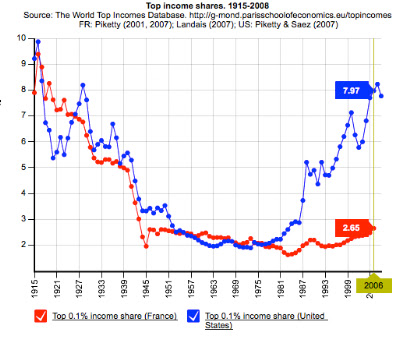
Certain leftists I know will say this is just populist bluster, that nothing is finance’s fault, and that this kind of language is just a distraction from genuine radical politics. But it’s not all bluster: As Arin D. points out, French bankers seem to have been born on the wrong continent, too.

 Maybe we can arrange a swap?

“Real” Isn’t Real

Sorry, no, it’s not about Lacan.

For a while, I’ve tried to avoid the common economic usage of calling the change in an observed variable, minus inflation, the “real” change. I prefer a more neutral and descriptive term like “inflation-adjusted.”

What we call nominal quantities really are real, in a sociological sense: they exist, they’re directly observable.Your mortgage or car loan requires a schedule of payments in dollars, in some fixed proportion to the value (also in dollars) of the original loan. Those are actual numbers you can see in your contract. The S&P 500 index is at at 1,286; a year ago it was at 1,282. Those are actual numbers you can look up in any financial website. You paid $2.50 for a tube of toothpaste; the bills and coins actually changed hands. Whereas the “real” values of all these numbers are constructions, estimated after the fact (and then re-estimated), involving more or less arbitrary choices and judgement calls. There’s no fact of the matter there at all.

To begin with, you have to choose your price index. It’s often not obvious whether the consumer price index, the GDP deflator, or some other index is most conceptually appropriate. [1] And it makes a difference! Just among the most important published price indexes, we see the increase in the price level over the past 50 years ranging from five times, to nearly eight times. Anyone who tells you something like, a dollar in 1960 “is equal to” 13 cents in 2010 is confused, or at least grossly simplifying.

And then there are the differences that don’t show up in the published indexes. The CPI is intended to be a price index for all urban consumers, but not every consumer is urban and not all urbs are equal. Robert Gordon estimates that the bulk of the college wage premium goes away if you correct for the higher cost of living in areas where college graduates live. Of course this only makes sense if college grads have to live in pricey urban areas in order to get their college wages. If you instead assumed that the cost of living is higher in urban areas because of various non-market amenities, which college graduates have a particular taste for, then Gordon’s correction would be inappropriate. [2] So again, while nominal values are real, in the sense that they observably exist, “real” values depend on assumptions about various unobservables.

And then there’s the after-the-fact adjustments which price indexes are always subject to. (As are nominal aggregates, to be fair, but to a much less extent, and almost always due to better data rather than conceptual changes.) That was what got me thinking about this today, in fact: rereading Dean Baker’s comments on the Boskin Commission. [3] Dean points out that if you take the Commission’s methodology seriously, you’d have to make even bigger downward adjustments to inflation in earlier periods, implying that when people in the postwar years thought the economy was threatened by inflation, it was “really” experiencing deflation:

If the size of the current annual overstatement [of the increase in the CPI] is 1.1 percentage points, the the annual overstatement may have exceeded 2.0 percentage points in past years, meaning that, at many times when there was public concern about inflation,  the economy was actually experiencing deflation. … Extrapolating the commission’s adjustment backwards implies that, throughout the 1950s and into the 1960s, prices were actually falling. This was a period when the president appointed a council to set wage-price guidelines to keep inflation in check.

It’s a problem. Obviously using just nominal values is deceptive in many cases, and there are plenty of cases where deflating by some standard index gives a more meaningful number. But one shouldn’t suppose that it is “real.” And certainly one can’t suppose, as the formalism of economics implicitly or explicitly does, that there are quasi-physical quantities of “utility” out there which the appropriate price deflators can convert dollar values into.

We have to think more critically about how the categories of economics join up with social and individual reality. Where goods exchange for each other in markets, they have a quantitative relationship: so much of this is, in some sense, “the same as” so much of that. (There’s a reason why Capital Volume I begins how it does, tedious as people sometimes find it.) But that relationship comes into existence in the process of exchange, it didn’t exist until then. So as soon as we are talking about goods that don’t exchange for each other, say because they exist at different moments, we can no longer regard them as being quantitatively comparable. In this sense, nominal figures are real, since they really describe the quantitative relationship of some stock or flow with others existing in the same pay community.  They are observable and are have direct consequences. Not so “real” figures, which depend on the implicit assumption that the only point of contact between the economy and human reality is the mix of goods that is consumed, and that there is a fixed consumption function that converts that mix into a quantity of utility. Without that assumption, there is no basis on which to say that two baskets of goods that can’t be traded for each other have any definite quantitative relationship.

Labor might seem to be a better universal standard than utility. There’s a reason Keynes made employment his standard measure of economic performance, and wanted to measure output in terms of wage-units. (And it’s certainly not because he thought the problems with capitalism originated in the labor market.) And there’s a reason why Adam Smith subtitled his chapter on “the Real and Nominal Prices of Commodities” (I don’t know how far back the distinction goes, maybe he made it first), “their Price in Labour, and their Price in Money.” Well, I don’t want to get into the labor theory of value here, except to say that I don;t think any other standard of “real” quantities is any more securely founded. My point is just that it may be, for questions we cannot answer with dollar values, there is no better, objective set of values we can use in their place. At that point we have to think about the various complex ways in which the system of monetary values interacts with the social reality in which it is embedded. For instance, the ways in which the costs of unemployment are not reducible to foregone output and income. The reproduction of society, let’s say, has quantitative, law-like moments; those moments are greatly distended under capitalism, but they still aren’t everything.

I’ll keep on adjusting nominal figures for inflation; what else can you do? But let’s not call them real.

[1]  It’s worth noting that writers in the Marxist tradition are often more sensitive to the differences between price indexes than are either (Post) Keynesian or mainstream economists. The possibility of a systematic divergence between the price of wage goods and the price of output as a whole was a question Marx gave a lot of thought to.

[2] I.e., the premium on urban areas implies there’s some desirable thing there that’s not being measured, but is it a consumer good or an intermediate good?

[3] Not for fun, for course prep, for my macro course, which I’m hoping to make fodder for blogging this spring. Thus the tag.

The Bergeron Solution

Does anybody else remember  that Kurt Vonnegut story “Harrison Bergeron”? (It’s an early one; he reused the conceit, I think, in one of his novels — The Sirens of Titan maybe?) The idea is that in a future egalitarian dystopia, perfect fairness is achieved by subjecting everyone to penalties corresponding to their talents — the physically fit have to wear burdensome weights, smart people like you and me and Kurt have earphones subjecting us to distracting noises, and so on. 
As a story, it’s not much — sort of a Simple English version of The Fountainhead. But I thought of it when I read this post from Nick Rowe last month. Microeconomics isn’t normally my bag, but this was fun.

Suppose we have a group of similar people. One of them has to do some unpleasant or dangerous job, defending the border against the Blefuscudians, say. Has to be one person, they can’t rotate. So what is the welfare-maximizing way to allocate this bad job? Have a draft where someone is picked by lot and compelled to do it, or offer enough extra pay for it that someone volunteers? You’d think that standard micro would say the market solution is best. But — well, here’s Nick:

The volunteer army is fair ex post. The one who volunteers gets the same level of utility as the other nine. … The lottery is unfair ex post, because they all get the same consumption but one has a nastier job. That’s obvious. What is not obvious, until you think about it, is that … the lottery gives higher expected utility. That’s the result of Theodore Bergstrom’s minor classic “Soldiers of Fortune” paper.

The intuition is straightforward. Think about the problem from the Utilitarian perspective, of maximising the sum of the ten utilities. This requires equalising the marginal utility of consumption for all ten men. … The volunteer army gives the soldier higher consumption, and so lower marginal utility of consumption, so does not maximise total utility. ….

If we assume, as may be reasonable, that taking the job reduces the marginal utility of consumption, that strengthens the advantages of the lottery over the volunteer army. It also means they would actually prefer a lottery where the soldier has lower consumption than those who stays home. The loser pays the winners, as well as risking his life, in the most efficient lottery.

It’s a clever argument. You need to pay someone extra to do a crap job. (Never mind that those sorts of compensating differentials are a lot more common in theory than in the real world, where the crappiest jobs are also usually the worst paid. We’re thinking like economists here.) But each dollar of consumption contributes less to our happiness than the last one. So implementing the fair outcome leaves everyone with lower expected utility than just telling the draftee to suck it up.

Of course, this point has broader applications. I’d be shocked if some version of it hasn’t been deployed as part of an anti-Rawlsian case against social insurance. Nick uses it to talk about CEO pay. That’s the direction I want to go in, too.

We all know why Bill Gates and Warren Buffett and Carlos Slim Helu are so rich, right? It’s because they sit on top of a vast machine for transforming human lives into commodities market income is equal to marginal product, and Buffet and Gates and Slim and everybody named Walton are just so damn productive. We have to pay them what they’re worth or they won’t produce all this valuable stuff that no one else can. Right?

The problem is, even if the monstrously rich really were just as monstrously productive, that wouldn’t make them utility monsters. Even if you think that the distribution of income is determined by the distribution of ability, there’s no reason to think that people’s ability to produce and their ability to derive enjoyment from consumption coincide. Indeed, to the extent that being super productive means having less leisure, and means developing your capacity for engineering or order-giving rather than for plucking the hour and the day virtuously and well, they might well be distributed inversely. But even if Paul Allen really does get an ecstasy from taking one of his jets to his helicopter to his boat off the coast of Southern France that we plebes, with our puny so-called vacations [1], can’t even imagine, the declining marginal utility of consumption is still going to catch up with him eventually. Two private jets may be better than one, but surely they’re not twice as good.

And that, if you believe the marginal product story, is a problem. The most successful wealth-creators will eventually reach a point where they may be as productive as ever, but it’s no longer worth their while to keep working. Look at Bill Gates. Can you blame him for retiring? He couldn’t spend the money he’s got in ten lifetimes, he can’t even give it away. But if you believe his salary up til now has reflected his contribution to the social product, his retirement is a catastrophe for the rest of us. Atlas may not shrug, but he yawns.

Wealth blunts the effects of incentives. So we want the very productive to have lots of income, but very little wealth. They should want to work 12 hour days to earn more, but they shouldn’t be tempted to cut their hours back to spend what they already earned. It seems like an insoluble problem, closely related to Suresh’s superstar doctor problem, which liberalism has no good answer to. [2]

But that’s where we come to Harry Bergeron. It’s perfectly possible for superstar doctors to have both a very high income and very low wealth. All that’s required is that they start in a very deep hole.

If we really believed that the justification for income disparities is to maintain incentives for the productive, we’d adopt a version of the Bergeron plan. We’d have tests early in life to assess people’s innate abilities, and the better they scored, the bigger the bill we’d stick them with. If it’s important that “he who does not work, neither shall he eat,” [3] it’s most important for those who have the greatest capacity to work. Keep Bill Gates hungry, and he might have spent another 20 years extracting rents from network externalities creating value for Microsoft’s shareholders and customers.

There’s no shortage of people to tell you that it might seem unfair that Paul Allen has two private jets in a world where kids in Kinshasa eat only every two days, but that in the long run the tough love of proper incentives will make more pie for everyone. Many of those people would go on to say that the reason Paul Allen needs to be encouraged so strenuously is because of his innate cognitive abilities. But very few of those people, I think, would feel anything but moral outrage at the idea that if people with Allen’s cognitive capacities could be identified at an early age, they should be stuck with a very big bill and promised a visit from very big bailiffs if they ever missed a payment. And yet the logic is exactly the same.

Of course I’m not endorsing this idea; I don’t think the rich, by and large, have any special cognitive capacities so I’m happy just to expropriate them; we don’t have to work them until they drop. (People who do believe that income inequality is driven by marginal productivity don’t have such an easy out.)

But it’s funny, isn’t it: As a society we seem to be adopting something a bit like the Bergeron Solution. People who are very productive, at least as measured by their expected salaries, do begin their lives, or at least their careers, with a very big bill. Which ensures that they’ll be reliable creators of value for society, where value is measured, as always, in dollars. God forbid that someone who could be doctor or lawyer should decide to write novels or raise children or spend their days surfing. Of course one doesn’t want to buy into some naive functionalism, not to say conspiracy theory. I’m not saying that the increase in student debt happened in order that people who might otherwise have been tempted into projects of self-valorization would continue to devote their lives to the valorization of capital instead. But, well, I’m not not saying that.

[1] What, you think that “family” you’re always going on about could provide a hundredth the utility Paul Allen gets from his yacht?

[2] That post from Suresh is where I learned about utility monsters.

[3] I couldn’t be bothered to google it, but wasn’t it Newt’s line back in the day, before Michele Bachman picked it up?

What We Talk About When We Don’t Talk About Demand

There sure are a lot of ways to not say aggregate demand.

Here’s the estimable Joseph Stiglitz, not saying aggregate demand in Vanity Fair:

The parallels between the story of the origin of the Great Depression and that of our Long Slump are strong. Back then we were moving from agriculture to manufacturing. Today we are moving from manufacturing to a service economy. The decline in manufacturing jobs has been dramatic—from about a third of the workforce 60 years ago to less than a tenth of it today. … There are two reasons for the decline. One is greater productivity—the same dynamic that revolutionized agriculture and forced a majority of American farmers to look for work elsewhere. The other is globalization… (As Greenwald has pointed out, most of the job loss in the 1990s was related to productivity increases, not to globalization.) Whatever the specific cause, the inevitable result is precisely the same as it was 80 years ago: a decline in income and jobs. The millions of jobless former factory workers once employed in cities such as Youngstown and Birmingham and Gary and Detroit are the modern-day equivalent of the Depression’s doomed farmers.

This sounds reasonable, but is it? Nick Rowe doesn’t think so. Let’s leave aside globalization for another post — as Stieglitz says, it’s less important anyway. It’s certainly true that manufacturing employment has fallen steeply, even while the US — despite what you sometimes here — continues to produce plenty of manufactured goods. But does it make sense to say that the rise in manufacturing productivity be responsible for mass unemployment in the country as a whole?

There’s certainly an argument in principle for the existence of technological unemployment, caused by rapid productivity growth. Lance Taylor has a good discussion in chapter 5 of his superb new book Maynard’s Revenge (and a more technical version in Reconstructing Macroeconomics.) The idea is that with the real wage fixed, an increase in labor productivity will have two effects. First, it reduces the amount of labor required to produce a given level of output, and second, it redistributes income from labor to capital. Insofar as the marginal propensity to consume out of profit income is lower than the marginal propensity to consume out of wage income, this redistribution tends to reduce consumption demand. But insofar as investment demand is driven by profitability, it tends to increase investment demand. There’s no a priori reason to think that one of these effects is stronger than the other. If the former is stronger — if demand is wage-led — then yes, productivity increases will tend to lower demand. But if the latter is stronger — if demand is profit-led — then productivity increases will tend to raise demand, though perhaps not by enough to offset the reduced labor input required for a given level of output. For what it’s worth, Taylor thinks the US economy has profit-led demand, but not necessarily enough so to avoid a Luddite outcome.

Taylor is a structuralist. (The label I think I’m going to start wearing myself.) You would be unlikely to find this story in the mainstream because technological unemployment is impossible if wages equal the marginal product of labor, and because it requires that output to be normally, and not just exceptionally, demand-constrained.

It’s a good story but I have trouble seeing it having much to do with the current situation. Because, where’s the productivity acceleration? Underlying hourly labor productivity growth just keeps bumping along at 2 percent and change a year. Over the whole postwar period, it averages 2.3 percent. Over the past twenty years, 2.2 percent. Over the past decade, 2.3 percent. Where’s the technological revolution?

Just do the math. If underlying productivity rises at 2 percent a year, and demand constraints cause output to stay flat for four years [1], then we would expect employment to fall by 8 percent. In other words, lack of demand explains the whole fall in employment. [2] There’s no need to bring in structural shifts or anything else happening on the supply side. A fall in demand, plus a stable rate of productivity increase, gets you exactly what we’ve seen.

It’s important to understand why demand fell, but from a policy standpoint, no actually it isn’t. As the saying goes, you don’t refill a flat tire through the hole. The important point is that we don’t need to know anything about the composition of output to understand why unemployment is so high, because the relationship between the level of output and employment is no different than it’s always been.

But isn’t it true that since the end of the recession we’ve seen a recovery in output but no recovery in employment? Yes, it is. So doesn’t that suggest there’s something different happening in the labor market this time? No, it doesn’t. Here’s why.

There’s a well-established empirical relationship in macroeconomics called Okun’s law, which says that, roughly, a one percentage point change in output relative to potential changes employment by one a third to a half a percentage point. There are two straightforward reasons for this: first, a significant fraction of employment is overhead labor, which firms need an equal amount of whether their current production levels are high or low. And second, if hiring and training employees is costly, firms will be reluctant to lay off workers in the face of declines in output that are believe to be temporary. For both these reasons (and directly contrary to the predictions of a “sticky wages” theory of recessions) employment invariably falls by less than output in recessions. Let’s look at some pictures.

These graphs show the quarter by quarter annualized change in output (vertical axis) and employment (horizontal axis) over recent US business cycles. The diagonal line is the regression line for the postwar period as a whole; as you would expect, it passes through zero employment growth around two percent output growth, corresponding to the long-run rate of labor productivity growth.

1960 recession

1969 recession

1980 and 1981 recessions
1990 recession

2001 recession
2007 recession

What you see is that in every case, there’s the same clockwise motion. The initial phase of the recession (1960:2 to 1961:1, 1969:1 to 1970:4, etc.) is below the line, meaning growth has fallen more than employment. This is the period when firms are reducing output but not reducing employment proportionately. Then there’s a vertical upward movement at the left, when growth is accelerating and employment is not; this is the period when, because of their excess staffing at the bottom of the recession, firms are able to increase output without much new hiring. Finally there’s a movement toward the right as labor hoards are exhausted and overhead employment starts to increase, which brings the economy back to the long-term relationship between employment and output. [3] As the figures show, this cycle is found in every recession; it’s the inevitable outcome when an economy experiences negative demand shocks and employment is costly to adjust. (It’s a bit harder to see in the 1980-1981 graph because of the double-dip recession of 1980-1981; the first cycle is only halfway finished in 1981:2 when the second cycle begins.)

There’s nothing exceptional, in these pictures, about the most recent recession. Indeed, the accumulated deviations to the right of the long-term trend (i.e., higher employment than one would expect based on output) are somewhat greater than the accumulated deviations to the left of it. Nothing exceptional, that is, except how big it is, and how far it lies to the lower-left. In terms of the labor market, in other words, the Great Recession was qualitatively no different from other postwar recessions; it was just much deeper.

I understand the intellectual temptation to look for a more interesting story. And of course there are obviously structural explanations for why demand fell so far in 2007, and why conventional remedies have been relatively ineffective in boosting it. (Tho I suspect those explanations have more to do with the absence of major technological change, than an excess of it.) But if you want to know the proximate reason why unemployment is so high today, there’s a recession on still looks like a sufficiently good working hypothesis.

[1] Real GDP is currently less than 0.1 percent above its level at the end of 2007.

[2] Actually employment is down by only about 5 percent, suggesting that if anything we need a structural story for why it hasn’t fallen more. But there’s no real mystery here, productivity growth is not really independent of demand conditions and always decelerates in recessions.

[3] Changes in hours worked per employee are also part of the story, in both downturn and recovery.

Is the Euro the Problem?

What’s wrong in Europe?

Krugman is saying, again, that it’s the inability to adjust exchange rates. He quotes Kevin O’Rourke:

The world nowadays looks very much like the theoretical world that economists have traditionally used to examine the costs and benefits of monetary unions. The eurozone members’ loss of ability to devalue their exchange rates is a major cost. Governments’ efforts to promote wage cuts, or to engineer them by driving their countries into recession, cannot substitute for exchange-rate devaluation. Placing the entire burden of adjustment on deficit countries is a recipe for disaster.
 In other words, it’s a problem of relative prices. Wages are too high in Greece, Spain and Ireland, so those countries face unemployment; wages are too high in Germany, so it’s experiencing an inflationary boom; and wages are just right in France, so it’s chugging along at full capacity.
Wait, what?
Of course that’s not what’s going on at all.
There are a lot of ways not to talk about aggregate demand.

The Mind of the Master Class

In comments, Arin says,

my view of the world is that there were (at least) two distinct phases … First was the emergence of a market for corporate control through hostile takeovers in the 1980s, which may have changed managerial incentives to basically ward off such possibilities. However, it didn’t lead to greater power of shareholders over management … consolidation and mergers over time ended up actually increasing managerial prerogatives. However, it was of course a very different type of management … one whose incentives were quite aligned with short term capital gains which were also potentially helpful to ward off challenge for control… So yes, the market for corporate control changed the world – but ironically it changed it by passing more rents to managers, not less.

I don’t know that I agree — or at least, it depends what you mean by managerial prerogatives. Relative to workers, to consumers, to society at large? Sure. Relative to shareholders? I’m not so sure. But let’s say Arin is right. I don’t think it fundamentally changes the story. What I’m talking about isn’t fundamentally a conflict between two different groups of people, but between two functions. Capital, as we know, is a process, value in a movement of self-expansion: M-C-C’-M’. The question is whether capital as a sociological entity, as something that act on its own interests, is conscious of itself more in the C moments or in the M moments. Do the people who exercise political power on behalf of capital think of themselves more as managers of a production process, or as stewards of a pool of money? The point is that sometime around 1980, we saw a transition from the former to the latter. Whether that took the form of an empowering of the money-stewards at the expense of the production-managers, or of everyone in power thinking more like a money-steward, is less important.

I heard a story the other day that nicely illustrates this. Back in the Clinton era, a friend of a friend was on a commission to discuss health care reform, the token labor guy with a bunch of business executives. So, he asked, why don’t the Big Three automakers and other old industrial firms support some kind of national health insurance? Just look at the costs, look at how much you could save if you focus on making cars instead of being a health insurer. Well yes, the auto executives at the meeting replied, you make a good point. But you know, our big focus right now is on reducing the capital gains tax. Let’s deal with that first, and then we can talk about health insurance.

If you’re an executive in neoliberal America, you’re an owner of financial assets first and foremost, and responsible for the long-term interests of the firm you manage second, third or not at all.

Netflix Disgorges the Cash

For a great example of what I’ve been talking about, check out this Dealbreaker post on how Netflix spent the past two years buying back its own stock, and then just this past Monday turned around and announced that it was selling stock again. Matt Levine:

NFLX bought 3.5 million shares of stock at an average price of $117 in 2010-2011, at a total cost of $410 million, and paid for it by issuing 5.2 million shares of stock at an average price of $77 in November 2011, for total proceeds of $400 million – minus $3 million that we pay to Morgan Stanley and JPMorgan to place the deal. So 1.7 million extra shares outstanding for net proceeds of negative $13mm or so. 

The comical thing about this from the point of view of the financial press is the buy-high, sell-low side of it. And of course whoever was on the other side of Netflix’s share repurchases this past summer, when the stock was at four times its current value, must be laughing right now. But as Levine says, this is what the system is set up to do:

Most companies are rewarded for squeezing every last penny out of EPS [earnings per share] – in executive bonuses, sure, but also in stock price more broadly. It’s what investors want. … So with Netflix: when things are good and it’s rolling in cash, it pushes up its price by buying. When things are bad and it needs cash, it pushes down its price by selling. And its incentives are neatly aligned to do so: when things are good, it needs one more penny of EPS; when things are terrible – hell, who cares about dilution when you’re unprofitable anyway? (It’s a good thing!)

Another way of looking at this, tho, is that buying its own shares high and selling them low is exactly how a firm should behave if shareholders really are the residual claimants, operationally and not just in principle. In the textbook this doesn’t really come out, since “shareholder as residual claimant” is just a first-order condition imposed on some linear equations. But if you take it seriously as a claim that shareholders own every incremental dollar that the firm earns or raises, and that management is a not just the solution to an Euler equation but a distinct group of people who may have their own views on the interests of the firm, then shareholders should want businesses to behave just like Netflix — pay out more when more is coming in, and then ask them for some back when more needs to go out. Can’t be a residual claimant if you don’t claim your residuals.

Now, financing investment is going to be more costly when it involves selling and repurchasing shares, compared to if you’d just kept the savings-investment nexus inside the firm in the first place. And these transactions were also disastrous for the firm’s long-term shareholders — in effect, they transferred $400 million from people who continued holding the stock to those who sold in 2010 and 2011. So in this case, a system designed to maximize shareholder value didn’t even deliver that. Shareholders would have done better with management who said, Screw the shareholders, we’re going to build the best, biggest online movie rental company we can. If you own our stock just sit back, shut up, and trust that you’ll get your payoff eventually.

As the man says, “When the capital development of a country becomes a by-product of the activities of a casino, the job is likely to be ill-done.”

On Other Blogs, Other Wonders

1. Are Banks Necessary?

Ashwin at Macroeconomic Resilience had a very interesting post last month arguing that the fundamental function of banks — maturity transformation — is no longer required. Historically, the reason banks existed was to bridge the gap between ultimate lenders’ desire for liquid, money-like assets and borrowers’ need to fund long-lived capital goods with similarly long-term liabilities. Banks intermediate by borrowing short and lending long; in some sense, that’s what defines them. But as Ashwin argues, today, on the one hand, we have pools of longer-term savings for which liquidity is not so important, at least in principle, in the form of insurance and pension funds, which are large enough to meet all of businesses’ and households’ financing needs; while on the other hand the continued desire for liquid assets can be met by lending directly to the government which — as long as it controls its own currency — can’t be illiquid and so doesn’t have to worry about maturity mismatch. It’s a very smart argument; my only quibble is that Ashwin interprets it as an argument for allowing banks to fail, while it looks to me like an argument for not having them in the first place.

Another way of reaching the same conclusion, in line with recent posts here, is that you can avoid much of the need for maturity transformation, and the other costs of intermediation, including the rentiers’ vig, if business investment is financed by the business’s own saving.  In comments to the Macroeconomic Resilience post, Anders (I don’t think the same Anders who comments here) points to some provocative comments by Izabella Kaminska in a Financial Times roundtable:

An FT view from the top conference, with Martin Wolf moderating. He said an interesting thing re. all the cash on the balance sheets of American corporates. That for many US corporates, banks have become completely redundant, they just don’t need them. … The rise of the corporate treasury, investing wisely on its own behalf. Banks have failed at the one job they were supposed to do well, which was credit intermediation… No wonder banks have sought ever more exotic creative financing options .. their traditional business is dying. They’re not lending, can’t lend. So corporates are inadvertently acting by piling up cash reserves to solve that problem…. [You] see lots of examples of Corporates who don’t trust banks. … it’s amazing to think that we have come this far in the last two years… to a point where people like Larry Fink are suggesting banks are pointless.

This is part of the story of Japan’s Lost Decade that Krugman doesn’t talk about much, but that Richard Koo puts right at the heart of the story: By the mid 1980s, Japanese corporations could finance almost all of their investment needs internally, but the now-redundant banking system didn’t shrink, but found a reason for continued existence in financing real estate speculation. Banks may be pointless, but that doesn’t mean they’ll go away on their own.

2. Are Copyrights Necessary?

I’m surprised there hasn’t been more discussion in the blogosphere of this new working paper by Joel Waldfogel on copyright and new music production. (Summary here.) Has Yglesias even mentioned it? It’s totally his thing: an empirical study of whether file-sharing has reduced the amount of good music being produced, where “good” is measured by radio airplay, and various critics’ best-of lists. Which, whatever, but you’ve got to measure it somehow, right? And, oh yeah, the answer is No:

We find no evidence that changes since Napster have affected the quantity of new recorded music or artists coming to market. … While many producers of recorded music have been made worse off by changes in technology, there is no evidence that the volume of high-quality music, or consumers, have suffered.

Information wants to be free.


3. It’s an Honor Just to Be Nominated

Hey, look, someone at everyone’s favorite site for d-bags with PhDs, econjobrumors.com, has started a thread on the worst economics blogs. And the first blog suggested is … this one. “Krugnuts times 11,” he says. I think that’ll be the new tagline.

Anti-Mankiw

Elsewhere on the World Wide Web: Some UMass comrades have revived the internet tradition of the grudge blog with this interesting new blog, with the Stakhanovite goal of refuting (tho thankfully not fisking) every post Greg Mankiw makes. It’s an ambitious goal, especially since the average wordcount ratio of an anti post to its underlying Mankiw post is running around 50:1. But they’re managing so far. You should read it. And if anyone wants to take a swing at the pinata, I think they may still be looking for new contributors.

So why aren’t I contributing? Mainly because time is scarce and I am very lazy, so blogging-wise I’m tapped out just keeping up a trickle of content here. But also, to be honest, because I have some qualms about the anti-ness of the left in economics generally. Anti-Mankiw is a great project, and I have nothing but admiration for the students who walked out of Mankiw’s class. But there’s a certain assumption here that we on the left have a well-developed alternative economics, which the Mankiws of the world are ignoring or suppressing. If only that were true.

Right now I’m teaching macro, and I’m presenting basically the same material as everyone else. ISLM, AS/AD, and their open economy equivalents. How come? Well, partly because I feel a certain professional duty. Students signed up for a course in intermediate macroeconomics, not in J.W. Mason Thought. (That will be next semester.) But mainly because it’s the path of least resistance. I don’t know any good textbook that presents the fundamentals of macroeconomics from a genuinely Keynesian or radical perspective. And working up a course by myself would be vastly more work, and I don’t think I could do it justice. A downward sloping AD curve, let’s say, is absurd. There’s no real economy on earth in which the main effect of deflation is to stimulate demand via a real balance or “Keynes” effect. It pains me to even put it on the board. But what’s the counterhegemonic model of inflation I should be teaching in its place?

It’s not just me. I know a number of people who are unapologetic Marxists in their own work, yet when they teach undergraduate macroeconomics, they use Blanchard or some similarly conventional text. It’s a structural problem. I don’t mean to defend Mankiw, but in some ways I think those of us on the left of the profession are more to blame for the state of undergraduate economics education. We spend too much time on critiques of the mainstream, and not nearly enough developing a systematic alternative. Some people criticize radical economists for just talking to each other, but personally I think we don’t talk to each other nearly enough.

The anti-Mankiw that’s needed, it seems to me, isn’t a critique, but an alternative; as long as we’re arguing with him, he still gets to decide what we’re talking about. That’s one reason I prefer to spend my time debating people like Krugman, DeLong, John Quiggin, and Nick Rowe, who I respect and learn from even when I don’t agree with them. (Another reason is that attention is a precious resource and I prefer giving the bit I get to allocate to people and ideas that deserve it.)

It’s true that the ideological policing in economics is very tight—but mainly at the top end, and even there mostly not at the level of undergraduate teaching. As far as I can tell, most places nobody cares what you do in the classroom; there’s already plenty of space for alternatives at schools that aren’t Harvard. But people mostly aren’t using that space. In my experience, even when people want to bring a “radical” perspective to undergraduate econ, that means presenting the mainstream models and then dissecting  them, which preserves the mainstream view as the default or starting point, when it doesn’t just leaves students confused. “Radical” economics almost never seems to mean simply teaching economics the way we radicals think it should be taught.

So yes, Occupy Mankiw, by all means. But maybe we should also think more about the classrooms we’re already occupying. Or as a graffito that should be familiar to the male fraction of anti-Mankiw says:

Start your own hit band or stop bitching

EDIT: If anyone reading this wants to suggest good models or resources for what an undergrad economics course ought to look like, I’d be thrilled to hear them.

FURTHER EDIT: Lots of suggestions. I need to walk back a little: There are more good alternatives to Mankiw  & co. than you’d guess reading this post. But the key point is still, we need to move past critique and develop our own positive views. As long we’re responding to him, he’s setting the terms of the conversation. Read about, say,  Paul Sweezy in the 1940s — he was so admired not because he had such a cutting critique, but because he so clearly and confidently offered an alternative. (And because he was so charming and good-looking, but that sort of goes with it, I think.) We’ll be getting somewhere when, instead of rushing to rebut everything Mankiw says, we can say, “Oh, is that guy still writing? Well, forget about him — here’s the good stuff.”

So, the good stuff.

I should have mentioned two excellent macro texts that, while they are too advanced for the students I’m teaching now, really comprehensively describe the state of the art alternative approaches to macro: Michl and Foley’s Growth and Distribution and Lance Taylor’s Reconstructing Macroeconomics. If, like me, you;re more more interested in short-term dynamics than growth models, you might get a little more out of the Taylor book, but both are very good.

In comments, NKlein suggests Godley and Lavoie’s Monetary Economics: An Integrated Approach, which I know other people recommend but I’m afraid I haven’t read (tho it’s on my Kindle), and mentions that Randy Wray and Bill Mitchell are working on a new textbook. I believe Wray currently teaches undergraduate macro at Kansas City using Keynes’ General Theory as the primary textbook, which is not a terrible idea (tho it would probably depend on the students.)

A lot of people like Understanding Capitalism, by Sam Bowles, Richard Edwards and Frank Roosevelt. Sam’s microeconomics textbook is also supposed to be good, if, god forbid, you have to teach that. (But the orthodox-heterodox divide doesn’t really exist in micro, I don’t think.)

Meanwhile, over on anti-Mankiw itself, Garth suggested — more or less simultaneously with this post — Steve Cohn’s Reintroducing Macroeconomics, and linked to a long list of heterodox texts. I’m only familiar with a few of the books on the list, altho most of the ones I do know are grab-bags of critical essays, which is not quite what I’m looking for. But clearly there’s a lot out there.

The Capitalist Wants an Exit

Like a gratifyingly large proportion of posts here, Disgorge the Cash! got a bunch of great comments. In one of the last ones, Glenn makes a number of interesting points, some of which I agree with, some which I don’t. Among other things, he asks why, if businesses really have good investment projects available, rational investors would demand that they pay out their cashflow instead. Isn’t it more logical to suppose that payouts are rising because investment opportunities are scarcer, rather than, as the posts suggests, that firms are investing less because they are being compelled to pay out more?

One standard answer would be information asymmetries. If firms have private information about the quality of their investment opportunities, it may be more efficient to have capital-allocation decisions made within firms rather than by outside lenders. The cost of being unable to shift capital between firms may be less than the cost of the adverse selection that comes with information asymmetries. That’s one answer. But here I want to talk about a different one.

Capital in general, and finance in particular, places a very high value on liquidity. But if wealth owners insist on the freedom to reallocate their holdings at a moment’s notice, and need the promise of very high returns to let them be bound up in something illiquid, then investment in the aggregate will be inefficiently low. As Keynes famously wrote,

Of all the maxims of orthodox finance none, surely, is more anti-social than the fetish of liquidity, the doctrine that it is a positive virtue on the part of investment institutions to concentrate their resources upon the holding of “liquid” securities. It forgets there is no such thing as liquidity of investment for the community as a whole.

Or as Tom Geoghegan recalls, from the last days of the old regime in the late 1970s,

Once a friend of mine from Harvard Business School came to visit, and I took him to South Works, just to see it.

“Wow,” he said. “I’ve never seen so much capital just lying on the ground. At B School we used to laugh at how conservative these big steel companies are, but then you could come out and see all this capital, just lying on the ground…”

Capitalists, in general, do not like to see their capital just lying on the ground. They prefer it to be abstract, intangible, liquid.

There’s no question that the shareholder revolution of the 1980s had a strong distributional component. Rentiers thought that workers were getting to much of “their” money. But if we’re looking specifically at the conflict between shareholders and management — as much a conflict between worldviews as between distinct groups of people — then I think “the fetish of liquidity” is central.

As Keynes understood, liquidity is what stock markets are for. What they’re not for, is raising funds for investment. That wasn’t why they were invented (the publicly traded corporation is a relatively recent innovation), and it’s not what they’ve been used for. Apart from a few years in the 1920s and a few more in the late 1990s, stock issues have never been an important source of investment finance for firms.

Let’s talk about Groupon. Huge IPO, raised $700 million, the biggest offering in years. So, those people who bought shares, they’re getting ownership of the company in return for providing it much needed funds for expansion, right?

Except that “Groupon has been shouting until it’s blue in the face that it doesn’t need the IPO cash, that it’s fine on the cash front, that the IPO is just a way of going public, and is not really about the money-raising at all.” Cashflow is more than enough to finance all their foreseeable expansion plans. So why go public at all, then?

Because their existing investors want cash, that’s why. Pre-IPO, Groupon was already notorious for using venture capitalist funds to cash out earlier investors.

Groupon is a very innovative company, and this is one of its most important innovations — the idea that the founder can and even should be able to cash out to the tune of millions of dollars very early on in the company’s lifecycle, while it is still raising new VC funds…. Historically, VC rounds have been about providing capital to companies which need it; in Groupon’s case, they’re more about finding a way to cash out early investors

But the venture capitalists need to be cashed out in their turn. After CEO Andrew Mason turned down offers from Yahoo and then Google to purchase the company, his VC bankers became increasingly antsy about being stuck owning a business, even a business selling something intangible as internet coupons, rather than safe pure money. Thus the IPO:

The board — and Groupon’s investors — had a message for Mason, though. Someday, he was going to have to either accept an offer like that one he had just turned down, or take this company public.

One investor recounts the conversation: “We said, okay Andrew, you took venture capital, and remember venture capitalists want an exit.  It doesn’t have to be tomorrow but you always have to be thoughtful when a company comes to buy your company, because it’s not just you, it’s your employees, options, investors and alike.”

That’s what Wall Street is for: to give capitalists their exit.

The problem finance solves is not how to allocate society’s scarce savings between competing investment opportunities. In modern conditions, it’s the opportunities that are scarce, not the savings. (Savings glut, anyone?) The problem is how to separate the rents that come from control of a strategic social coordination problem from the social ties and obligations that go with it. The true capitalist doesn’t want to make steel or restaurant deals or jumbo jets or search engines. He wants to make money. That’s been true right from the beginning. It’s why we have stock markets in the first place.

Historically the publicly-owned corporation came into being to allow owners (or more typically, their heirs) to delink their fortunes from particular firms or industries, and not as a way of raising capital.

In her definitive history of the wave of mergers that first established publicly-traded corporations (outside of railroads), Naomis Lamoreaux is emphatic that raising funds for investment was not an important motivation for adopting the new ownership form. In contemporary accounts of the merger wave, she says, “Access to capital is not mentioned.” And in the hearings by the U.S. Industrial Commission on the mergers,  “None of the manufacturers mentioned access to capital markets as a reason for consolidation.” Rather, the motivation for the new ownership form was a desire by the new capitalist elite to separate their wealth and status from the fortunes of any particular firm or industry:

after the founder’s death or retirement, ownership dispersed among heirs “who often were interested only in receiving income” from the company rather than running it. Where the founder was able to consolidate family control, as in Ford or Rockefeller,

the shift to public ownership was substantially delayed.

The same point is developed by historians Thomas Navin and Marian Sears:

A pattern of ownership somewhat like that in the cotton textile industry of New England might eventually have come to prevail: ownership might have spread, but to a limited degree; shares might have become available to outsiders, but to a restricted extent. It was the merger movement that accelerated the process and intensified it – to a smaller extent in the earlier period, 1890-1893, to a major degree in the later period, 1898-1902. As a result of the merger movement, far more people parted with their ownership in family businesses than would otherwise have done so; and doubtless far more men of substance (nonindustrialists with investable capital) put their funds into industry than would otherwise have chosen that type of investment. …

[As to] why individual stockholders saw an advantage in surrendering their ownership in a single enterprise in favor of participation in a combined venture …, one of the strong motivations apparently was an opportunity to liquidate part of their investment, coupled with the opportunity to remain part owners. At least this was a theme that was played on when stockholders were asked to join in a merger. The argument may have been used that mergers brought an easing of competition and an opportunity for enhanced earnings in the future. But the trump card was immediate liquidity.

The comparison with New England is interesting. Indeed, in the first half of the 19th century a very different kind of capitalism developed there, dynastic not anonymous, based on acknowledging the social ties embodied in a productive enterprise rather, than trying to minimize them. But historically the preference for money has more often won out. This was even more true in the early days of capitalism, in the 17th century. Braudel:

it was in the sphere of circulation, trade and marketing that capitalism was most at home; even if it sometimes made more than fleeting incursions on to the territory of production.

Production, he continues, was “foreign territory” for capitalists, which they only entered reluctantly, always taking the first chance to return to the familiar ground of finance and long-distance trade. Of course this changed dramatically with the Industrial Revolution. But there’s an important sense in which it’s still, or once again, true.